You've invested in the best sales methodologies. You've purchased licenses for Sandler Training or books on MEDDIC. You've even sent your team to that expensive "closers camp" everyone was talking about.
And yet, here you are, frustrated beyond belief because, as one sales leader bluntly put it: "My reps don't read books, bro."
If you can't even convince your team to "crack a book that will make them wealthier," you might be wondering what's wrong with your team—or worse, your leadership.
But here's the truth: The problem isn't your team's motivation. It's that traditional sales training methods are fundamentally misaligned with how today's sales professionals actually learn and work.
Your SDRs and AEs aren't avoiding development because they're lazy. They're drowning in priorities. Between prospecting, discovery calls, demos, negotiations, and account management, the modern sales professional barely has time to breathe, let alone digest a 300-page sales methodology.
As research from RAIN Group highlights, "Time commitment is a significant challenge—our sales teams are under immense pressure to generate new clients AND account manage existing clients." When forced to choose between hitting quota or reading about Winning by Design principles, guess which one wins every time?
The skills needed by an SDR making cold calls differ dramatically from those needed by an AE navigating complex enterprise deals. Yet many training programs serve up identical content to both roles.
"Training often serves us one size fits all and not role-based training," notes one sales leader. This explains why some reps who experienced Sandler Training report they "didn't learn much new to be honest." When training feels generic, engagement plummets.
Even when reps do engage with traditional training, the knowledge rarely sticks. According to research, learners forget up to 90% of new information within a week without reinforcement.
One sales manager captured this perfectly: "You can't teach a kid to ride a bike at a seminar. Building sales acumen is a months-long process of developing new habits a little at a time." Yet most training programs are designed as one-off events rather than continuous development journeys.
The final nail in the coffin is the disconnect between training and application. As one frustrated leader noted, "The hard part is how you enforce the incorporation of the training into their interactions, and make it a consistent behavior."
Too often, sales training focuses on theoretical knowledge rather than practical application. It's no wonder one rep complained that most "sales training tends to just be recorded product demonstrations with no real selling experience involved."
The good news? There are proven, engaging alternatives to traditional training that actually work. Here are three approaches that transform reluctant readers into eager learners:
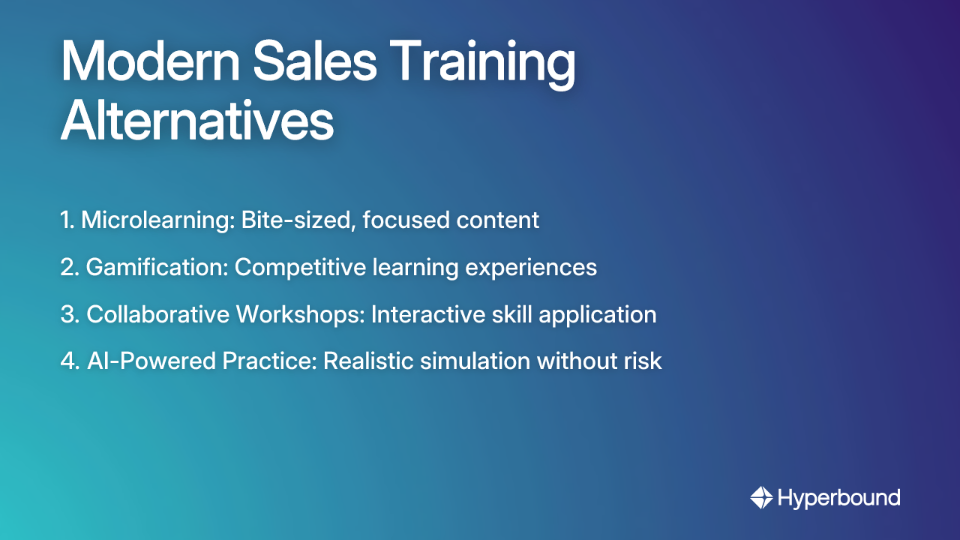
What it is: Microlearning delivers short, focused segments of content (3-5 minutes) that reps can consume quickly on any device, right in the flow of their work.
Why it works:
Implementation tip: Integrate microlearning directly into your Salesforce rep training workflow. For example, provide short video snippets on handling specific objections that reps can access right from their opportunity records.
What it is: Gamification incorporates game elements like points, leaderboards, badges, and rewards into the training process.
Why it works:
Implementation tip: Create team competitions where SDRs and AEs earn points for completing training modules, practicing skills, and demonstrating proficiency in customer centric selling techniques. Make the rewards meaningful—perhaps the winning team gets first pick of leads for a week.
What it is: Interactive, real-time sessions (in-person or virtual) focused on application, role-playing, and peer-to-peer learning.
Why it works:
Implementation tip: Use a "flipped classroom" model where reps consume short preparatory content before attending a workshop focused entirely on practice and feedback. For example, provide a 5-minute video on Miller Heiman Group's Blue Sheet methodology before a workshop where reps apply it to actual opportunities in their pipeline.
What it is: AI-powered practice platforms, like Hyperbound, create hyper-realistic sales role-playing simulations. Reps can practice everything from cold calls and objection handling to complex negotiations with AI buyers that respond dynamically and realistically.
Why it works:
Implementation tip: Use AI role-plays to certify reps on new product messaging or competitive talk tracks before they engage with customers. This ensures they are confident and prepared for real-world conversations.
Having the right training formats is only half the battle. Here's how to create a culture of continuous learning and accountability without micromanaging:
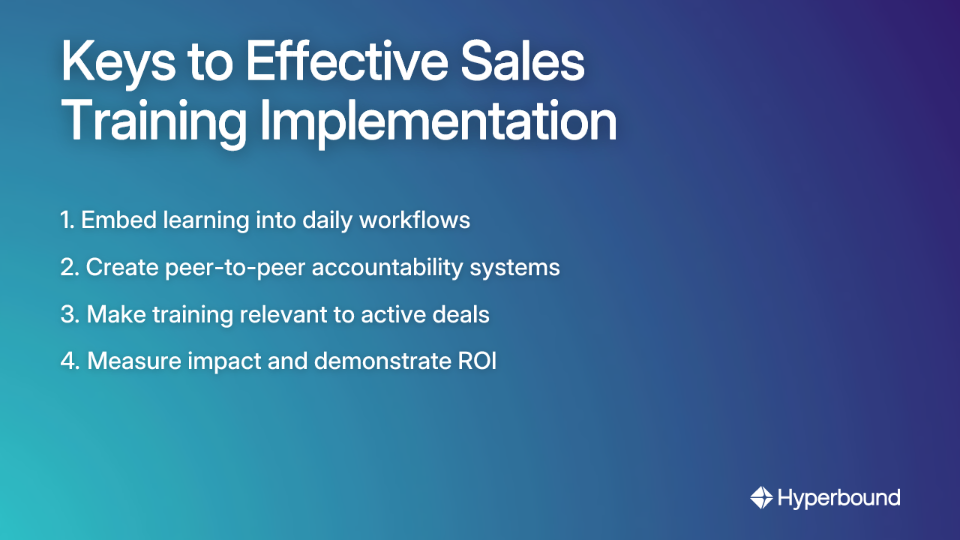
Don't make training a separate activity that competes with selling time. Instead:
Separating learning from work is one of the biggest mistakes in sales enablement. When learning becomes part of the workflow rather than an interruption to it, adoption soars.
Instead of always driving accountability from the top down:
Generic training fails because it doesn't address immediate needs:
Sales reps respond to data. Show them the impact of training on their results:
The right continuous learning approach can lead to significant improvements in quota attainment and revenue per representative.
The refusal to read books isn't a character flaw in your sales team—it's a symptom of outdated training approaches that don't match how modern sales professionals work and learn.
By shifting from static, one-size-fits-all reading assignments to dynamic, engaging, and workflow-integrated learning experiences, you transform training from a dreaded obligation into a valued resource that directly contributes to success.
Effective sales Enablement isn't about forcing books on reluctant readers. It's about creating an ecosystem of continuous learning that meets your team where they are, respects their time constraints, and delivers immediate value. This approach doesn't just change behaviors—it transforms results.
Your reps aren't against learning; they're against learning methods that don't work for them. Give them the right tools, and watch as they evolve from product-pitchers into trusted advisors who don't just meet quotas—they crush them.
Traditional sales training is often ineffective because it fails to align with the modern sales professional's workflow and learning style. Key issues include immense time pressure on reps, a one-size-fits-all approach that ignores role-specific needs, poor knowledge retention from one-off events, and a significant gap between theoretical knowledge and practical application on real sales calls.
The best alternatives to book-based sales training are dynamic, interactive, and integrated into the daily workflow. These include microlearning for bite-sized content, gamification to drive engagement through competition, collaborative workshops for hands-on practice, and AI-powered practice platforms like Hyperbound for realistic, risk-free skill simulation and coaching.
To make sales training stick, shift from one-time events to a continuous development model with reinforcement. Microlearning helps by breaking down complex topics into digestible chunks, and spaced repetition improves recall. Additionally, AI-powered practice allows reps to apply and reinforce concepts until they become second nature, dramatically increasing long-term retention compared to passive learning.
AI-powered practice platforms are the most effective way for sales reps to practice their skills in a safe and scalable environment. These tools, like Hyperbound, offer hyper-realistic role-playing simulations where reps can practice objection handling, negotiation, and new messaging with an AI buyer. This provides a risk-free space to fail, refine talk tracks, and receive immediate, data-driven feedback for rapid skill improvement.
You can integrate sales training into a busy workflow by embedding learning directly into the tools your team already uses, such as your CRM. Utilize microlearning to deliver short, 3-5 minute lessons that can be consumed between calls. Also, dedicate small, consistent blocks of time in regular team meetings for skill practice, making learning a natural part of the job rather than a separate, time-consuming task.
To measure the ROI of your sales training, you should track key performance metrics before and after implementation. Monitor business outcomes like conversion rates, average deal size, sales cycle length, and quota attainment. By correlating improvements in these metrics with training participation, you can demonstrate the direct financial impact and prove the value of your enablement program.










Use Cases
Legal