You've been attending Toastmasters meetings for months now. The nervous shakes that once accompanied your every speech have subsided. You can confidently stand in front of the room without your heart trying to escape your chest. Your fellow club members offer encouraging smiles and supportive feedback after each presentation.
Yet something still feels missing.
"I am confident when it comes to speaking, it's just the fluency I'm lacking in," as one public speaking enthusiast put it. Despite your growing comfort at the lectern, you still catch yourself using filler words, struggling to find the right vocabulary, and falling short of the eloquence you aspire to.
If this resonates with you, you're experiencing what I call the "Toastmasters Plateau" – that frustrating middle ground where your confidence has improved, but your technical speaking skills haven't kept pace.
Before diving into limitations, let's acknowledge why Toastmasters remains a fantastic starting point for aspiring speakers:
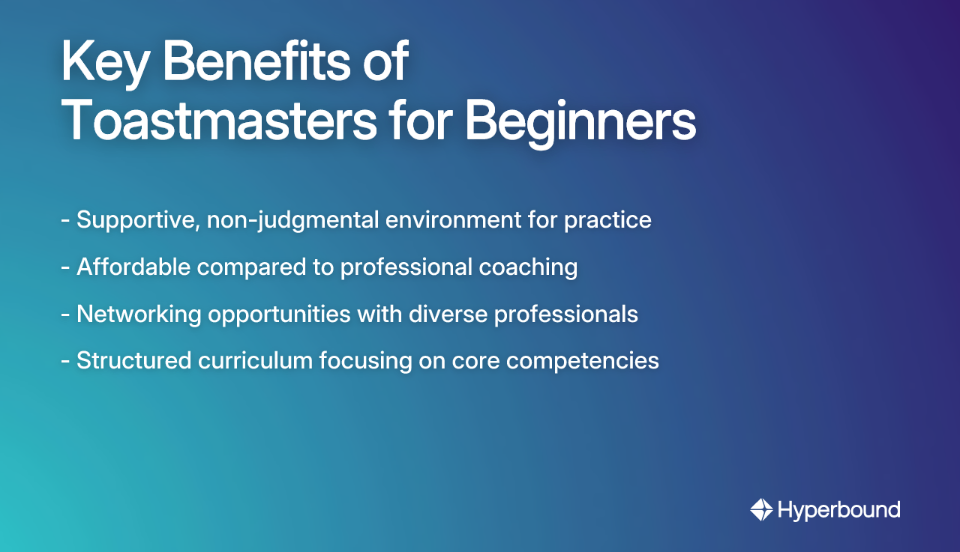
Toastmasters excels at building confidence and providing regular speaking opportunities. For many, it's the perfect first step into public speaking.
So why, despite your dedication, might you feel your speaking skills plateauing? Several structural limitations of the Toastmasters model can impede advanced skill development:
The primary learning mechanism in Toastmasters is peer-to-peer evaluation. While well-intentioned, most members are amateur speakers themselves. This creates a feedback loop where evaluations often focus on general encouragement ("Great job!") rather than technical skill correction that would improve your diction, articulation, or vocal image.
As one member noted in a Quora discussion on Toastmasters limitations, "The feedback quality varies dramatically depending on who happens to be in your club."
The standardized meeting format and Pathways curriculum, while providing helpful structure, may not address your specific challenges. Generic exercises often "don't address your specifics," as one frustrated member put it. Your unique struggle with filler words or articulation might never receive the focused attention it requires.
Toastmasters meetings often emphasize speech mechanics – hitting time limits, avoiding filler words, and maintaining eye contact – sometimes at the expense of developing compelling content, strategic messaging, and rhetorical techniques that truly captivate audiences.
While Table Topics provides some impromptu practice, the brief 1-2 minute format doesn't adequately prepare you for the demands of real-world spontaneous communication like navigating challenging Q&A sessions, participating in high-stakes meetings, or engaging in meaningful debate.
Your growth in Toastmasters depends entirely on your own initiative. Without external accountability or personalized guidance, it's easy to stagnate in familiar patterns. As one member observed, "a year passes with little progress" without structured intervention.
If you're experiencing the Toastmasters Plateau, it's time to supplement your journey with resources specifically designed to elevate your technical speaking abilities. Let's explore a comprehensive toolkit that addresses what many Toastmasters members find themselves seeking.
.png)
Technology offers what peer feedback often can't: objective, data-driven analysis of your speaking patterns.
Platforms like Hyperbound stand out as a particularly valuable resource. This AI-powered platform provides:
Unlike generalized encouragement, these tools provide concrete metrics that help identify specific patterns in your speech, allowing for targeted improvement where you need it most.
As one experienced speaker noted, "A good teacher can do two things that general-audience video courses cannot: help you become objective about your own performance, and keep you from wasting time on exercises that are nice but really aren't YOUR next steps."
A professional speaking coach offers:
When seeking a coach, prioritize "someone local in your region, ideally a pro who understands your cultural background and performance context." This cultural awareness ensures feedback that's relevant to your specific speaking environment.
For those seeking different learning environments to complement or replace Toastmasters, consider these alternatives:
Beyond structured groups, powerful self-directed exercises can dramatically improve specific aspects of your speaking. These practical drills, many shared by experienced speakers in online communities, target the technical elements that Toastmasters often doesn't address:
Sometimes speaking challenges stem from issues that go beyond simple practice. If you're consistently struggling despite dedicated effort, it may be time to consult a Speech-Language Pathologist (SLP).
According to the Cleveland Clinic, an SLP is a certified healthcare professional who "diagnoses and treats communication and swallowing disorders." They provide clinical therapy addressing the root causes of speech difficulties.
Consider consulting an SLP if you experience:
SLPs offer specialized treatment plans that go far beyond what peer feedback or self-help can provide, particularly when there may be underlying physical or neurological factors affecting your speech.
Toastmasters offers an invaluable foundation for building speaking confidence in a supportive environment. But true mastery requires going beyond this foundation to develop technical excellence.
By supplementing your Toastmasters experience with technology like VirtualSpeech, personalized coaching, alternative practice groups, targeted DIY exercises, and professional help when needed, you create a comprehensive development program tailored to your unique challenges.
The journey to eloquence isn't about abandoning what works – it's about thoughtfully adding what's missing. Your Toastmasters experience provides a solid base; now build upon it with these targeted resources to transform not just your confidence, but your technical speaking abilities.
The goal isn't simply to get through a speech without anxiety; it's to connect, persuade, and express yourself with the clarity, power, and eloquence you know you're capable of achieving.
The Toastmasters Plateau is the point where a speaker has gained confidence from Toastmasters but finds their technical speaking skills, such as fluency, articulation, and vocabulary, are no longer improving. This occurs because while Toastmasters is excellent for building confidence, its peer-feedback model may not provide the specialized, technical guidance needed for advanced skill development. Speakers feel more comfortable on stage but still struggle with filler words, vocal variety, and overall eloquence.
Toastmasters may not improve advanced skills due to its reliance on amateur peer feedback, a one-size-fits-all curriculum, and a primary focus on delivery basics over technical refinement. The feedback from fellow members, while encouraging, often lacks the technical expertise to correct specific issues in diction or vocal production. The standardized format can't always address individual challenges, leading to a stall in skill progression.
To move beyond a plateau, supplement your Toastmasters practice with tools that provide expert, personalized feedback. This includes using AI-powered platforms like Hyperbound for objective analysis, hiring a professional speaking coach for tailored guidance, joining complementary groups like improv or debate clubs for different skills, and performing targeted DIY drills to improve specific areas like diction and vocal power.
Effective DIY drills include reciting tongue twisters for articulation, speaking with a clean wine cork in your mouth to improve diction, and practicing speeches while running or walking uphill to enhance breath control. These exercises target the physical aspects of speech: the cork drill forces your mouth muscles to work harder for clearer speech, tongue twisters train muscle memory for difficult sounds, and breath control exercises build diaphragm strength for a more powerful and stable voice.
You should hire a professional speaking coach when you need expert, personalized feedback to overcome specific, persistent challenges that aren't being addressed by peer evaluation. A coach is invaluable if you're struggling with issues like poor diction, a monotonous voice, or weak messaging. They can provide a tailored assessment, create a customized improvement plan, and offer accountability to ensure progress.
An AI speaking coach provides objective, data-driven, and instant feedback on specific metrics, whereas feedback at Toastmasters is subjective and based on the observations of amateur peers. AI tools can analyze your speech for filler word usage, pace, and other patterns with complete objectivity, allowing you to track concrete progress. Toastmasters feedback, while valuable for encouragement, can vary in quality and often lacks this level of detailed, technical analysis.
You should consult a Speech-Language Pathologist (SLP) if you suspect your speaking challenges are caused by an underlying clinical issue rather than just a lack of practice. An SLP is a certified healthcare professional who diagnoses and treats communication disorders. If you have persistent issues with articulation, stuttering, chronic hoarseness, or finding words that feel more severe than typical nervousness, an SLP can provide a clinical diagnosis and specialized therapy.










Use Cases
Legal