You've just hired a promising new sales rep. They're eager, well-qualified, and ready to make an impact. Three months later, they're drowning in confusion, struggling to meet targets, and already updating their resume.
Sound familiar?
"90 days into my 1st Sales job and I haven't had any real or formal training. Day 1 consisted of a list of things to do with no instructions on where or how to get the info being requested," laments one sales professional on Reddit. This experience isn't unique – it's the predictable outcome of the "sink or swim" approach to onboarding that continues to plague sales organizations.
As a sales leader, you may believe this baptism by fire separates the strong from the weak. After all, sales is tough – shouldn't your onboarding reflect that? But the data tells a different story: this approach isn't creating resilient salespeople – it's sabotaging your 1-year sales forecast, driving up costs, and undermining your team's potential.
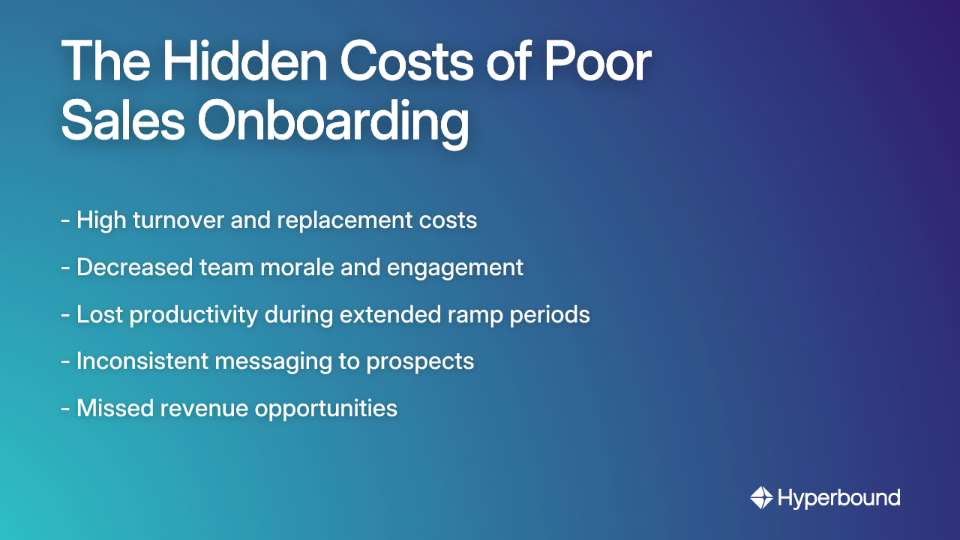
The absence of structured onboarding creates a revolving door that bleeds your company dry. Nearly 33% of new hires look for a new job within their first six months, with inadequate training cited as a primary reason.
"My managers do this and are surprised when our turnover rate is obscenely high," notes one frustrated team member about the sink-or-swim approach. This shouldn't be surprising: companies with effective sales training programs report significantly lower turnover (33.8%) compared to those without (45.5%).
Every time a rep leaves, you're not just losing talent – you're burning money:
For a company with 20 salespeople and a 45% turnover rate, this could mean replacing 9 reps per year. At a conservative $50,000 per replacement, that's $450,000 annually just to maintain headcount – money that could be invested in growth.
"I hated my job, A LOT because I was not given any sales training until I learnt everything myself from books," shares another sales professional. This sentiment spreads quickly in teams without proper onboarding.
Unsupported reps don't just underperform – they become actively disengaged. They hesitate to take initiative, as one sales leader observes: "People wait for instructions instead of driving things." This hesitation creates a culture of mediocrity where innovation and proactive problem-solving disappear.
The productivity cost is staggering. A CSO Insights study found that effective onboarding helps new reps become fully productive two months faster. For a rep with a $2 million annual quota, this delay can cost your company $50,000 to $100,000 per new hire in lost revenue.
Without structured product training and a defined sales methodology training, each rep develops their own approach and messaging. This inconsistency confuses prospects, dilutes your brand, and creates a disjointed customer experience.
When reps lack comprehensive training in overcoming objections and articulating your product's value proposition, they miss opportunities to address the market gap your solution fills. The result? Longer sales cycles, lower conversion rates, and frustrated customers who receive contradictory information.
The good news? There's a clear alternative to the sink-or-swim approach, and its benefits are well-documented.
Companies implementing structured sales onboarding programs see dramatic improvements:
These aren't marginal gains – they're transformative shifts that directly impact your bottom line and your ability to forecast sales accurately.
When you implement comprehensive onboarding, new hires contribute faster:
This acceleration has profound implications for your SDR program and the entire sales organization. New hires quickly progress from cost centers to revenue generators, allowing you to recoup your investment and begin generating returns far sooner.
The connection between proper onboarding and retention is undeniable. According to Gallup, 70% of employees who experience exceptional onboarding say they have "the best possible job" and are 2.6 times more likely to be extremely satisfied with their workplace.
This satisfaction translates directly to reduced turnover, increased discretionary effort, and a sales team that's invested in long-term success rather than looking for the exit.
Building an effective program is about intentionality, not just budget size. More than 60% of organizations already have dedicated sales onboarding programs, so you won't be starting from scratch. Here's how to create a system that transforms new hires into confident, competent sellers:
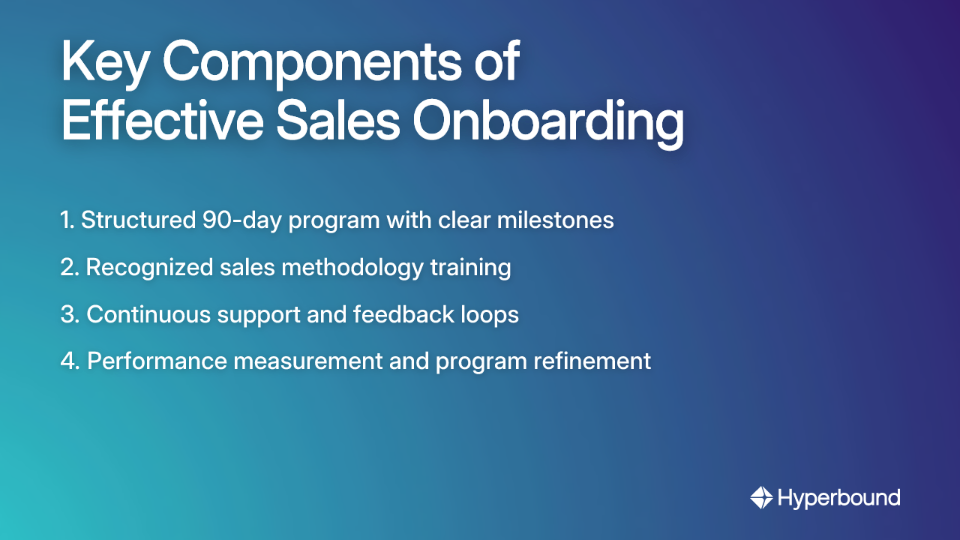
Generic training won't cut it. Consider established methodologies like:
These proven frameworks provide a consistent language and approach that elevates your entire team's capabilities.
Effective onboarding isn't a one-and-done event but an ongoing process:
To demonstrate the ROI of your structured onboarding program, you need to track the right metrics:
Use pre- and post-training data to create a clear picture of your program's impact and make adjustments as needed.
When seeking executive approval and budget for enhanced onboarding:
The 'sink or swim' method isn't a tough-love rite of passage – it's a direct path to failure. One experienced salesperson's advice to newcomers says it all: "If any young people are reading this, bail ASAP if you don't receive sales training, don't even stay for a single month."
When your onboarding philosophy drives away talent, it's time for a radical rethink.
Structured onboarding isn't just a nice-to-have HR initiative – it's the single most effective lever you can pull to build a resilient, high-achieving sales team that stays, performs, and wins. It's about recognizing that, as one sales professional put it, "Companies cannot expect to just hire someone and let that be the end of it."
By investing in your people from day one, you create a virtuous cycle:
The data is clear, the business case is compelling, and the choice is yours: Will you continue to watch promising talent sink, or will you build the structures that help your entire team swim toward greater success?
Your competitors are already making their choice. What's yours?
"Sink or swim" sales onboarding is an informal approach where new hires receive minimal guidance and are expected to learn their roles independently through trial and error. This hands-off method lacks structured training, clear milestones, or dedicated support, often leading to high turnover, inconsistent messaging, and significant lost revenue.
A structured sales onboarding program is crucial because it dramatically improves new hire performance, reduces costly turnover, and shortens the time it takes for a rep to become a productive, revenue-generating team member. Companies with effective programs see higher quota attainment, better sales growth, and increased employee engagement, providing a clear return on investment.
An effective sales onboarding program should last for at least 90 days. This timeframe allows a new hire to progress from foundational knowledge to practical application and refinement without feeling overwhelmed. A well-designed program breaks this period into phases: foundational learning (weeks 1-2), process and product mastery (weeks 3-6), and practical application with coaching (weeks 7-12).
The most critical metrics for measuring onboarding success are time to first deal, quota attainment rate, employee turnover rate, and time to full productivity. Tracking these KPIs allows you to quantify the program's ROI and demonstrate its impact on revenue and team stability. Other valuable metrics include sales cycle length and customer satisfaction scores from new reps' interactions.
To build a compelling business case, frame the program as a solution to specific business problems like high turnover costs and missed revenue targets. Present a clear cost-versus-return analysis by calculating the current cost of turnover (recruitment, lost productivity) and the potential revenue gain from faster ramp times. This positions onboarding as a strategic, revenue-driving investment rather than a cost.
AI-powered tools improve sales onboarding by providing scalable, realistic practice environments and data-driven coaching insights. For example, AI sales role-playing platforms allow new reps to practice handling objections and mastering messaging in a safe environment. AI coaching tools can then analyze performance to provide managers with specific, actionable feedback, making training more efficient and effective.











Use Cases
Legal