
You've put on your best business attire, practiced your pitch in the mirror, and confidently walked through the doors of a prospect's office. But instead of the warm welcome and productive conversation you envisioned, you're met with a dismissive receptionist, an unavailable decision maker, and that all-too-familiar feeling that you've just wasted another afternoon.
If this scenario sounds painfully familiar, you're not alone. Walk-ins fundamentally have a low ROI as a sales strategy, especially in today's B2B environment where gatekeepers are trained to filter out unsolicited visitors and decision makers have packed calendars.
"It's a giant waste of time," as many experienced sales professionals confess. Yet companies continue sending their teams into the field with little more than a list of addresses and a product brochure, expecting results from a strategy that's increasingly ineffective.
But what if there's a better way? What if the problem isn't walk-ins themselves, but rather how they're executed? This article breaks down why traditional sales walk-ins fail and provides five actionable strategies to transform your approach from cold, awkward encounters into warm, productive meetings.
.png)
Before we can fix the problem, we need to understand exactly why walk-ins so often end in disappointment. Three fundamental issues plague the traditional approach:
Cold walk-ins are notoriously inefficient with minimal returns on the considerable effort invested. The math simply doesn't work out:

The person at the front desk represents the first and often insurmountable hurdle in your walk-in strategy.
"The gatekeeper has no incentive to help you; they are incentivized to help decision makers turn people away," notes one sales veteran on Reddit. Receptionists and administrative assistants serve as the first line of defense, designed specifically to block unsolicited sales pitches from reaching busy executives.
The fundamental problem is clear: you're pitching to someone who cannot say "yes" but has full authority to say "no." And in most organizations, that person is extremely good at their job of keeping unexpected visitors away from decision makers.
Perhaps the most obvious yet overlooked issue with walk-ins is the timing. Showing up unannounced virtually guarantees you're arriving at the wrong moment:
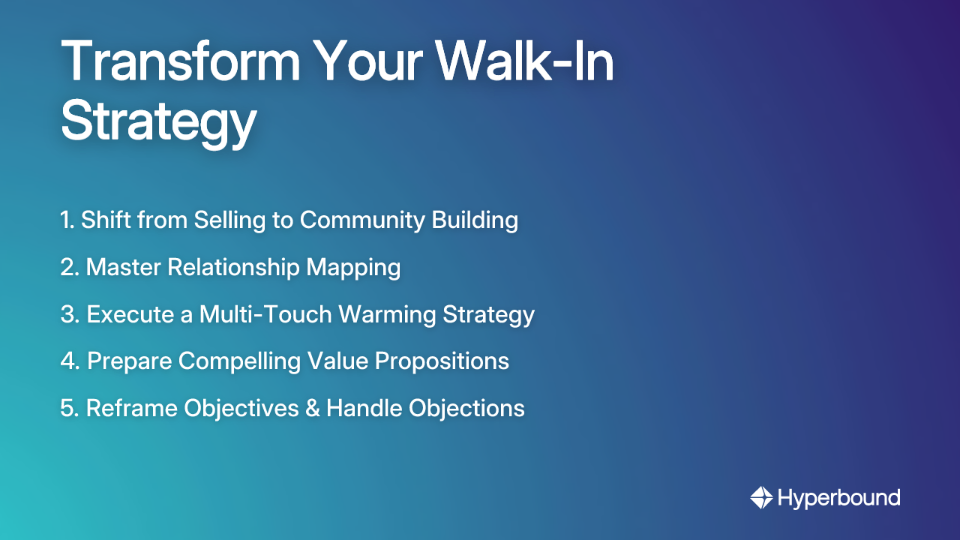
Now that we understand why traditional walk-ins fail, let's explore five proven approaches to transform this outdated strategy into a powerful tool for your sales arsenal.
The most successful B2B sales professionals no longer think in terms of one-off transactions but rather in building meaningful connections within their target market.
Actionable Steps:
Never walk in blind. The most successful sales professionals thoroughly research and map the relationships within their target organizations.
Actionable Steps:
A walk-in should never be your first touchpoint with a prospect. Instead, it should be a strategic step in a carefully orchestrated multi-channel outreach campaign.
Actionable Steps:
When you do finally walk in, you must be hyper-prepared with a value proposition that speaks directly to your prospect's specific needs and challenges.
Actionable Steps:
The goal of a first visit is not to make a sale; it's to qualify the prospect and set a formal appointment for a deeper conversation.
Actionable Steps:
The era of ambush-style cold walk-ins is over. Today's B2B sales environment requires a more strategic, thoughtful, and value-driven approach. By building community connections, mapping relationships, implementing multi-touch strategies, crafting compelling value propositions, and setting appropriate objectives, you can transform your walk-ins from awkward interruptions to welcomed conversations.
Remember: Success in modern sales isn't about forcing your way through the front door—it's about earning the right to be invited in. Shift your focus from selling products to building relationships and solving problems, and you'll find prospects far more receptive when you do walk through their doors.

Which of these five strategies will you implement this week to transform your approach from cold calls to warm conversations? Your next great client relationship might be just one strategic walk-in away.










Use Cases
Legal