
A rep can pass every scenario in a sales roleplay tool and never change what they do on a live call, and the tool has no way of knowing. That is not a bug in any specific product. It is the structural condition of practice-only software: it measures success inside the simulator, and the simulator has no window into what happens forty minutes later on a real cold call. The industry's answer to weak transfer has been to build better roleplays. That fix improves the simulator. It does nothing to close the loop, and the research on training transfer identifies the loop, not the simulator, as the point where behavior changes.
This is a structural problem for enablement leaders, frontline managers, and RevOps buyers evaluating this category, because the pitch for every roleplay tool is identical: practice more, get better. The pitch is not wrong. It is incomplete in a way that costs ramp time and pipeline, and the reasons are specific.
AI sales roleplay software runs practice sessions, typically thirty seconds or longer, where a rep works an objection, a pitch, or a discovery flow against an AI buyer and is scored against a rubric or a company's own methodology. The idea behind it is sound: skill is built through focused repetition against a standard, with feedback, a principle sales enablement borrowed from deliberate-practice research and applied to a domain, live selling, where reps otherwise receive very few live practice opportunities before a deal is at risk.
The better tools in the category extend beyond a chat window. They build custom scenarios from a company's own scripts and objections, add team dashboards, run pass/fail certifications, grade uploaded call recordings, and layer in enterprise features such as SSO and SCIM for security teams. As of 2026, Yoodli's public pricing page shows a free tier with five lifetime sessions up through an unlimited-roleplay enterprise plan, and its enterprise posture (SOC 2 Type 2, GDPR, SSO/SCIM, LMS and HRIS integrations) points to a product built for the learning stack. As of 2026, Second Nature's public site describes scripted and semi-scripted scenarios for regulated industries, certifications, and onboarding modules across more than twenty languages.
None of that is a complaint. Practice compresses repetitions a rep would otherwise only gain by using live pipeline while learning on the job, and the value is recognized by enablement leaders. The claim that starts to stretch is the implicit one: that passing the simulator predicts what happens on the next live call. The evidence on that point is less favorable.
Training researchers have measured this gap for decades, long before anyone built an AI buyer persona. Baldwin and Ford's 1988 review found that most formal training fails to transfer to the job, and a 2010 meta-analysis by Blume and colleagues put the average transfer rate at 10 to 15 percent, meaning roughly seven out of eight things a person practices never appear in how they work. A more recent synthesis estimates the cost: failed training transfer runs U.S. organizations an estimated $164 billion a year.
The most relevant finding for buyers of roleplay tools concerns satisfaction. Burke and Hutchins found no correlation between how much a learner enjoyed or was satisfied with training and whether it changed their on-the-job behavior. A rep can score perfectly on a scenario, rate the session five stars, and change nothing about the next real call. Holton and Bates make the mechanism explicit: knowledge retention and skill transfer are separate systems. Knowing something and doing something are not the same thing. Even self-reported improvement is unreliable: one study found leaders who used a post-training app felt they had improved, while the people who worked for them noticed no difference at all.
This is not an argument that practice is worthless. It is an argument that a scoring system confined to the practice environment cannot see the thing it exists to improve. A vendor review of Second Nature makes the point concretely: even its call-analysis feature grades after practice, not during live calls, and the same review notes that pass/fail certification on a simulated conversation "may not reflect real conversation skills." That is not a criticism of the product. It is what every practice-only architecture looks like from the outside, because the practice environment is not connected to the live environment.
The instinct, faced with a transfer gap, is to make the simulator harder, more realistic, and broader in scenario coverage and language support. Thorndike and Woodworth's "identical elements" principle from 1901 supports part of that instinct: transfer is strongest when training closely resembles the real work environment, which is why a roleplay built from a rep's actual objections outperforms a generic script. But realism inside the simulator only closes part of the distance. It does not answer the harder question of whether the tool can observe what the rep does after leaving the simulator.
Baldwin and Ford's transfer model ranks trainee characteristics, training design, and work environment as the three forces that determine whether learning transfers to the job. Work environment is the strongest, ahead of training design or individual motivation. Blume and colleagues go further and identify supervisory support as the single biggest predictor of whether training transfers, ahead of training quality or trainer skill. That finding reframes the category. If the environment and the manager's involvement matter more than the design of the practice session, then a tool that only measures the practice session is addressing the wrong factor. Aim For Behavior states the underlying principle: when the environment, the process, and the tools around a rep stay the same, they become the barrier, and a behavior will not sustain unless the system around it is designed for that.
There is a useful diagnostic in that research: a training program has a gap if the behavior it teaches will not sustain when no one is observing. Every roleplay-only tool fails this test by construction, not by poor execution. No one is observing the live call, so the tool has no way of knowing whether the behavior sustained.
Supered's research on sales training identifies the resulting problem. Content consumed, engagement scores, and completion rates are all input metrics: they measure activity, not outcome, and all three can rise while behavior on real calls stays flat. That is not a hypothetical. Supered's 2026 research on sales enablement found that 89 percent of teams have a defined sales process, but only 36 percent see reps run it. The gap between having a standard and executing it is the same gap a passed roleplay certification cannot detect.
This gives any buyer evaluating the category a concrete screening question, and it is worth stating as one: ask a vendor which of the numbers on their dashboard are inputs and which are behavior outputs measured on real calls. Completion rate, pass rate, and engagement time are all inputs. If that is the entire dashboard, the tool is reporting on the simulator, not on the job.
The counter-argument is that a good rep will apply what they learned in practice on the next call without manager oversight or dashboard visibility. Some reps do exactly that. The research on relapse shows that most will not, for a specific, mechanical reason rather than a motivational one. Marx's 1982 relapse-prevention research found that learners revert to old habits when they encounter real resistance, unless they are given an explicit strategy for maintaining the new behavior under pressure. A rep who passes a simulator certification and then meets an unscripted, irritated prospect fits the scenario relapse prevention describes. The practiced behavior does not hold under friction the simulator did not model, because no mechanism forces the connection back into the next practice session.
Broad and Newstrom's research adds a timeline to the same failure: without ongoing reinforcement, learned skills decay quickly, and most people revert to prior habits within six months. That is the empirical case against the single certification model that much of this category still relies on: a rep certifies once at onboarding, or once at a kickoff, and the system considers the job done. Sales kickoffs often report certification rates in the 90 percent range. What happens on calls three months later is, in most stacks, not tracked.
Lim and Morris' research on opportunity-to-perform explains why this cannot be delegated to the rep's discretion: skills that are not applied in the real environment shortly after being learned decline regardless of how well they were learned. That means the connection between what a rep practiced and what they do on the next real call needs to be engineered into the system, not assumed as a byproduct of good intentions. Aim For Behavior's framing states this directly: transfer is not up to the individual. When the environment and the tools around the individual stay static, they are the barrier, however motivated the rep is.
This is also where sales enablement leaders and frontline managers encounter the gap. Enablement can prove a rep completed a roleplay. It generally cannot prove that behavior appeared on a real call a month later, because the reporting available stops at completion rate and click-throughs and says nothing about what changed. Conversation intelligence platforms sit on the other side of that same gap: they record and score the real call, but the fix they offer after a poor call is a comment left in a tool, on a call, that the rep may never revisit. Neither side of the stack was built to integrate with the other, and a rep, in practice, is not the mechanism that reliably closes that gap. A sales call scoring loop connected to practice is the structural piece most stacks are missing.
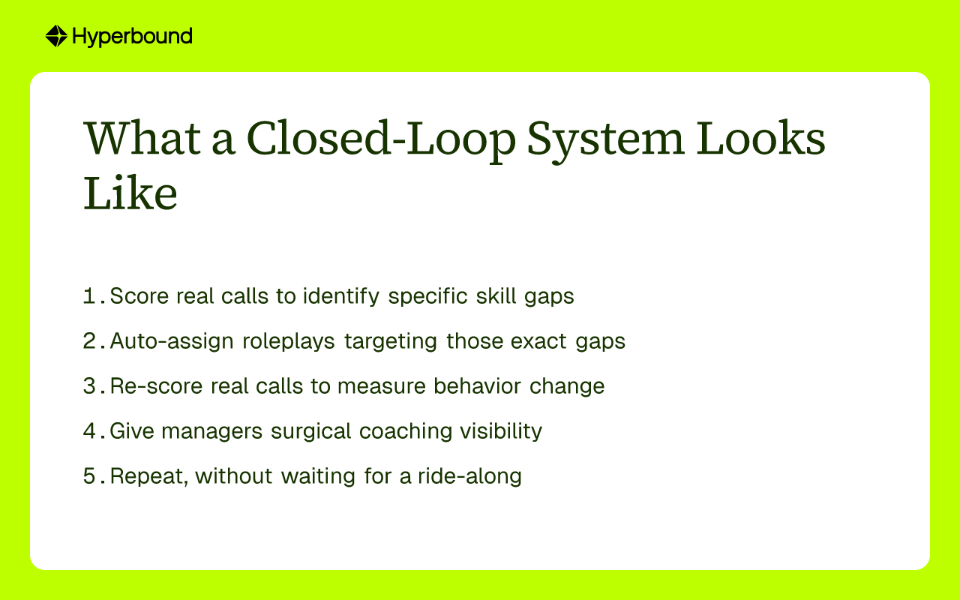
If supervisory support is the strongest predictor of transfer, and the barrier is the system around the rep rather than the rep's motivation, then the fix has to be architectural. It has to be a system that monitors what happens on real calls, identifies where a specific rep's execution diverges from the standard, and automatically turns that divergence into the next practice assignment, rather than waiting for a manager to notice during a call review they may never conduct (frontline managers report spending only five to eight percent of their time coaching, and listening to under one percent of recorded calls). That design goal differs fundamentally from making the roleplay more realistic.
This is the premise Hyperbound is built on: practice is necessary, and on its own it is not sufficient. The operational loop Hyperbound runs with its customers involves scoring real calls, identifying the specific skill gap, assigning the roleplay that targets that gap, and then scoring real calls again to check whether the behavior changed. At ALKU, which had no call recording at all before adopting Hyperbound Perform, that loop provided real-call visibility for the first time and let coaching target what reps were doing on live calls rather than generic curriculum. At Staff Domain, the same connection cut the time to identify a coaching need from ninety days down to four weeks. At finally, managers now prescribe specific roleplay bots to specific reps based on weaknesses those reps show on real calls, a pattern the team calls surgical coaching, layered on top of a cold-call certification every SDR has to pass with the VP of Sales and CRO before using any other tool. Across these accounts, the bottleneck was not a lack of roleplays. It was manager bandwidth, and a system that could not connect what happened on a real call back to what got practiced next.
This is also the design principle behind Agentic Enablement, Hyperbound's autonomous behavior change system, a concept connected to the Practice to Perform to Activate loop. The system is being designed to identify a skill gap surfacing on live calls and turn it into a targeted practice assignment automatically, aiming to close the loop the transfer research says the rep cannot be expected to close alone. It is described here as an announced direction, not a shipped feature, and organizations evaluating the category should treat it that way while it moves toward release. The announcement and Hyperbound Perform lay out how the loop is meant to work in more detail.
None of this means conversation intelligence or roleplay practice are the wrong investments. Gong-style platforms make execution visible in ways that earlier tools did not, and that visibility is real progress over having no record of a call at all. Roleplay platforms compress repetitions a rep would otherwise only gain by using live pipeline while learning, and Thorndike and Woodworth's identical-elements research says that practice modeled closely on real scenarios does transfer better than generic scripts. The claim here is narrower and, on the evidence, harder to dispute: visibility into a call after it happened and practice before a call happens are both necessary, and neither one, run in isolation, produces the loop that determines whether behavior on the next call differs from the last one. Kirkpatrick and Kirkpatrick note that fewer than 15 percent of organizations even measure long-term transfer, at multiple points after training rather than immediately after a course ends. Most of this category, including the enablement teams buying into it, is not yet set up to answer the question most relevant to it.
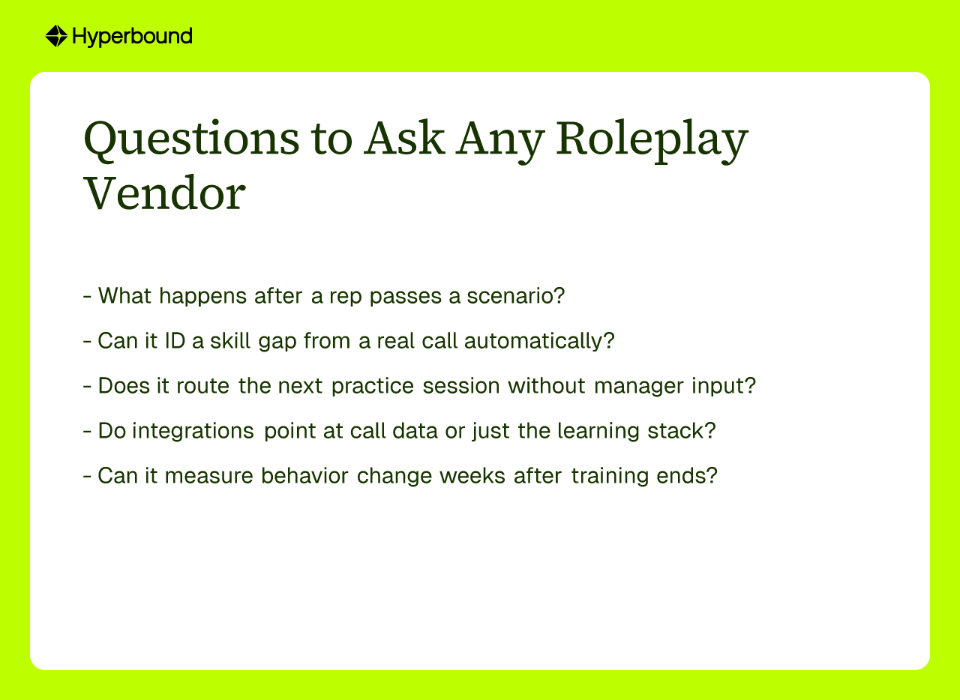
For sales enablement leaders and RevOps buyers evaluating roleplay vendors, the practical takeaway is a screening test, not a rejection of the category. Ask what happens after a rep passes a scenario. If the answer stops at a completion badge and a leaderboard, the tool is reporting on the simulator. Ask whether the system can identify a specific behavior gap from a real call and route the next practice session around it without a manager manually connecting the two. Ask whether the vendor's own integrations point at a learning stack (LMS, CMS, HRIS) or at the call data itself. The architecture of a vendor's integrations says more about what it was built to solve than its marketing does.
The deeper point is that this is not a rep-discipline problem to be solved with more reminders or more roleplays. It is a systems problem, and the research on training transfer has demonstrated for close to forty years that work environment matters more than training design, supervisory support matters more than training quality, and opportunity to perform on the real job matters more than how well a skill was rehearsed in a simulator. Practice remains the input every rep needs. The system that decides what gets practiced next, based on what happened on the last real call, is the part of the category still being built.
An AI sales roleplay tool is software that enables sales reps to practice pitches, discovery calls, and objection handling against an AI buyer and receive automated scoring against a rubric or methodology. The most useful tools also build custom scenarios from a company's own scripts, run pass/fail certifications, grade recorded calls, and add team dashboards and enterprise features such as SSO and SCIM.
Practice can improve live performance, but improvement is not automatic. Training-transfer research shows that most formal training does not transfer to the job: average transfer rates sit around 10 to 15 percent, and learner satisfaction does not reliably predict on-the-job behavior change. AI roleplay improves live performance most when practice is connected to real call data and reinforced over time, not when it ends at a completion badge.
Reps often revert to old habits when they encounter real resistance, such as an unscripted objection, a rushed tone, or a high-stakes moment, unless they have an explicit strategy for maintaining the new behavior under pressure. The research on transfer also ranks work environment and supervisory support above training design, so if a manager and the surrounding process do not reinforce the skill, it decays.
The sales training transfer problem is the gap between what reps demonstrate in training or a simulator and what they do on the job. Transfer research suggests that as little as 10 to 15 percent of what people learn in formal training appears in their work, and satisfaction or engagement does not reliably predict that transfer. In a sales team, this is why a rep can pass a roleplay certification and still execute differently on live calls.
Organizations measure it on real calls, not through completion rates, pass rates, or engagement inside the training tool. Teams should score real calls for the specific skill before training, then score again at multiple points after training, for example at six weeks, three months, and six months, to see whether the behavior appears and sustains. If the dashboard only shows inputs such as completions, it is not measuring transfer.
Conversation intelligence records, transcribes, and scores real calls after they happen, while AI roleplay software lets reps practice before a call. Conversation intelligence makes rep execution visible but does not automatically change the next practice session; roleplay builds skill but does not see the live call. On their own, neither reliably closes the skill-transfer loop.
Buyers should look for evidence that the tool connects practice to real call behavior, not just learner engagement or completion. Ask what happens after a rep passes a scenario, whether the system can identify a skill gap from a real call and route the next practice session automatically, and whether integrations point at call data or only at the learning stack. The dashboard should also show output metrics measured on real calls, not only simulator inputs.
A closed-loop system scores real calls to identify specific skill gaps, automatically assigns roleplays that target those gaps, and then re-scores live calls to confirm the behavior changed. That loop turns coaching from a manager-dependent step into a system-driven process, and it aligns with research showing that work environment and supervisory support matter more than training design alone.










Use Cases
Legal