
You've just settled into your rhythm on a cold call with a promising prospect when suddenly you remember: this conversation is being recorded. That familiar knot forms in your stomach. "Having my manager listen to every single one of my calls on-demand? Sounds brutal," you think to yourself. You worry about stumbling over words, missing key talking points, or worse—having to announce "this call is being recorded" and immediately killing your chances of booking that meeting.
If this scenario sounds familiar, you're not alone. Many sales professionals view call recording as a digital leash—a way for managers to nitpick every word and micromanage their teams from afar. But what if the reality is far more nuanced? What if recording calls is less about watching your every move and more about protection, performance improvement, and strategic insight?
This article will break down the business rationale behind why your sales manager hits that record button—and how you can leverage this practice to your advantage rather than seeing it as something that's done to you.
Before you assume your manager is obsessively tracking your every "um" and "uh," understand that the primary driver for call recording often has nothing to do with micromanagement. It's about legal compliance and liability protection—non-negotiables for any business.

Beyond regulatory compliance, recordings serve as concrete evidence that can protect both parties:
This protection alone justifies the practice of call recording—but it's only the beginning of how recordings serve both the company and the individual sales professional.
While legal requirements may necessitate call recording, the practice offers far more than just protection against liability—it's a powerful tool for professional development and performance improvement.
For new BDRs and sales professionals, call recordings provide a treasure trove of real-world examples:
Your manager isn't recording calls just to catch mistakes—they're looking for opportunities to help you improve:
As one sales professional noted, "It's great for development... we can't create a single few scripts that'll make sense every time." Recordings capture the dynamic nature of sales conversations and provide contextual learning opportunities.
Beyond individual improvement, recordings help maintain consistent standards across the sales organization:
The value of call recordings extends far beyond the sales department:
These organization-wide benefits make call recording a strategic asset for the entire business, which explains why the practice persists despite occasional resistance from sales teams.
If you're picturing your sales manager hunched over a computer, gleefully noting every mistake in your cold calls, it's time to adjust your mental image. In reality, managers use recordings in ways that might surprise you.
Contrary to popular belief, most sales managers aren't interested in nitpicking individual calls. Instead, they're looking for patterns across the team:
These insights help managers adapt the overall sales strategy and training curriculum to improve pipeline generation for everyone—not just to point out your personal flaws.
Managers often review recordings to find exemplary moments to share with the entire team:
This approach to call reviews transforms recordings from tools of judgment into resources for team-wide improvement.
The goal of reviewing recorded calls should be empowerment, not punishment:
Rather than dreading call recording, savvy sales professionals are finding ways to use this practice to their advantage. Here's how you can do the same:
Don't wait for your manager to review your calls—take the initiative yourself:
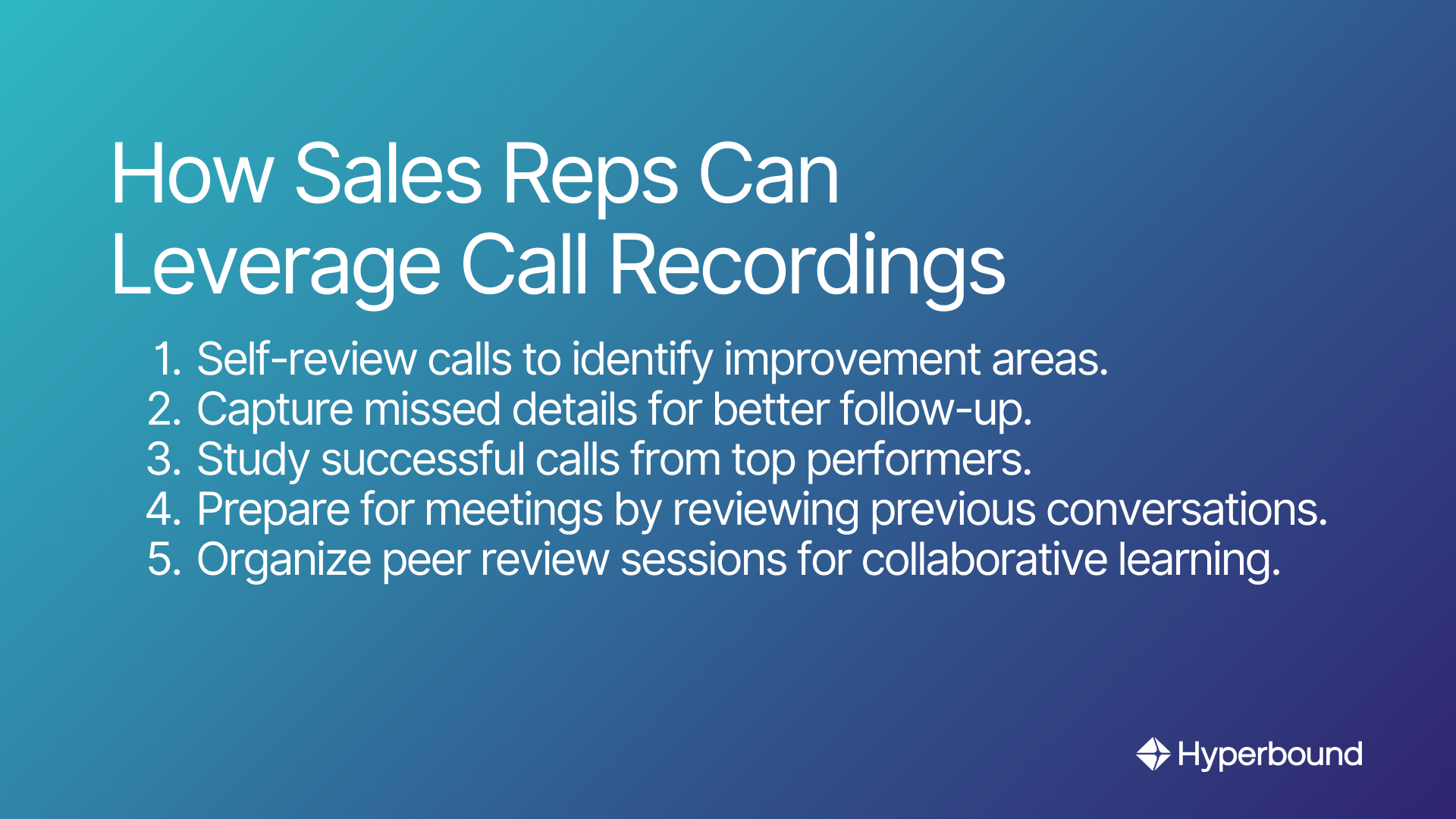
Make recordings work for you with these tactical approaches:
One of the biggest concerns about call recording is having to announce it at the start of a conversation. Here's how to handle it smoothly:
Modern sales technology, like Hyperbound's AI Sales Coaching platform, does more than just record calls—it transforms them into actionable coaching opportunities.

Call recording is a strategic business function driven first by legal compliance and liability concerns, but its value extends far beyond these necessities. When implemented thoughtfully, recording becomes a powerful tool for training, coaching, and performance improvement that benefits both the organization and individual sales professionals.
The next time you see that "recording" indicator, try reframing your perspective. Call recording isn't something that's done to you—it's a resource you can use to your advantage. By understanding the "why" behind recording and leveraging the "how," you can transform what might feel like surveillance into a catalyst for becoming a top performer in your organization's sales metrics.
After all, the most successful sales professionals don't fear scrutiny—they welcome the insights and opportunities for growth that come from seeing their work from new perspectives. The record button isn't watching you; it's watching out for you.
Sales calls are primarily recorded for legal compliance, liability protection, and quality assurance. Beyond these essential reasons, companies use recordings as a powerful tool for training new hires, providing personalized coaching to reps, and gathering insights that benefit other departments like marketing and product development. It's a strategic business practice, not just a way to monitor employees.
Yes, it is legal for companies to record sales calls, provided they follow the consent laws of the relevant jurisdictions. These laws vary. Some regions, known as "one-party consent" states, only require one person on the call (like the sales rep) to consent. Others are "two-party" or "all-party" consent states (like California and Florida), which require notifying everyone on the call that it is being recorded. International laws like GDPR in Europe have even stricter consent requirements.
Your manager is typically looking for broad patterns and "teachable moments" rather than nitpicking individual mistakes. They analyze calls across the team to identify common objections, successful value propositions, and areas where the team might be struggling. They also look for examples of excellent performance that can be shared as best practices to help the entire team improve. The goal is strategic improvement, not just finding your personal flaws.
The best way is to state it confidently and briefly, then immediately pivot to the purpose of your call. Try a simple script like, "Hi [Prospect Name], just to let you know, this call is being recorded for quality and training purposes. Now, the reason for my call today is..." This approach is professional, transparent, and keeps the conversation moving forward without creating awkwardness.
You can use call recordings for self-coaching, better follow-up preparation, and learning from top performers on your team. Proactively listen to your own calls to identify areas for improvement, like your talk-to-listen ratio or how you handle objections. Review past conversations before a follow-up meeting to recall key details. Ask your manager if you can listen to successful calls from colleagues to learn what works.
No, call recording is a standard business practice focused on compliance and development, not a reflection of personal trust. The practice is implemented team-wide to ensure consistent quality, provide legal protection for both you and the company, and create a library of training materials. It's a tool for organizational growth and risk management that applies to everyone, from new hires to seasoned veterans.









Use Cases
Legal