
New sales messaging fails through habit reversion under pressure rather than memory loss. When a call becomes difficult, a rep falls back to the pitch that felt safest before the new message arrived, and the enablement process is not built to detect that shift. Sales messaging fails for a different reason than the one most rollouts are designed to solve.
That distinction matters because the standard enablement response, a launch, certification, and manager coaching, is a reasonable approach. It addresses a real constraint: enablement teams are outnumbered, managers spend a limited portion of their week coaching, and certifying a group of reps on a new pitch is difficult to execute. The limitation is that certification proves a rep can deliver the new message once in a low-stakes setting without buyer opposition. It does not demonstrate whether the same rep returns to that message three weeks later when a prospect objects on price and the call begins to slip.
The mechanism is habit competition rather than knowledge loss, and it operates faster than most enablement planning assumes. The response a rep learned first, the pitch they could already deliver before the new message arrived, is the one that stays strongest under pressure. When a call gets hard, the brain reaches for the most automatic script it has, and that script is the old one. The new message has not had time to become automatic, so holding onto it requires active cognitive effort, exactly the resource that stress depletes first. The old response never disappeared; it remains latent and is simply the path of least resistance the moment a call begins to slip. As a result, a rep who demonstrated the new pitch in week one drifts back to the familiar script by week three without any conscious decision to abandon the training.
This reframes the enablement conversation. Most enablement discussions still center on forgetting-curve percentages, as though more repetition of the same content is the solution. The sharper point is that forgetting is the wrong frame entirely. The old response never disappeared, so the problem is not that the new message was lost but that it loses the competition for attention the moment the call gets hard. Each time pressure pushes a rep back to the old script, that path gets a little more automatic and the retreat becomes the new normal. This also explains why reps default to price and commoditization instead of value: price talk and feature dumping are usually the responses reps learned first, before discovery questions or value framing were introduced, so they are the responses stress surfaces first.
The retreat follows a mechanical pattern. Top reps ask ten to fourteen questions across a thirty-minute discovery call; a rep who has slipped back into the old pitch runs long monologues, often past sixty to seventy-five seconds at a stretch, and stops asking. That pattern is the observable signature of a message that decayed under pressure rather than a buyer who was uninterested. It also explains why sales messages fail to connect with buyers even when the content itself was correct: the delivery reverts before the content.
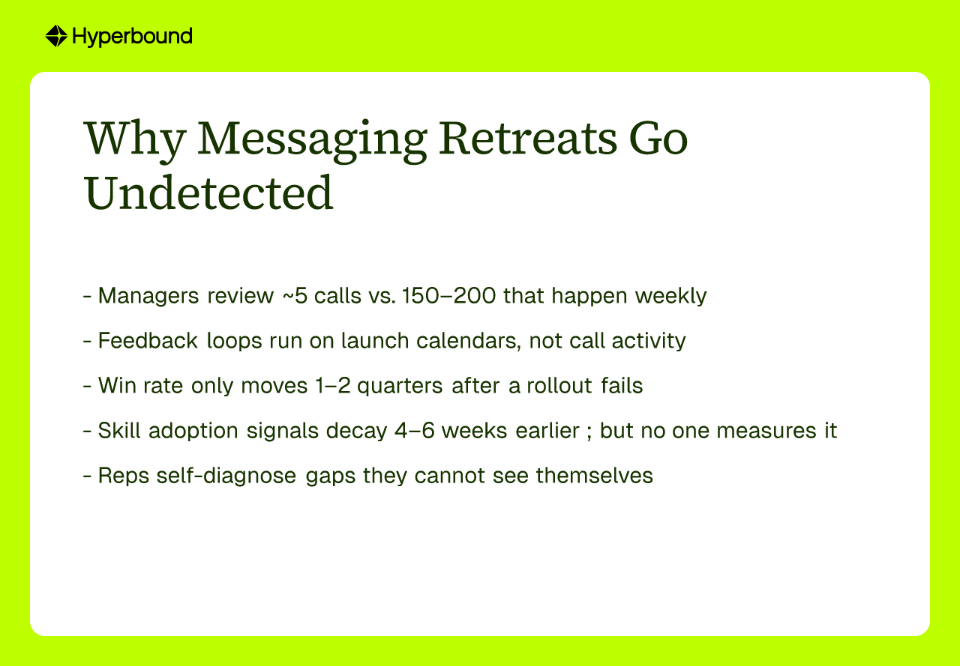
The more significant issue for enablement leaders is that the retreat is largely invisible to how coaching is run today. Manager coaching typically samples a handful of calls, often around five, against a much larger volume of real conversations happening every week, a gap on the order of thirty to fifty times. A retreat on any call outside that sample is not detected. Reinforcement cadence compounds the problem. Weekly one-on-ones outperform monthly ones, and feedback delivered within a day meaningfully improves adoption, but most rollouts run on a launch-and-check-in calendar rather than a call-triggered one.
The measurement model also targets the wrong signal. Win rate is a lagging indicator that moves only one to two quarters after a rollout, long after intervention should have occurred. The leading indicator is skill adoption, how often the specific coached behavior appears per call, and it moves in four to six weeks. A rollout that has already failed by week three will not appear as a problem in the metrics leadership watches until well after it was fixable.
Most of the tooling built for this problem addresses only half of it. Conversation intelligence platforms are effective at surfacing call scores and coaching notes, but they typically do not generate targeted practice from a specific call. Roleplay and practice tools build fluency in a simulator, but they often operate without visibility into what the rep is doing on live calls. Both approaches leave the connecting step to the rep: identifying a real-call slip and converting it into targeted practice. In our experience building tools for this exact seam, many reps do not take that step, not because they are careless but because nothing in their day prompts it. This same seam is where sales methodology reinforcement tools live on the manager side, automating the identify-and-assign work so a manager does not have to run the loop by hand.
That is the gap Hyperbound is building Agentic Enablement, its autonomous behavior change system, to close, a concept currently in private preview with design partners being recruited now, not yet a shipping product. The idea: each rep call would be scored against the specific behavior enablement wants reinforced, and a missed behavior would trigger a short roleplay built from that exact call, deal, and stakeholder rather than a generic library exercise. The rep's next real call would be scored against the same criterion, and reps who already demonstrate the behavior would be left alone. The loop is designed to run for the length of the rollout, closing the circuit between what conversation intelligence sees and what a practice tool can fix, without waiting for the rep to notice a gap and act. If you're interested in making your behavior change autonomous, talk to our team.

The obvious objection is that some rollouts fail because the message itself was wrong rather than because reinforcement lapsed. The objection has merit, and no reinforcement system fixes a bad message. But it does not explain the pattern enablement teams report: a message that tested well in certification, that reps could articulate clearly, and that still stops appearing on real calls within weeks. That pattern indicates retreat rather than rejection. Enablement teams that have moved from occasional, manager-led practice to daily, continuous practice tied to real call activity, as Perform is built to support, observe the difference: the message continues to appear because reinforcement continues, not because the message changed.
If the retreat is triggered by call activity, then reinforcement must also be triggered by call activity rather than by a training calendar. That means treating launch and certification as the start of an ongoing loop, not the end of the process, and measuring skill adoption per call as the leading indicator that a rollout is fading weeks before win rate would reflect the same pattern. The tools to run that loop at scale are still taking shape: Hyperbound Perform already scores real calls and routes misses back into targeted roleplay, and the broader Agentic Enablement system behind it is in private preview.
New sales messaging fails because reps revert to older, safer pitches when live calls become difficult rather than because they forgot the new message. A launch proves a rep can deliver the new pitch once in a low-stakes setting, but it does not show whether the rep will return to it weeks later under buyer pressure.
Stress depletes the cognitive control that lets a rep select a newly learned message instead of an old, more automatic one. A first-learned response is already the path of least resistance, so when a call gets hard the rep falls back to it without consciously choosing to abandon the new message.
Price talk and feature dumping are usually the responses reps learned first, before value framing was ever introduced. Under pressure the brain reaches for the oldest and most automatic script, which is why reps default to price and commoditization even after value messaging has been trained.
Track skill adoption per call instead of waiting on win rate. Skill adoption moves within four to six weeks, while win rate is a lagging indicator that takes one to two quarters to reflect a failed rollout.
Skill adoption measures how often a specific coached behavior appears on a live sales call. It is the leading indicator that a new message is being used in the field, and it signals decay much earlier than revenue outcomes do.
Managers typically review around five calls per week against a total volume of 150 to 200 calls, so most live-call retreats fall outside the coaching sample. If a rep slips back into an old pitch on an unreviewed call, the pattern remains invisible until larger performance metrics degrade.
More training only fixes decay if it is continuous and tied to real call activity. Repeating the same launch content does not address the core issue, because the problem is habit competition under stress rather than a knowledge gap.
Enablement teams need a loop that scores real calls against the target behavior and automatically triggers targeted roleplay from the same call when a rep slips. That closes the gap between conversation intelligence platforms, which surface what went wrong, and practice tools, which build the replacement habit.










Use Cases
Legal