
Here is the objection every sales enablement leader is already forming, whether or not they have said it out loud: put a prompt card in front of a rep who has closed two hundred deals, and the tool has not made the call better. It has made the rep worse at listening. That instinct is correct, and it is backed by real cognitive science. The mistake the category is making is not that it built live coaching. It is that it built one mode of live coaching and pointed it at everyone.
We built Live Call Coaching. We also believe the skeptics are right about the failure mode they are describing. Both things are true, and the resolution is not a smarter prompt. It is refusing to coach a ten-year rep the same way you coach a new hire.
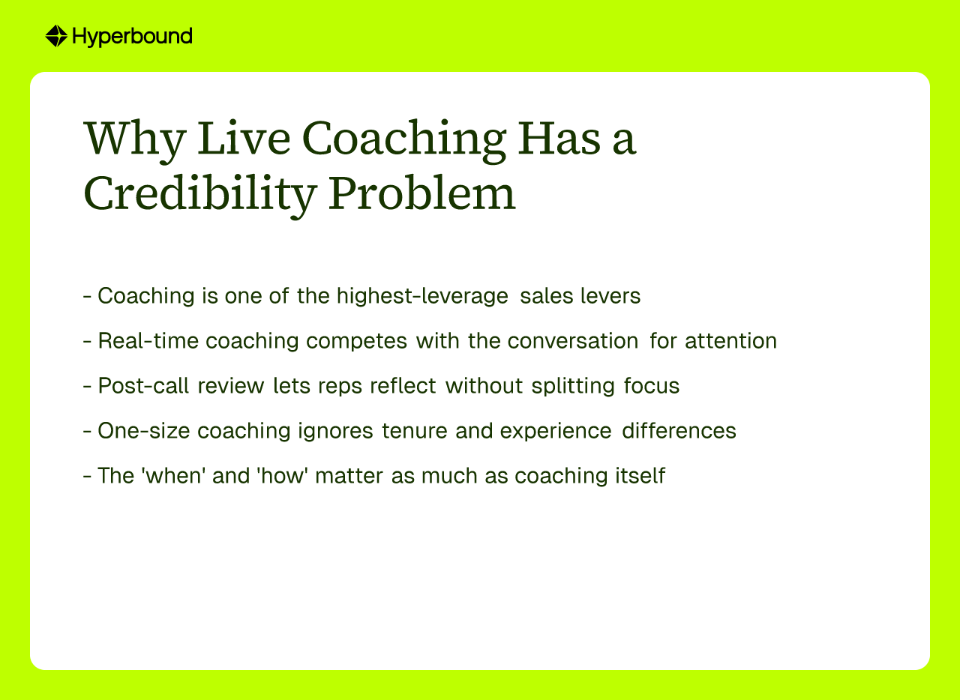
Start with what nobody disputes. Coaching is one of the highest-leverage things a sales organization does. Combining training with coaching is four times more effective than training alone, and effective coaching can move a seller's gap to goal by as much as 19 percent, according to Challenger's research on sales coaching. Nobody serious argues coaching does not work.
The argument is about when and how. Real-time coaching, a card, a checklist, a nudge that appears on screen while the rep is on a live call, is a fundamentally different intervention than post-call review. Post-call review happens after the task is done, when the rep can reflect without splitting attention. Real-time coaching is delivered during task performance, competing directly with the conversation itself for the rep's cognitive bandwidth. That distinction matters more than the category has admitted, and it is the entire reason live coaching has a credibility problem with experienced sellers.
There is a well-documented phenomenon in instructional science called the expertise reversal effect: guidance that helps a novice actively hurts an expert, and the effect reverses predictably as the learner's domain knowledge grows. It has been replicated across many studies and materials, not just observed once.
The mechanism is working memory. Working memory is a fixed, severely limited store for processing new information, while long-term memory, the expert's advantage built from thousands of reps run, is effectively unlimited. When a rep has to read a battle card and simultaneously track what the prospect is saying, that is the split-attention effect: information related to the same task, separated in space or time, forces visual search and cross-referencing that adds extraneous cognitive load. For a veteran, that load is not compensating for a gap in knowledge. It is pure overhead, subtracted directly from presence in the conversation. This is the precise, citable version of what enablement leaders mean when they say a teleprompter-style tool causes reps to stop listening to the prospect.
The cognitive load story explains why a prompt distracts an expert. It does not fully explain why an expert resents one. That second layer is autonomy. Learners at higher levels of expertise need autonomy and space for self-determination, and that need does not coexist well with constant feedback. Advanced learners show measurable frustration, not just degraded performance, when made to process guidance pitched at a level below their skill.
This gives enablement leaders two distinct reasons an A-player rejects a live prompt, not one. Sometimes the card overloads them mid-sentence. Sometimes the card insults them: it tells a rep something they already knew, at the exact moment they were about to act on it themselves. Either failure mode produces the same outcome: a rep who tunes out the tool, or worse, tunes out the buyer to deal with the tool.
This is the part that should reframe the buying decision for a risk-aware VP of Sales. It is not that mismatched coaching is a wash: help some, ignore the rest, no harm done. Done poorly, coaching hurts performance nearly twice as much as good coaching helps. The Challenger research is direct on this point: it would be better to simply not coach at all than to coach the wrong way.
That is the number that should worry anyone rolling out real-time coaching uniformly across a team with a five-year tenure spread. A one-size prompt stream is not a modest inefficiency for your top reps. It is a subtraction from quota, applied to the people carrying the most pipeline.

It would be easy to stop at "live coaching is risky for experts" and leave enablement leaders with nothing to do about it. But the same research that documents the problem also states the practical implication plainly: adjust guidance as the learner gains experience. Feedback useful for one rep is likely counterproductive for another, and reps who can already figure something out should be left to do so. The coach's job, human or software, is knowing when to stay quiet.
Challenger's coaching model already operationalizes this outside of any software context. It deliberately targets the middle of the team, the core performers, because low performers show only marginal gains from coaching and high performers do not benefit from the same guidance as everyone else. Segmenting coaching by experience is not a product feature we invented. It is what the underlying research on both cognition and sales performance has been arguing for all along. Almost nobody in the live coaching category has actually built for it.
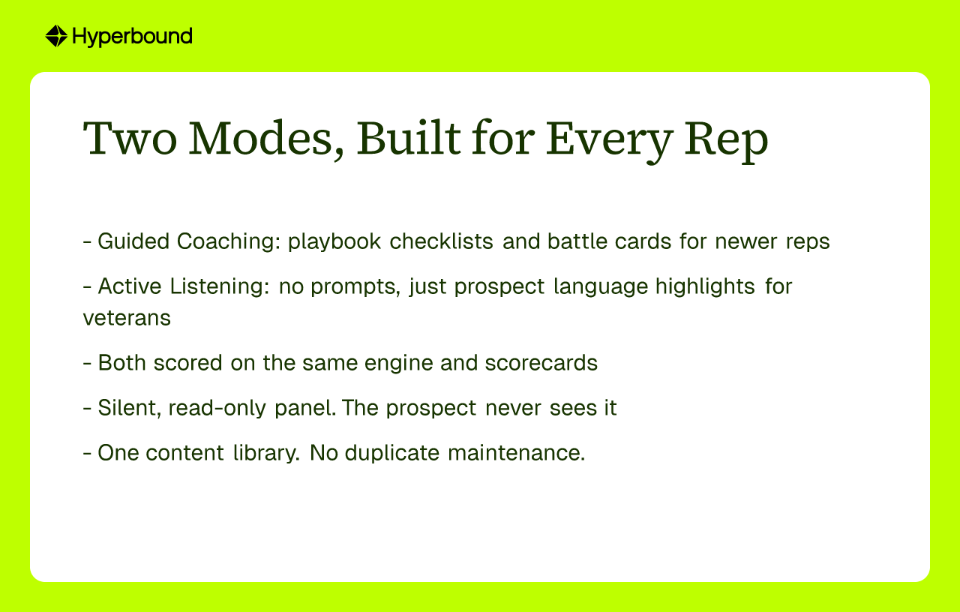
We designed Live Call Coaching, which launched as part of Hyperbound Perform, around that segmentation rather than around a single interface. It runs as a silent, read-only desktop side panel that the prospect never sees, and it operates in two equally-weighted modes, neither is a downgrade of the other.
Guided Coaching is the mode built for reps who benefit from structure: a playbook checklist that ticks off as the rep covers each point, and battle cards that surface when the prospect names a competitor, raises an objection, or asks about pricing, each one citing the source material it came from. This is exactly the kind of scaffolding the research says helps a less experienced rep, because it substitutes for domain knowledge they have not built yet.
Active Listening is the mode built for the rep who has already built that knowledge. It surfaces no cards and no prompts to read. It highlights the specific language the prospect used, so the rep can reflect it back, without asking them to divide attention between a screen and a human being. It is the closest thing to giving a veteran rep the autonomy the research says they need, while still keeping the call inside the same scoring and coaching system as everyone else's.
Both modes run on the playbooks and battle cards already built inside Hyperbound, scored against the scorecards the team already uses, so a manager is not maintaining two libraries of content for two philosophies of coaching. When the call ends, the panel scores it against the same scorecards the team already uses, flags what was hit and missed with timestamps, and lands it in the same call record as every other call the team runs. Live and post-call scoring sit on the same engine, whichever mode generated the call.
The fair objection is: if live coaching genuinely damages listening in the moment, why coach live at all? Why not let every rep run in Active Listening, or push all structured guidance into post-call review, where the expertise-reversal research does not predict harm?
The answer is that the research is specific to in-task guidance, not to structure itself. It does not say structured coaching is bad for veterans. It says live, mid-conversation prompting is the wrong delivery mechanism for someone who has already internalized the material. A rep six weeks into the job has not internalized it, and for that rep, a checklist that ticks off in real time is closing a real knowledge gap, not adding noise. The design choice was never "coaching versus no coaching." It was matching the delivery mode to what the rep actually needs from it.
If the thesis holds, the practical move for enablement leaders is not to avoid live coaching, and it is not to buy a tool that gives every rep the same experience and call it personalization because the words on the card change. It is to ask any vendor, before rollout, a direct question: does this tool coach a first-quarter rep and a ten-year rep the same way? If the answer is yes, the tool is optimized for the newest person on the team and is quietly taxing the person carrying the most pipeline. That is the gap Live Call Coaching was built to close. It is the reason it sits inside Hyperbound Perform rather than as a bolt-on prompt layer, and it belongs to the same loop as practice before the call and the review that happens after it: coaching that changes with the rep, not a script that assumes there is only one kind of rep to coach.

Real-time sales coaching delivers guidance while a rep is on a live call, usually as a prompt, checklist, or battle card. It differs from post-call review because it competes for the rep’s attention during the conversation itself, whereas post-call review happens after the call when the rep can reflect without splitting focus. The expertise reversal research is specifically about in-task guidance, not about structured feedback delivered after the call ends.
Live coaching can hurt experienced reps for two related reasons. Cognitively, it triggers the split-attention effect: a veteran who already knows the playbook spends working-memory resources reconciling an on-screen card with the prospect’s words, which reduces presence and listening quality. Motivationally, it can also threaten autonomy, because high-expertise sellers often experience constant prompts at their level as redundant or even insulting.
The expertise reversal effect is an instructional science finding that guidance that helps a novice can actively hurt an expert. As a seller’s domain knowledge grows, the same prompts that once scaffolded learning become extraneous cognitive load. In sales coaching, this means one-size-fits-all live prompts will likely degrade your most experienced reps rather than improve them.
Yes. Coaching remains one of the highest-leverage activities in sales: combining training with coaching is four times more effective than training alone, and effective coaching can move a seller’s gap to goal by up to 19 percent, according to Challenger research. However, the research also shows that poor coaching can hurt performance nearly twice as much as good coaching helps, so the payoff depends on matching the coaching style to the rep.
No. The evidence does not say structured coaching is bad for veterans; it says live, mid-conversation prompting is the wrong delivery mechanism for someone who has already internalized the material. The better move is to keep live coaching for new hires and early-tenure reps who need real-time scaffolding, while giving experienced reps a mode that preserves listening and autonomy, supported by post-call review.
Segment the coaching experience by tenure and skill. Newer reps benefit from structured guidance such as playbook checklists, cited battle cards, and objection-handling prompts. Experienced reps need the opposite: no mid-call prompts, and instead a mode that highlights the prospect’s language so they can listen more deeply. Both groups should be scored on the same playbooks and scorecards so managers do not maintain duplicate content.
The key question is: does this tool coach a first-quarter rep and a ten-year rep the same way? If the answer is yes, the tool is likely optimized for the newest person on the team and may be taxing the person carrying the most pipeline. Also ask whether it supports multiple delivery modes, respects experienced reps’ autonomy, and connects live and post-call scoring through one content library.
Hyperbound Perform uses two modes rather than one. Guided Coaching gives newer reps the playbook checklists and battle cards they need in real time. Active Listening removes prompts entirely for experienced reps and instead highlights the prospect’s language, allowing the rep to stay present in the conversation. Both modes run on the same engine, scorecards, and content library, so the team gets differentiated coaching without duplicated maintenance.










Use Cases
Legal