
You've invested six figures in Gong. You have thousands of hours of call recordings, transcripts, and AI-surfaced insights sitting in your dashboard. Your managers are leaving time-stamped comments on calls, flagging missed discovery questions, and bookmarking "coachable moments."
So why is coaching still inconsistent across your teams? Why are the same skill gaps showing up on deal after deal, quarter after quarter?
The answer isn't that Gong isn't doing its job. It's that the job Gong does — diagnosing what happened — is only half the equation.
Let's be clear: Gong is a widely-used conversation intelligence tool, and for good reason. It automatically records, transcribes, and analyzes every sales conversation. It surfaces patterns, tracks talk ratios, and helps managers understand what separates top performers from everyone else.
For sales leaders who used to manage purely on gut feel and end-of-quarter numbers, Gong was a revelation. Suddenly, you could actually see what was happening inside your pipeline. You could tell which reps were doing proper discovery and which were pitching before they understood the problem.
That visibility is real and provides useful context.
But here's where even Gong users — including many on Reddit who've invested in the platform — run into a wall: "I am looking for how to improve rep skill gaps not just on a deal or call. Then help me recommend what to change across all rep calls."
Gong can tell you what the skill gap is. It struggles to fix it.
Here's a situation that will feel familiar if you manage a sales floor.
A manager reviews a call in Gong on Tuesday morning. Their AE was on a strong discovery call — the prospect was engaged, the conversation was flowing — but then a classic mistake happened. The prospect casually mentioned they'd need to "run it by a few people internally," and the AE let it pass. No follow-up question. No mapping of the buying committee. A potential multi-stakeholder deal just became a black box.
The manager flags it. Leaves a comment: "Great energy on this call, but we missed the chance to map out the internal approval process. Let's make sure we're doing this earlier."
Then their calendar pings. Forecast call in 20 minutes. Eight other reps waiting for 1:1s. Two deals in late-stage that need attention. The coaching moment is logged. The intent was genuine. And then life happened.
The AE reads the comment. They get it intellectually. But the next discovery call they're on? Same situation arises — and without ever having practiced it in a low-stakes environment, they revert to what feels natural. The moment passes again.
Multiply this by eight reps, three managers, and four quarters. That's where inconsistent sales coaching across teams is born — not from bad intentions, but from a system that identifies problems without providing a structured path to solve them.

This isn't a Gong failure. It's a gap that many teams experience: manager call review cadences that start strong can drop to zero within the year, not because managers stop caring, but because there's no structural forcing function to turn insights into action.
The core problem is this: Gong is the world's best diagnostic tool. But diagnosis and treatment are different things.
Think of it like an MRI. It gives you a precise, detailed image of the problem. But you don't leave the radiology clinic healed — you need a rehabilitation plan, targeted exercises, and regular check-ins to actually fix whatever the scan revealed. Without that follow-through, even the sharpest diagnosis just becomes an expensive piece of documentation.
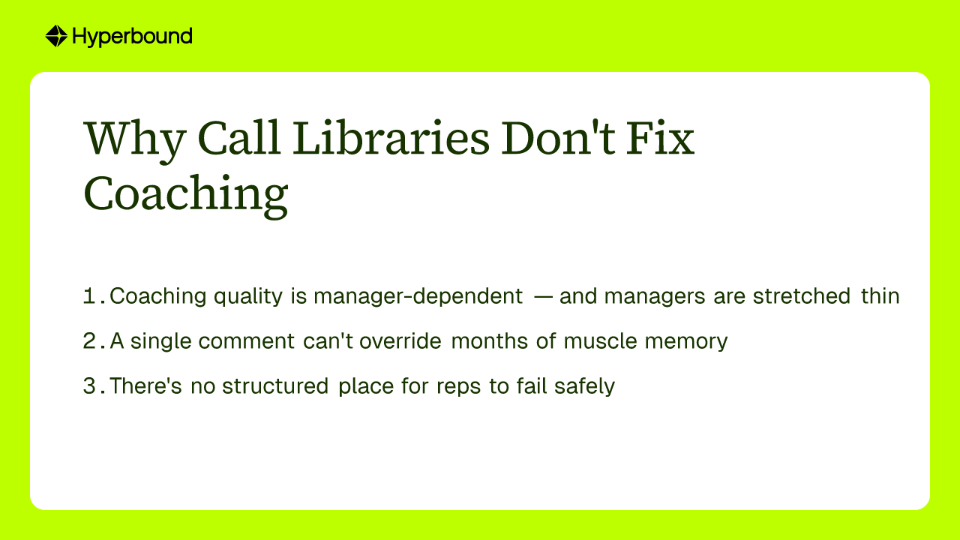
There are three structural reasons why passive call libraries fall short when it comes to fixing inconsistent sales coaching across teams:
1. Coaching quality becomes manager-dependent — and managers are stretched thin. Frontline managers spend only 5–8% of their time on coaching, and it's consistently the first activity to be cut when deal urgency spikes. Without a system that automates the practice loop, the quality and frequency of coaching varies entirely by manager. One runs rigorous weekly role-plays. Another relies on deal reviews. Another does neither. The result is a team with wildly different skill levels that have nothing to do with raw talent.
2. A single comment can't override months of muscle memory. Sales enablement leaders know that 80% of training content is forgotten within 30 days. A time-stamped note in Gong is even more fleeting. Reps aren't avoiding improvement — they just haven't had enough at-bats with the new behavior to make it automatic. The only way to internalize a new skill is through repetition in a safe environment, not passive consumption of feedback.
3. There's no structured place to fail safely. Real deals are high-stakes. A rep can't experiment with a new discovery framework on a $200,000 opportunity. The result is that reps effectively burn pipeline while learning, with the first few calls setting the trajectory for every deal. Without a practice environment, the only place to try something new is also the only place where getting it wrong costs the company revenue.
Industry data shows that teams receiving consistent, weekly coaching see 76% of reps achieve quota attainment, compared to just 47% for those coached less frequently. Gong creates the opportunity for coaching moments — but without a mechanism to enforce consistency at scale, those moments remain optional, uneven, and easily deprioritized.
This is the gap that Hyperbound was built to close. The company coined the term Revenue Activation to describe exactly this: what happens when teams stop just analyzing call data and start using it to change outcomes.
Hyperbound connects to Gong and other call intelligence tools — and instead of surfacing another dashboard to review, it turns the insights into structured practice, deal-level coaching, and manager-orchestrated interventions. The model works in three connected layers:
When a manager flags that missed discovery question in Gong, they can assign a targeted Bitesized Roleplay directly from Hyperbound — a focused, five-minute session where the rep practices navigating exactly that moment with a realistic AI buyer persona.
These aren't generic scripts. Hyperbound Practice is trained on 2M+ hours of real B2B sales conversations, so the AI buyer pushes back the way a real prospect would — getting evasive about internal stakeholders, deflecting with "we're just exploring options," responding to how the rep actually shows up. After the session, the rep gets an immediate AI Scorecard: talk ratio, methodology adherence, exactly where the conversation went off track.
The rep gets the repetitions they need. In a safe environment. Before the next deal.
Hyperbound Perform goes beyond individual calls to analyze every interaction across an entire deal lifecycle. Where Gong shows you what happened on one call, Perform connects the dots across all touchpoints — cold call, discovery, demo, follow-up — to surface what's helping or hurting a specific opportunity.
If a rep is consistently failing to establish an internal champion across multiple deals, Perform surfaces that pattern and recommends a targeted Bite-Sized Roleplay to address it before the deal stalls. It turns deal inspection from a manual, manager-driven guessing game into a structured feedback loop that connects behavior to outcomes.
Kota Activate is where the inconsistent sales coaching across teams problem gets solved at scale. Kota is Hyperbound's AI Revenue Analyst that sits above both Practice and Perform — analyzing performance data across every rep, every deal, and every coaching interaction, and then taking action.
Working directly in Slack or Teams, Kota can surface a pattern like: "60% of your team is struggling with the new pricing objection. Here's a roleplay built from your top closer's winning approach — want me to assign it to the team?" It shifts managers from reactive call reviewers to proactive, data-driven coaches — without requiring them to find four extra hours in the week.
The goal isn't to replace Gong. The goal is to stop letting the value locked inside it evaporate.
Gong tells you a rep missed a critical discovery question. Hyperbound makes sure they never miss it again. Gong identifies that 40% of your team is struggling on competitive calls. Hyperbound assigns a targeted roleplay based on how your top performers handle that exact scenario — automatically, at scale, without a manager having to coordinate it manually.
The teams getting the most out of their conversational intelligence investment aren't the ones with the most data. They're the ones who've built a system to act on it.
Vanta is one example: after adding Hyperbound's activation layer to their revenue stack, they reduced ramp time by 60% — from 210 days down to 72 — while growing their BDR team 4x. Nivoda saw 50% faster ramp and 2x revenue year-over-year, with a 150% increase in demo conversion rates.
Those results don't come from better diagnostics. They come from closing the loop between insight and behavior change — consistently, across every manager and every rep, not just the ones lucky enough to have a great coach in their corner.
If your team is already using Gong, you have the diagnosis. The question is whether you have a system to act on it.
The main limitation is that Gong is a diagnostic tool, not a treatment plan. It excels at identifying what happened on a call and surfacing skill gaps, but it doesn't provide a structured system to fix those gaps or build new skills across the team.
Hyperbound solves this gap by activating the insights found in Gong. It turns call analysis into targeted, AI practice sessions for reps, provides deal-level coaching recommendations, and allows managers to orchestrate coaching interventions at scale, ensuring insights lead to actual behavior change.
No, Hyperbound is designed to work with and enhance Gong, not replace it. Think of Gong as the MRI that diagnoses the problem, and Hyperbound as the personalized rehabilitation plan that treats it. You need both to get the best results.
Revenue Activation is the process of moving beyond passively analyzing sales data to actively using it to change rep behavior and improve deal outcomes. It involves a structured loop of practice, performance feedback, and automated coaching to turn insights into measurable revenue growth.
AI roleplay provides a safe and scalable environment for reps to practice specific scenarios, like handling objections or navigating discovery questions, without risking live deals. It allows them to build muscle memory through repetition and receive immediate, objective feedback, which is critical for internalizing new skills.
Yes, this is a core problem Hyperbound solves. By systemizing the coaching process, it ensures every rep receives consistent, high-quality practice on key skills, regardless of their manager's availability or individual coaching style. It creates a standardized baseline for skill development across the entire organization.
Teams that combine Gong's diagnostics with Hyperbound's activation layer can expect significant improvements in key sales metrics. For example, companies have seen results like a 60% reduction in new hire ramp time, a 2x increase in year-over-year revenue, and a 150% increase in demo conversion rates.
See how Hyperbound activates your Gong data →










Use Cases
Legal