
Enablement leaders are often asked to address two requirements: grade every sales call for feature dumping, and provide every rep with a practice environment before those behaviors reach live deals.
Scoping the initiative produces a plan to update scorecards for cold calls, discovery, demos, and negotiations, each split by vertical and region, and to build practice bots for every vertical and language. The plan is coherent. The strategic case is clear.
In execution, each scorecard must be opened, edited, and saved individually. Each bot must be built from scratch. The manual volume exceeds available capacity, so the team ships the two highest-priority scorecards and three bots.
This descoping pattern is structural rather than a reflection of effort or skill. It is, in project terms, the mirror image of scope creep: descoping removes deliverables without removing the underlying need, while scope creep adds work without removing constraints. The CSO Insights 5th Annual Sales Enablement Study found that only 27.5% of stakeholders believe enablement initiatives meet expectations. The gap between plan and delivery is structural.
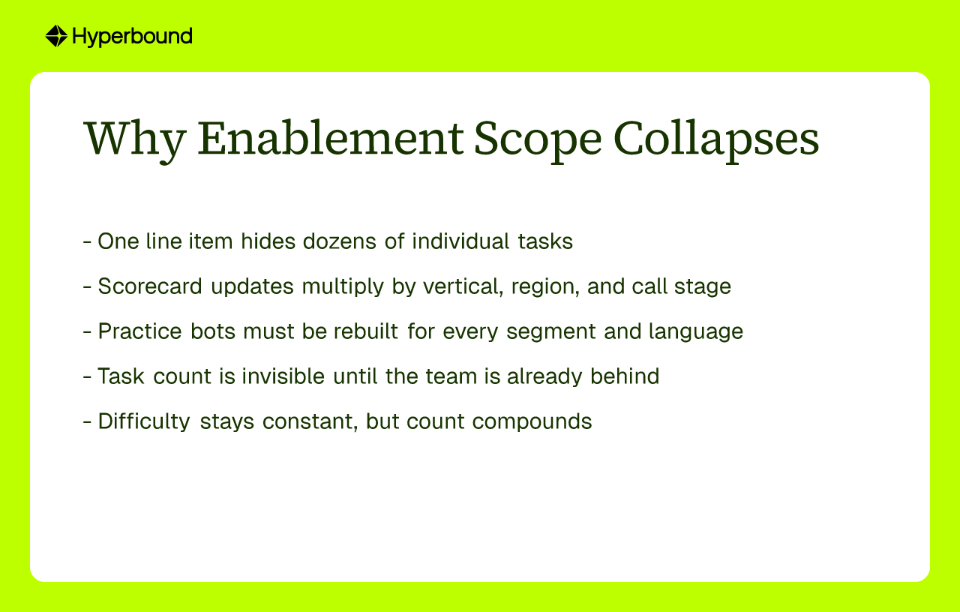
The project plan lists "update scorecards" as a single line item. In practice, the change requires opening the "US - Enterprise - Financial Services - Discovery" scorecard, editing it, saving it, and then repeating the process for "EMEA - Mid-Market - Technology - Discovery" and every other permutation built when the team first segmented by vertical and region.
None of those individual tasks is difficult. None of them rises to the level of a blocker. That is exactly why the volume does not show up in the plan. The task count is invisible until someone is three hours in and has updated four scorecards out of forty.
This pattern appears consistently across sales enablement programs. The scope is not underestimated because the work is misunderstood. It is underestimated because a long sequence of small, similar tasks reads, in a project plan, as a single action.
The same logic applies to the practice bots. Building one bot for enterprise financial services discovery calls is a defined piece of work. Building one for each vertical, each language, and each call stage multiplies that work by however many segments the program covers. The difficulty stays constant. The count compounds.
When the count of remaining tasks exceeds what the team can complete before launch, descoping is the reasonable choice. It is not a failure of ambition or planning discipline. It is a predictable outcome of the system.
Ken Madison's analysis of descoping frames it as the structural opposite of scope creep: where scope creep adds work without removing constraints, descoping removes deliverables without reducing the underlying need. The strategic requirement remains. The rep in the APAC region still needs a practice environment. The negotiation scorecard for the mid-market vertical still needs to reflect the call quality criteria the CRO asked for. Those needs do not disappear when the team ships two scorecards instead of twelve.
The downstream costs are real. When a QA rollout covers only a fraction of the planned scorecards, the call evaluation process works from an incomplete foundation. Managers monitoring call quality are sampling from a small, unrepresentative set. Reviewing five calls from a rep who handled three hundred in a month gives a picture that may bear no resemblance to that rep's actual patterns. A rep could handle the same objection badly twenty times in a week, and if none of those calls fall within the reviewed set, the issue goes unobserved. The coaching moment is missed.
This is not a new observation. It is a persistent feature of how QA and coaching programs operate at scale, and it explains why QA feedback often feels inconsistent to the people receiving it. The feedback is not necessarily inconsistent in its criteria. It is inconsistent in its coverage. When sampling is thin, the calls that happen to get reviewed become the entire basis for judgement, regardless of whether they are representative.
The further consequence is that the programs most likely to close the performance gap, comprehensive practice environments, systematic call evaluation across all segments, and centrally maintained scoring criteria, are the programs most likely to be descoped before they reach the reps who need them.
Gall's Law holds that a complex system that works has invariably evolved from a simple system that worked. The practical problem for enablement teams is that the volume of tasks required to ship even the simple version of a program is large enough to force descoping before the simple version is complete. The larger vision does not get to evolve from a working foundation because the foundation itself gets cut.

Enablement programs ship narrower than planned because the volume of work exceeds execution capacity. Complexity is not the binding constraint. The two problems have different solutions.
When the constraint is complexity, the answer is to simplify: build a cleaner scorecard, reduce the number of segments, run a pilot. When the constraint is count, simplification does not help. A simpler scorecard still has to be opened and edited individually across every variant. A smaller bot still has to be duplicated manually for every language and vertical. Reducing the scope of the individual task does not reduce the number of tasks.
Once count is recognized as the binding constraint, the relevant question changes. Rather than asking how to simplify the scorecard so it is easier to update, the question becomes how to make a change in one place that propagates across every relevant scorecard automatically. Rather than asking how to build the most important bots first, the question becomes how to define the logic once and apply it everywhere.
This distinction determines what is possible at full scale. When the count stops being the binding constraint, a program does not have to exclude the APAC region or the mid-market vertical or the four languages that did not make it into the first rollout. The scope can match the strategic requirement rather than the team's capacity for manual edits.
Enablement programs ship narrower than planned because the work escalates in count before it registers as a risk. Descoping is rational under those constraints. The constraint is not inherent to the work itself. When the number of items to build, edit, and maintain stops compounding with every segment added, the program can ship as planned.

Platforms such as Hyperbound Practice are purpose-built for this requirement. They allow teams to define scorecards and roleplay scenarios once, then generate localized variations at scale instead of requiring manual rebuilds.
This is the operating model behind Kota Actions, Hyperbound's recently launched capability for making bulk changes across a whole instance. In the launch scenario, an enablement leader describes one change and the scorecards it should appear in, and Kota Activate applies it across all 80 scorecards at once. One request covers the whole set instead of one record at a time, exactly the propagation that lets a program ship at its planned scope.
This operating model supports full enablement rollouts.
Descoping is the practice of reducing the deliverables or scope of an enablement initiative while the original strategic need stays unchanged. For example, a team may plan to update 12 call scorecards but ship only two when the manual workload becomes unmanageable. The needs that drive the original scope, such as consistent QA coverage across all regions, do not disappear when the deliverable is cut.
Sales enablement scope collapses because the work escalates in count, not in difficulty. A project plan line like "update scorecards" often hides dozens of small, repetitive tasks across verticals, regions, and call stages. Because no single task is complex, the total volume stays invisible until the team is already behind, and descoping becomes the rational response.
Enablement teams can avoid descoping by treating task count as the primary constraint rather than complexity. Instead of simplifying individual scorecards or bots, they should use systems that let one change propagate across all segments, languages, and regions automatically. This eliminates the manual duplication that causes scope to be cut before delivery.
Scope creep adds work without removing constraints, while descoping removes deliverables without reducing the underlying need. Both are structural failures in scope management, but descoping is often seen as a rational response, which is why it persists even when the strategic requirement remains unmet.
Descoping should be a last resort, used only when the team has already reduced manual task count through automation and still cannot meet a hard deadline. In most cases, the better move is to reframe the constraint from “too much work” to “too many manual repetitions” and choose tools that propagate changes centrally.
Sales teams scale sales call scorecards without manual rebuilds by defining the scoring logic once and using a platform that can generate localized variations across verticals, regions, and languages automatically. Rather than opening and editing each scorecard individually, teams can apply a single update everywhere it is needed, such as with Hyperbound Practice.
When QA scorecard coverage is incomplete, call evaluations are based on a small, unrepresentative sample. A rep could mishandle the same objection twenty times in a week without any of those calls being reviewed. This creates inconsistent-feeling feedback, misses coaching moments, and leaves performance gaps unresolved.
Enablement programs often fail to meet expectations because the volume of small, similar tasks required to ship a program is underestimated. Only 27.5% of stakeholders believe enablement initiatives meet expectations. The gap between plan and delivery is structural: descoping cuts scope before the program reaches the reps who need it.
Practice bots support full enablement rollouts by giving every rep a place to practice before live deals, but building bots manually for each vertical, language, and stage multiplies the work. Teams can support a full rollout by defining bot logic once and generating localized scenarios at scale, rather than rebuilding bots from scratch for every segment.









Use Cases
Legal