You've crafted an impressive pitch for your cutting-edge cybersecurity solution. You've highlighted the AI-powered threat detection, the seamless integration with existing systems, and the robust compliance features. Yet as you wrap up your third call with the prospect, you hear those all-too-familiar words: "This looks great, but we'll need to delay this project for now."
Sound familiar? You're not alone. Across the industry, cybersecurity sales professionals are facing an increasingly uphill battle. The data confirms what many have felt intuitively: selling cybersecurity solutions has become demonstrably harder. According to recent analysis of RepVue data, only 20% of 27 major cybersecurity companies showed improvement in year-over-year quota attainment. Industry giants are struggling too - Check Point saw quota attainment drop to 57% (down 4%), while Palo Alto Networks fell to 51% (down a concerning 14%).
The hard truth is that the old cybersecurity sales playbook is failing. The market has fundamentally changed, buyers have shifted, and the perception of cybersecurity itself has evolved. What's behind this transformation, and more importantly, how can today's cyber sellers adapt?
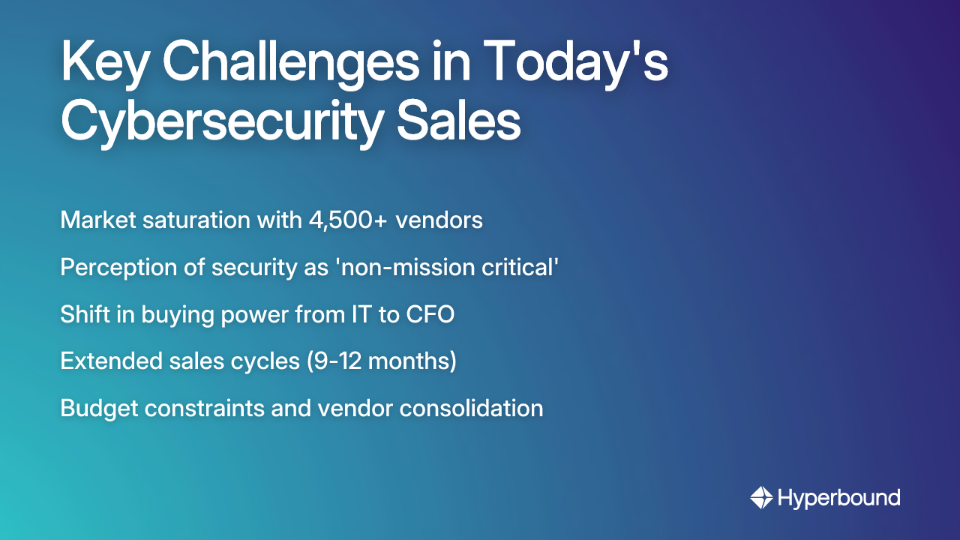
The cybersecurity landscape has become incredibly crowded. With over 4,500 vendors competing for attention, prospects are overwhelmed by options that all sound remarkably similar. Every solution claims to be "AI-driven," "next-generation," and "comprehensive" - creating a sea of sameness where differentiation becomes nearly impossible.
This oversaturation has created a perfect storm where even essential security tools like Identity Protection Software appear interchangeable to buyers. When every vendor uses identical buzzwords and promises similar outcomes, decision-makers struggle to see meaningful differences between offerings.
Meanwhile, industry consolidation continues as the "big seven" cybersecurity companies (including CrowdStrike and Palo Alto Networks) account for over 65% of the $200B+ industry. This concentration makes it even harder for innovative solutions to break through the noise.
Perhaps the most challenging obstacle facing cybersecurity sellers is the widespread perception that "the majority of cyber stuff on the market is fluff and absolutely not mission critical." Unlike ERP systems or Cloud Infrastructure that directly enable business operations, security solutions are often viewed as cost centers rather than revenue generators.
This perception manifests in frustrating ways:
While your prospects likely understand cybersecurity is important in theory, they often don't feel the urgency to act now. Unlike investments in Point of Sale (POS) Systems or Financial Software with clear and immediate ROI, security investments are viewed through the lens of risk avoidance - a much harder sell in financially constrained environments.
Perhaps the most significant shift is who makes the buying decision. Cybersecurity purchases were once primarily technical decisions made by IT departments and CISOs. Today, the CFO has emerged as the new power broker in cybersecurity procurement.
This shift changes everything about the sales conversation:
As one cybersecurity professional observed, "Management only understands things in terms of Business Risk." When the buying decision shifts from the server room to the boardroom, the language of bits and bytes must transform into the language of dollars and risk.
This evolution coincides with companies actively consolidating their security vendors. Most enterprises already utilize 15-30 security tools, making it extremely difficult to displace an existing solution that's perceived as "good enough," particularly when budgets for new initiatives are being frozen or slashed.
The challenges are real, but they also present an opportunity for elite sales professionals to differentiate themselves. Here are three proven strategies to thrive in today's challenging cybersecurity sales environment:
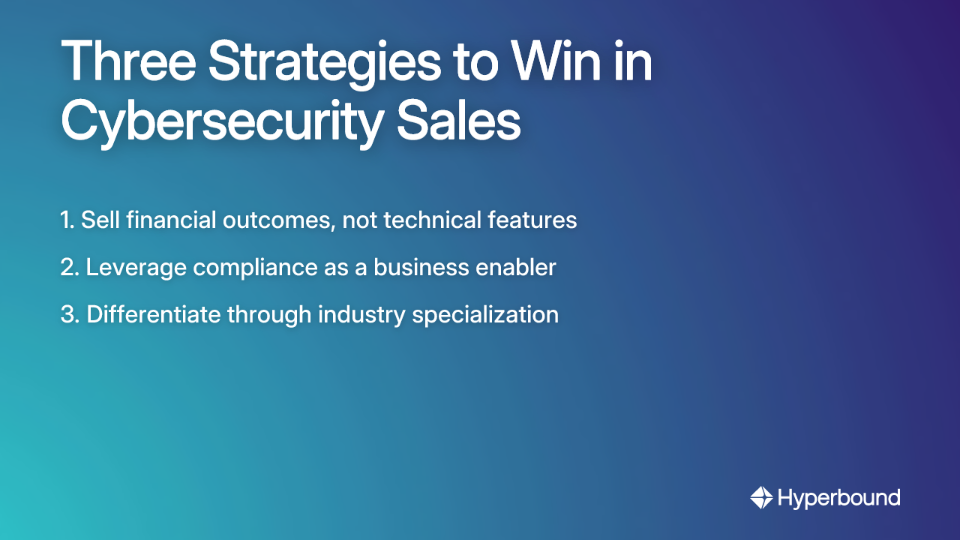
When selling to CFOs and business leaders, technical features become far less compelling than financial outcomes. Your AI-powered Analytics might be impressive from an engineering standpoint, but decision-makers care about how it translates to business value.
Actionable steps:
This approach directly addresses the "fluff" perception by anchoring your solution to tangible business outcomes rather than technical specifications.

While many view compliance as mere "checkbox theater," savvy cybersecurity sellers recognize that regulatory requirements can be powerful sales catalysts. Rather than positioning compliance as a burden, frame it as a business enabler that provides competitive advantage and risk mitigation.
Actionable steps:
In a commoditized market, specialization becomes a vital differentiator. Generic cybersecurity pitches get lost in the noise, while tailored approaches that demonstrate deep industry understanding cut through the clutter.
Actionable steps:
The cybersecurity sales landscape has undeniably become more challenging. Market saturation, the perception of security as "fluff," and the shift of buying power to the CFO have created a perfect storm for sales professionals. Yet these very challenges present an opportunity for those willing to adapt.
By shifting from feature-focused pitches to financial outcome discussions, leveraging compliance as a catalyst rather than a checkbox, and differentiating through specialization and trust-building, today's cybersecurity sellers can overcome the "commodity trap" and position their solutions as truly essential.
The most successful cybersecurity sales professionals will be those who evolve from product vendors to strategic advisors—partners who help organizations navigate complex risk landscapes while delivering measurable business value through their Compliance Software and security solutions.
As one industry expert aptly put it: "Embrace the challenge as an opportunity for growth. Consider this a pivotal moment to evolve into more effective sales professionals." In today's challenging market, that evolution isn't just beneficial—it's essential for survival and success.
Selling cybersecurity has become more difficult due to three main factors: extreme market saturation, the perception of security solutions as non-essential cost centers, and a shift in buying power from technical IT staff to budget-focused CFOs. With over 4,500 vendors, many products appear interchangeable, creating a "sea of sameness." Business leaders often view security as "fluff" rather than a mission-critical investment, delaying purchases. Most importantly, the final decision-maker is now often the CFO, who prioritizes financial ROI and risk management over technical features.
The key decision-maker in cybersecurity purchases has shifted from the IT department and CISO to the Chief Financial Officer (CFO). This shift means the sales conversation must change. Instead of focusing on technical specifications and features, salespeople must now emphasize financial outcomes, such as ROI, cost avoidance, and business risk reduction. The CFO's involvement often extends the sales cycle and requires a strong business case to justify the investment.
To sell cybersecurity effectively to a CFO, you must translate technical features into clear financial outcomes and business value. Instead of discussing AI-powered analytics, focus on how your solution reduces the average cost of a data breach, lowers insurance premiums, or ensures operational uptime. Create customized ROI models that show the potential financial impact of a security incident versus the cost of your solution. Frame the purchase as a strategic investment that enables business growth, not just an expense.
Leveraging compliance means positioning regulatory requirements not as a burden, but as a powerful business enabler and a catalyst for a security purchase. With regulations like the SEC's new disclosure rules, compliance is now a board-level concern. You can use this urgency to drive sales by showing how your solution helps meet specific mandates (like NIST or CMMC) and avoids costly non-compliance penalties. Furthermore, you can frame strong compliance as a competitive advantage that helps your prospect win business with their own enterprise clients.
Your cybersecurity solution can stand out in a crowded market by moving away from generic pitches and focusing on industry specialization and building trust. Instead of trying to sell to everyone, develop deep expertise in 2-3 key verticals. Tailor your messaging to address the unique security challenges and regulatory pressures of those specific industries. This allows you to differentiate yourself as a strategic advisor rather than just another vendor.
Prospects often perceive cybersecurity as "fluff" because, unlike systems that directly generate revenue or enable core operations (like ERP or POS systems), security is viewed as a cost center focused on risk avoidance. The return on investment for security is not always immediate or obvious, and the prevailing attitude is often "no one cares about security until they're breached." To overcome this, sellers must anchor their solutions to tangible business outcomes and demonstrate a clear financial case for the investment.











Use Cases
Legal