
A call recording shows what was said. It does not show what the rep was reaching for, what they never got around to asking, or whether the buyer actually confirmed the next step or just let it pass. That gap, between the transcript and the intent behind it, is the reason most frontline coaching stays reactive no matter how much call volume gets recorded. Recordings are diagnostic. They are not corrective. Understanding exactly where that line falls is the difference between a manager who reviews calls and a manager who changes them.
Frontline managers spend roughly 5 to 8 percent of their time coaching, and coaching is typically the first activity cut when pipeline pressure rises. Most managers listen to less than 1 percent of the calls their team records. That is not a discipline problem. It is a bandwidth problem: one manager, five to ten reps, and a stack of recordings that grows faster than any single person can review it.
Given that constraint, the honest question is not "should we record calls." Recording is the easy part, and nearly every sales organization already does it. The real question is what a manager can actually diagnose from the recordings that do get reviewed, and where that diagnosis runs out. Most conversation intelligence content skips this question because it is written for the buyer evaluating a platform, not for the manager sitting in the seat trying to figure out why a rep's numbers are soft. This piece is written for the seat.
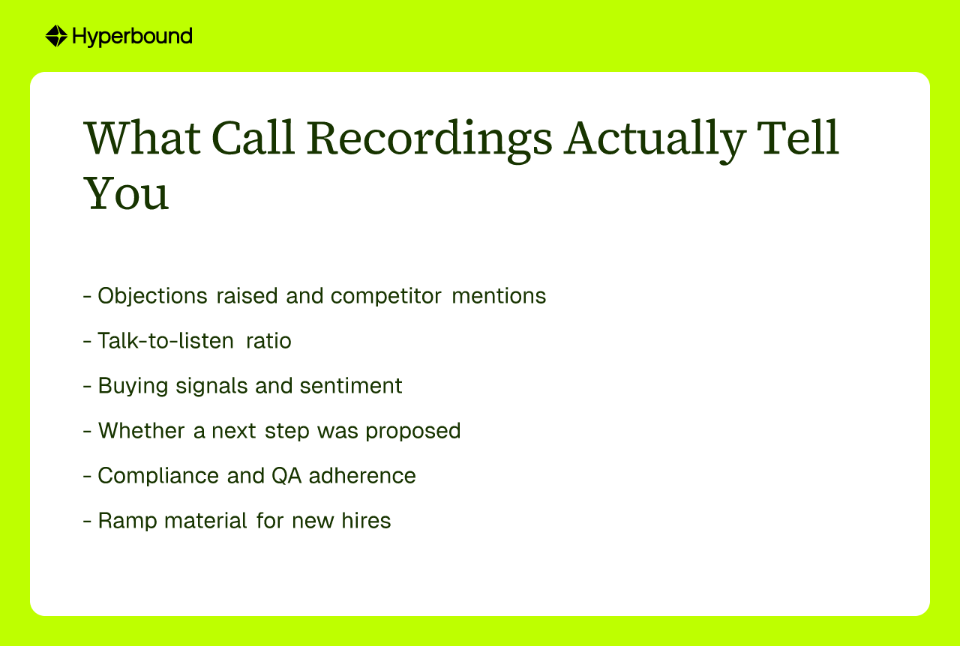
It is worth stating the strong case for recordings first, because it is a real case. Conversation intelligence turns a raw recording into structured, inspectable data: key topics, objections raised, competitor mentions, buying signals, sentiment, and talk-to-listen ratio. That is a legitimate and useful surface. A manager pulling up a call can see what the buyer pushed back on, whether a competitor came up, and how much of the call the rep spent talking versus listening.
Recordings also do real work beyond surveillance. They power coaching on objection handling and discovery; they flag pipeline risk when a deal has gone silent or an objection sat unaddressed; they inform messaging and content decisions; they support compliance and QA; and they are the raw material new reps use to ramp, because the fastest way to learn the job is to listen to someone doing it well.
None of that is in dispute. A manager who says "I can tell what my rep talked about and what came up" is right. The trouble starts one layer deeper, at the question the recording was never built to answer: not what was said, but what should have been said and was not.
Call-recording law in many jurisdictions means a large share of recorded calls are one-sided: the rep's audio is captured, the buyer's is not. This is not a vendor limitation. It is a legal constraint on what can be recorded at all. Frontline managers describe one-sided recordings as feeling close to useless, and the comparison holds: a one-sided recording is strictly inferior to a two-sided one for coaching, because half the conversation, the buyer's objections, hesitations, and actual words, simply is not there.
That sounds like a dead end, but it reframes rather than eliminates the manager's job. Even from a one-sided recording, a manager can still fully evaluate the rep's own behavior: whether the rep opened well, delivered the value proposition, asked real discovery questions, qualified correctly, told the right customer story, hit compliance disclaimers, and closed for a defined next step. There are typically five to ten of these behaviors per call type, and a scorecard is the mechanism for checking whether they happened. The legal constraint does not remove the manager's visibility into the rep's side of the conversation. It just draws a hard boundary around what "the recording" can be asked to prove.

The deeper failure mode is not legal, it is diagnostic. When a deal stalls, a manager reviewing the aftermath cannot easily tell whether the cause was lead quality, a skills gap, or a broken process. All three produce the same visible symptom: a cold pipeline and a rep with a plausible excuse.
This is the activity-versus-behavior distinction that most pipeline reviews collapse into a single number. Activity coaching asks whether a rep is doing enough: dials made, meetings booked, the things a dashboard already shows. Behavior coaching asks whether the rep is doing it right: whether the criteria that actually predict a close got covered on the calls that did happen. Managers default to activity because activity is dashboard-visible and behavior requires listening to the call, and no manager can listen to every call. The two questions are not close substitutes. Reps scoring above 70 percent on discovery methodology adherence win at roughly twice the rate of reps scoring below 50 percent, regardless of how many calls they made, and coaching-score trends predict quota attainment more reliably than activity trends do. A fifteen-point improvement in a coaching score outperforms a fifteen percent increase in call volume. Volume was never the lever. Whether the rep asked the right question was.
The cleanest illustration is the economic buyer. Whether a rep actually identified who signs the check is a question a CRM field cannot answer, no matter how well it is filled out. It is only judgeable by listening to the conversation, or by scoring it. A recording can supply that answer. A dashboard cannot.
Here is the boundary that most call-recording content quietly steps around: a recording is a record of what happened, not of what the rep was trying to do. It cannot show the question the rep meant to ask and lost the thread of when the buyer changed direction. It cannot show whether the "next step" at the end of the call was a real commitment or a polite deflection the rep chose not to push on. It cannot show the objection the rep saw coming and avoided because they did not have a confident answer ready.
This is the frontline manager's actual daily problem, described almost verbatim by managers themselves: every rep ends up running their own private version of the sales process, and the frustrating part is always finding out after the fact. A recording documents the aftermath. It does not catch the drift while it is still cheap to correct.
The obvious fix, coach the rep in real time instead of after the call, is not a clean win either, and it is worth engaging directly rather than waving past it. The logic is sound: post-call coaching only improves the next call, while real-time coaching improves the call happening now. That is a real advantage on paper.
But the common workarounds for delivering it are genuinely bad. A manager typing guidance into Slack while listening in is disruptive and slow, and it does not scale past one call at a time. Battle cards taped to a desk are static and blind to what the specific buyer just said. Feedback saved for a 1:1 three days later arrives after the deal has already moved, or died. And the more aggressive version of real-time coaching, a teleprompter feeding the rep lines to read off a screen, can undercut a competent rep's delivery: a rep reading words off a screen sounds like a rep reading words off a screen, and buyers notice. Hyperbound's approach instead surfaces the points to hit and leaves the wording to the rep.
There is a real tension underneath this, and one practitioner states it plainly: listening to recordings at all might already be too late, because real training happens live. The counterpoint is just as real: mid-call whisper coaching can break a rep's concentration at exactly the moment they need to be present with the buyer, and rehearsal built through repetition embeds a behavior more durably than an interruption does. Both are true. The resolution is not choosing between live and after-the-fact. It is choosing what gets delivered live, and making sure it is a read, not an interruption.
That is what methodology-based live scoring already does in practice: calls get auto-scored against a defined framework, MEDDIC, BANT, Challenger, or a custom playbook, and the manager sees covered-versus-missed criteria as the call unfolds rather than a script fed into the rep's ear. The category has split into distinct approaches: methodology scoring, script-adherence tools, behavioral and tone analysis, and enterprise QA platforms, and even tools built for live cue cards have only limited auto-scoring behind them. The gap in the market is not "does real-time coaching exist." It is that a live score sitting in a separate tool, disconnected from the same scorecard used in training and the same playbook the rep was actually prompted on, becomes a second data silo that the coaching program, the deal review, and the manager's 1:1 never see.
This is the point most call-recording and real-time-coaching content misses, because it treats "record the call" and "score the call live" as two separate product categories rather than two ends of one loop. They are not separate. The value shows up specifically when the criteria a manager scores a live call against are the identical criteria the rep was drilled on before ever getting on the phone.
The mechanism is coaching compression: closing the distance between when a gap appears in a rep's execution and when a manager can name it. When the scorecard used to grade a live call is the same scorecard used in practice roleplays, a manager reviewing performance is not inferring a skill gap from a transcript days later. They are watching whether the rep ran the exact discovery sequence, objection response, or qualifying question they were trained on, at the moment it mattered. That is the Practice → Perform loop: score real calls, identify the specific gap, send the rep back to practice on that exact gap, then re-score. It replaces the guesswork of "something went wrong in that call" with a specific, actionable answer to "which behavior, from which part of the playbook, did not show up."
The bandwidth math changes too. A manager does not need to listen to every call to know whether a rep is running the process, because the scorecard, not the manager's ear, is doing the first pass. Staff Domain saw a 300% increase in meetings after adopting Hyperbound. ALKU cut time to first deal from six months to three months after adding Hyperbound Perform. Klaviyo saw a 42% increase in new-hire PPR. None of these are recording upgrades. They are cases of the same playbook following the rep from rehearsal into the live call, so the manager's review and the rep's training are finally reading from the same page.
This is also where Hyperbound's Live Call Coaching launch matters for how this category should be read going forward. Live call coaching as a category is still young, roughly eighteen months old, and the early attempts struggled for a structural reason: bolting a live layer onto a recording tool without connecting it to how reps were trained produces exactly the disconnected-silo problem described above, a live score nobody's coaching program actually uses. A rep who gets a competitor named twelve minutes into a discovery call needs the response that connects to what they rehearsed, not a generic prompt disconnected from their own training history.
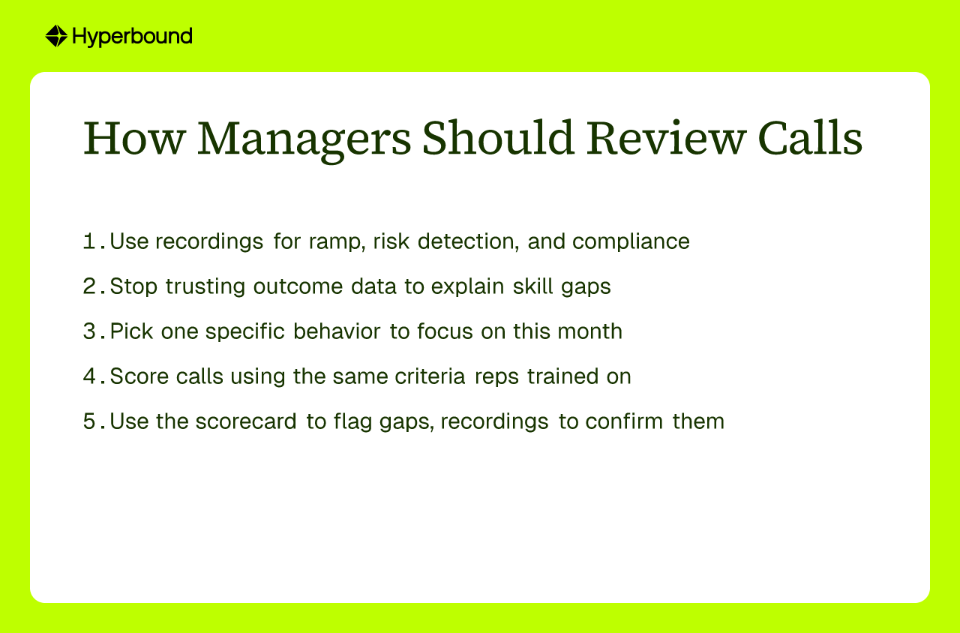
None of this argues against recording calls. Recordings remain the correct tool for ramping new reps against top performers, for pipeline risk detection when a deal has gone quiet, for messaging decisions, and for compliance review. What it argues against is treating a recording archive as a substitute for knowing, in the moment, whether a rep ran the play they were trained on.
The practical shift for a frontline manager reviewing calls this week is narrower than it sounds: stop trying to listen to everything, and stop trusting outcome data to explain a skill gap it was never built to explain. Pick the specific behavior that matters this month, score a handful of calls against it using the same criteria reps were trained on, and treat the recording as confirmation of a gap the scorecard already flagged rather than the tool doing the flagging. That single change, scoring against the same playbook end to end, is what turns a recording from a record of what already happened into a lever a manager can actually pull before the next call, not after it.

A call recording shows what was said, including objections, competitor mentions, talk-to-listen ratio, buying signals, compliance issues, and whether a next step was proposed. It does not show what the rep intended to ask, how the buyer actually responded beyond the transcript, or whether the next step was a real commitment.
Most frontline managers listen to less than 1 percent of the calls their team records. Coaching takes only 5 to 8 percent of manager time, and call review is often the first activity cut when pipeline pressure rises.
Recordings are diagnostic, not corrective. They document what happened but cannot reveal the rep's intent, the question they avoided, or whether a buyer's "yes" was real or polite deflection. Coaching improves only when a manager turns that evidence into a specific behavior change.
Activity coaching asks whether reps are doing enough, such as dials made and meetings booked. Behavior coaching asks whether reps are doing it right, such as whether they asked discovery questions, identified the economic buyer, or closed for a defined next step. Behavior coaching is the stronger predictor of quota attainment.
Managers can use a scorecard built from the same playbook reps trained on to score live calls and flag gaps automatically. That scorecard, not the manager's ear, does the first pass, and the manager reviews only the calls or moments where a specific behavior did not show up.
One-sided recordings capture only the rep's audio, so the buyer's objections, hesitations, and actual words are missing. A manager can still evaluate the rep's side of the conversation, such as discovery questions and closing behavior, but cannot use the recording to prove what the buyer said.
Live call coaching gives reps real-time guidance during a call, such as prompts, cues, or scoring against a methodology. It is most effective when the guidance connects to the same playbook and scorecard the rep practiced before the call; otherwise it becomes a disconnected second silo.
Use one scorecard for practice roleplays, live call scoring, and post-call review. When reps are trained against the same criteria that later score their live calls, managers can see exactly which behavior from the playbook did not show up and send the rep back to practice that specific gap.










Use Cases
Legal