
Revenue activation is the operational layer between sales insight and sales outcome. It is what happens when you stop watching call data and start using it to change what reps do before the next conversation. The results are hard to ignore. Under CRO Stevie Case, Vanta reduced sales ramp time by 60%, cutting the average from 210 days down to 72. That same approach helped build a $125 million pipeline. That is not a dashboard metric. That is a revenue outcome.
So what is revenue activation, exactly? And why can't your current call recording tool deliver it?
Before defining the category, it helps to clear away what it is not. Three familiar tools often get confused with revenue activation. They are not the same thing.
It is not call recording.
Call recording and conversation intelligence (CI) tools do one thing well: they document what happened. They transcribe calls, surface keywords, and build libraries of past conversations. That is genuinely valuable. But recording alone does not provide insights on deal qualification or recommended next steps. It captures the past. It does not change the future.
Sales reps feel this gap acutely. On Reddit's r/Sales_Professionals, one user summed it up: "I still heard their post call workflows aren't it." Another added: "Most tools that claim to do everything do recording and transcription well but the CRM push is clunky." Data in, nothing actionable out.
It is not sales forecasting.
Forecasting tools predict pipeline outcomes based on historical patterns. They are built for planning conversations, not execution ones. Revenue activation is not about predicting what will happen. It is about actively shaping what happens during sales engagements before and after each conversation.
It is not traditional sales enablement.
Classic enablement delivers content: playbooks, battle cards, slide decks, certifications. It prepares reps in theory. Revenue activation is what ensures that preparation translates into real-time execution and adaptation. Having a playbook is not the same as running the play.
Revenue activation is not a single feature. It is an operational discipline with three distinct components working together.
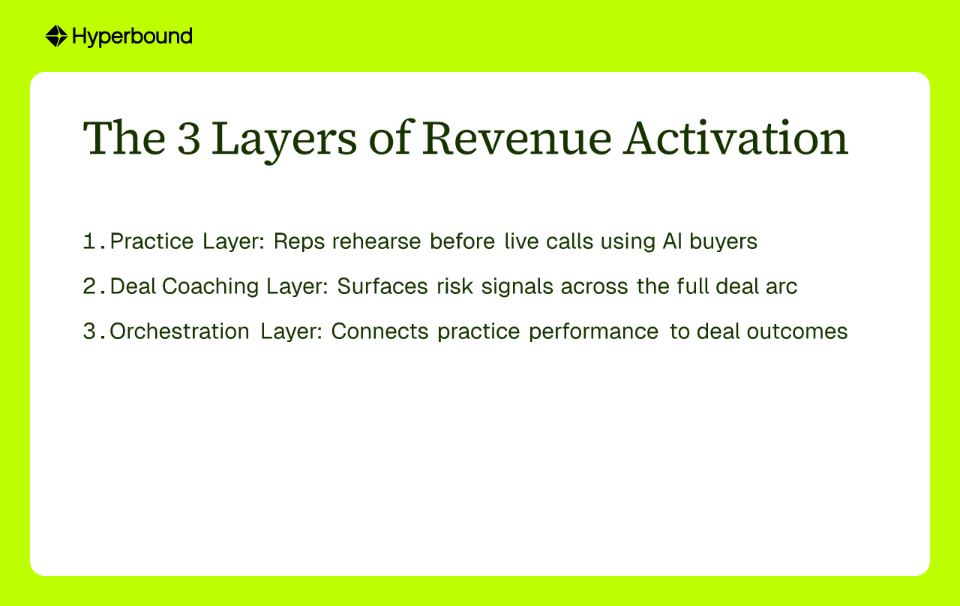
This is where reps rehearse before live calls. Instead of learning from a lost deal in retrospect, reps practice against AI-generated buyers built from the company's own call recordings and top-performer data. They test messaging, handle objections, and build muscle memory before the conversation counts.
The shift is from post-call analysis to pre-call preparation. One sales rep on r/sales put it plainly: "most 'AI coaches' are just fancy dashboards with alerts." The practice layer is the opposite. It is a repetition engine, not a reporting engine.
This layer provides guidance across the full arc of a deal, not just on a single call. It reads behavioral signals across the deal lifecycle to surface risk and recommend next actions.
Is the rep failing to multi-thread? Has next-step confirmation dropped off? Is the economic buyer disengaged? These signals appear before the deal is lost, not after. Managers get a real-time view of pipeline health tied to rep behavior, not just CRM fields.
This is the connective tissue. AI connects practice performance to deal data and recommends tailored interventions. If a rep consistently stumbles on pricing objections in practice sessions, the system surfaces that pattern when a pricing conversation is coming up. It creates a closed loop between what a rep does in practice and how they perform on live deals.
This is the layer that solves what so many sales reps describe: the frustration of "switching is annoying, and I just want one place it all happens." Orchestration connects the dots so managers and reps do not have to.
Sales teams have never had more data. Calls are recorded. Transcripts are searchable. Dashboards show talk ratios, sentiment scores, and keyword trends. And yet, quota attainment has been declining industry-wide.
This is the central paradox. Record investments in conversation and competitive intelligence have not translated into better outcomes. Merely having more data does not lead to better sales outcomes.
The missing piece is activation. Companies are data-rich but action-starved. They know what their best reps do differently. They have libraries of winning calls. But that insight sits in a folder, not in the behavior of the rep who needs it most.
Revenue activation closes that gap. It takes the insight that already exists in your call data and builds a system that puts it to work before the next conversation happens.

Here is what this looks like in real sales workflows.
Vanta
Before a key demo, a Vanta rep practices against an AI buyer trained on the company's top-performing discovery calls. The system identifies that the rep is talking too much and not asking enough qualifying questions. The rep adjusts before going live. The conversation improves. This is not post-call review. This is pre-call preparation powered by real sales data. Across the team, that behavioral change added up to a 60% reduction in ramp time and a $125 million pipeline.
Nivoda
A manager at Nivoda sees a flag on a high-value deal. The deal coaching layer has detected that the rep has not confirmed the economic buyer's attendance at the next meeting. The manager pulls the rep into a quick deal clinic. Together, they build a plan to re-engage the right stakeholder before the deal goes cold. The insight came from automated behavioral signal detection. The action came from a targeted human conversation. That is revenue activation managing deal risk in practice.
Both examples share the same structure. Data from past conversations is used to change rep behavior before the next conversation. No passive dashboards. No alerts that go unread. Actual workflow changes tied to actual outcomes.
Revenue activation does not replace conversation intelligence. It depends on it.
CI is the input. It captures what happened in a sales conversation, transcribes it, and makes it searchable and analyzable. That is essential. Without it, there is no signal to act on.
Revenue activation is what you do with that input. CI provides the raw data from conversations, while revenue activation focuses on the strategic application of that data. One is the game tape. The other is the practice field, the coaching staff, and the in-game adjustments.
Think of it this way. A conversation intelligence tool records your calls and tells you what your top performers do differently. That is valuable. Revenue activation takes that insight and builds AI buyers that let every rep practice those behaviors before the next call.
Platforms like Hyperbound are built to be this operational layer. They ingest data from CI tools and use it to power the practice, deal coaching, and orchestration layers that drive real behavior change. The goal is not to replace your CI investment. It is to finally put it to work.
Revenue activation is the answer to the question every CRO eventually asks: "We have all this call data. Now what?"
The answer is not more dashboards. It is not better transcripts. It is an operational system that takes what your best reps do, builds it into a practice environment, surfaces deal risk before it becomes deal loss, and orchestrates interventions that change what reps do next.
Most AI coaching tools are still fancy dashboards with alerts. Revenue activation is the next step: turning passive insight into active behavior change at the rep level, the deal level, and the team level.
Vanta did not reduce ramp time from 210 days to 72 by watching more calls. They built a system that changed what reps did before those calls ever started.
That is what revenue activation does. And that is why your call recording tool cannot do it alone.
Revenue activation is an operational system that turns insights from sales call data into practical actions for sales reps, helping them improve their performance before their next customer conversation. It bridges the gap between analyzing past calls (insight) and improving future calls (outcome). Instead of just providing dashboards and reports on what happened, it creates a structured environment for practice, offers real-time deal coaching, and connects training performance to live deal outcomes to drive behavior change.
Conversation intelligence (CI) records and analyzes past conversations, while revenue activation uses that analysis to proactively change future conversations. Think of CI as the "game tape"—it shows you what happened. Revenue activation is the "practice field" and the "coaching staff." It takes the insights from the game tape and builds AI-powered practice scenarios and deal-level guidance to ensure reps are prepared to execute effectively. It's the action layer that sits on top of the data layer provided by CI.
A revenue activation platform typically consists of three core layers: a Practice Layer, a Deal Coaching Layer, and an Orchestration Layer. The Practice Layer lets reps rehearse against AI buyers before live calls. The Deal Coaching Layer analyzes behavioral signals across the entire deal lifecycle to identify risks and suggest next steps. The Orchestration Layer connects the practice and coaching layers, linking rep performance in practice to real-world deal outcomes for targeted interventions.
Revenue activation is important now because sales teams are overwhelmed with data from call recordings but are struggling to translate that data into better sales performance, as shown by declining quota attainment. Companies have invested heavily in tools that generate data and insights, creating a "data-rich, action-starved" environment. Revenue activation solves this by providing a system to operationalize those insights, ensuring that the knowledge of what works is actively applied by the entire team.
AI is central to revenue activation, primarily by creating realistic practice environments and automating the analysis of sales behaviors to provide timely coaching. In the practice layer, AI generates dynamic "AI buyers" from your company's own call data, allowing reps to rehearse against lifelike scenarios. In the deal coaching and orchestration layers, AI analyzes signals across CRM data and conversations to flag deal risks, identify skill gaps, and recommend personalized coaching interventions.
Companies using revenue activation have achieved significant business outcomes, including drastically reduced sales ramp time, larger pipeline generation, and improved deal management. For example, Vanta used a revenue activation approach to cut its new sales rep ramp time by 60%, from 210 days down to just 72. This same strategy also helped them build a $125 million pipeline by ensuring reps were better prepared for every conversation.
No, revenue activation does not replace traditional sales enablement; it enhances it by ensuring the theoretical knowledge from enablement is effectively applied in real-world sales situations. Traditional enablement provides the foundational content—playbooks, battle cards, and training. Revenue activation provides the operational tools to practice and apply that content in a safe environment and receive coaching on its execution during live deals. It makes enablement more effective by bridging the gap between knowing what to do and actually doing it consistently.











Use Cases
Legal