
You've launched your startup. You've built a great product. Now you're running sales yourself and feeling completely lost in the chaos of sporadic outreach, missed follow-ups, and inconsistent results.
Sound familiar?
If you're nodding your head, you're not alone. Many founders find themselves in this exact position – trying to juggle product development, fundraising, and now the daunting task of systematically generating sales conversations without a dedicated team.
Enter sales sequences: your map and compass in the wilderness of startup selling.
A sales sequence (sometimes called a sales cadence) is a pre-planned series of touchpoints executed through various channels – email, phone calls, social media messages, SMS, and even voicemail drops – designed to engage prospects and generate meaningful conversations.
Unlike random outreach efforts, a sales sequence follows a structured timeline with specific actions scheduled at strategic intervals. The goal isn't just to blast your message into the void; it's to create genuine engagement opportunities with qualified prospects.
Research shows that the most effective sales sequences contain at least 8 touchpoints over a span of 10 days. This systematized approach eliminates the guesswork from your outreach process – you'll always know exactly which prospects need attention and what action to take next.
Sales sequences can be triggered by specific prospect actions (like downloading content or attending a webinar) or simply by adding a prospect to your target list. Modern sales sequence software then automates the repetitive aspects of this outreach while maintaining a personalized feel.
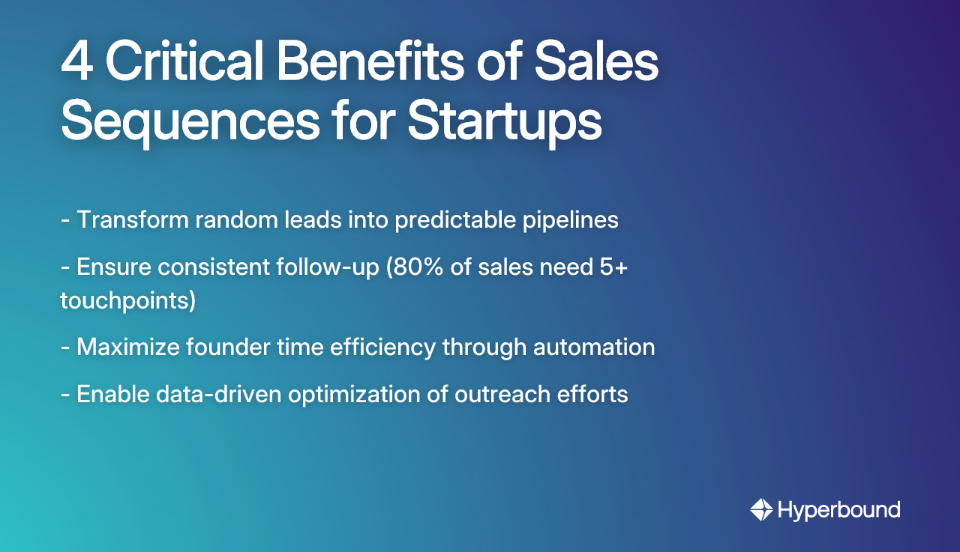
For early-stage companies with limited resources, sales sequences aren't just a nice-to-have tool – they're a crucial competitive advantage. Here's why:
A well-crafted sales sequence transforms random leads into a predictable, qualified customer pipeline. Instead of hoping prospects respond to your one-off emails, you're implementing a proven system that consistently moves prospects toward conversations and demos.
Consider this sobering statistic: 80% of sales require five follow-up calls after the initial contact, yet 48% of salespeople never make a single follow-up attempt. Without a systematic approach to follow-up, you're potentially leaving the majority of your sales on the table.
Sales sequences automate this persistence, ensuring no prospect falls through the cracks simply because you got busy or forgot to follow up.
As a founder, your time is your most precious resource. Sales sequences automate the repetitive aspects of outreach, allowing you to focus on high-value activities like personalizing key messages, conducting demos, and closing deals.
With structured sequences, you can measure exactly what's working and what's not. You'll track key metrics like open rates, response rates, and conversion rates to continuously refine your approach – something impossible with ad hoc outreach.
One of the most common points of confusion for startups is understanding the difference between sales sequences and marketing emails. Using them interchangeably can damage your deliverability and confuse your prospects. Here's how they differ:
.png)
Organizations often face issues when both Sales and Marketing teams email the same contacts, leading to confusion and potential deliverability problems. To avoid this, establish a Service Level Agreement (SLA) between functions and use suppression lists in your marketing tool to exclude contacts currently in an active sales sequence.
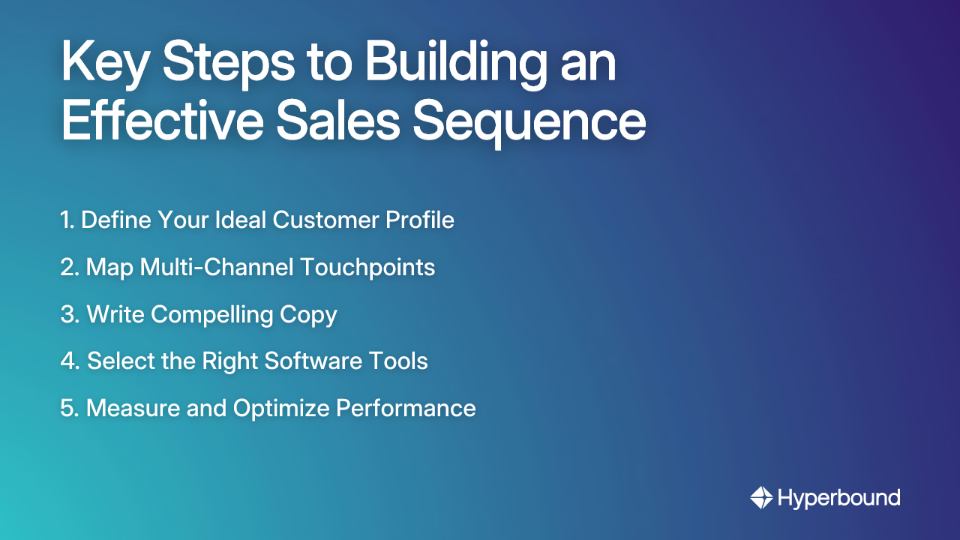
Ready to build your first sales sequence? Follow these steps to create an outreach strategy that generates consistent results:
Before writing a single email, get crystal clear on who you're targeting. As one sales expert notes, "If you additionally add Buyer Personas, Customer Segments and Value Proposition Canvas, you will beat 99% of competitors."
Document your ideal customer's:
A powerful sales sequence leverages multiple channels to meet prospects where they are. Here's an example of an effective cold outbound sequence template:
The effectiveness of your sequence hinges on the quality of your messaging. Follow these best practices:
With numerous sales outreach tools on the market, selecting the right one can be overwhelming. An effective toolkit combines two critical elements: a platform to practice and perfect your messaging, and software to automate the delivery of that message. Here's a look at options to build your stack.
Before you automate any outreach, your messaging must be compelling and effective. Hyperbound is an AI Sales Coaching platform that helps your team master the conversations that happen within your sequences.
Pros:
Cons:
Once your messaging is dialed in, these platforms can help you execute your sequences at scale. Here’s a comparison of popular options based on real user experiences:
Pros:
Cons:
Pros:
Cons:
Pros:
Cons:
Pros:
Cons:
To maximize the effectiveness of your sales sequences, implement these proven best practices:
Time your outreach strategically:
Structure your messages with this powerful framework:
Continuously monitor key metrics like open rates, click-through rates, lead conversion rates, and sales cycle length. Use this data to A/B test different subject lines, CTAs, and timing to refine your approach.
The sales automation tools you choose should provide clear analytics on your sequence performance, allowing you to identify which touchpoints drive the most engagement.
Sales sequences are not just another marketing tactic – they're a fundamental strategy for startups to build a scalable and predictable sales engine. By implementing structured outreach, you bring order to the chaos of sales development and ensure no qualified lead falls through the cracks.
You don't need a complex, expensive setup to start. Begin with a simple sequence, choose a tool that fits your budget, and focus on providing value in every interaction. The investment in creating a structured process will pay dividends in growth, efficiency, and peace of mind.
Remember: in the early days of your startup, consistent, persistent outreach is often the difference between struggling for traction and building the momentum that leads to sustainable growth. Sales sequences give you the framework to make that consistency possible – even as a team of one.
A sales sequence is a series of pre-planned, automated touchpoints across multiple channels (like email, phone, and social media) designed to engage a prospect and start a sales conversation. Unlike random outreach, it follows a specific schedule and logic to ensure persistent and consistent follow-up. The primary goal is to move a qualified prospect from initial contact to a meaningful interaction, such as a demo or meeting.
Sales sequences are crucial for startups because they transform unpredictable sales efforts into a consistent, scalable, and measurable pipeline. They automate follow-ups (where most sales are made), maximize the founder's time by handling repetitive tasks, provide clear data on what messaging works, and ensure no potential lead is forgotten or ignored.
To create an effective sales sequence, you must first clearly define your Ideal Customer Profile (ICP), then map out a multi-channel series of touchpoints, write personalized and compelling copy for each step, and finally, use software to automate and measure the process. The process starts with understanding who you're targeting. From there, build a mix of emails, calls, and social media interactions over 10-14 days. Each message should be personalized, concise, and have a clear call-to-action.
The main difference is intent and personalization: a sales sequence is a 1-to-1 conversational tool for engaging specific prospects, while a marketing email is a 1-to-many broadcast for brand awareness or announcements. Sales sequence emails are typically text-based and highly personalized, aiming to start a dialogue. Marketing emails are often HTML-designed and sent to a broad list of subscribers with more general content like newsletters or promotions.
An effective sales sequence should have at least 8 touchpoints spread out over several days. Research shows that the majority of sales require multiple follow-ups. A sequence with 8-12 touchpoints across different channels (email, phone, LinkedIn) over a 10-14 day period provides enough persistence to engage busy prospects without being overly aggressive.
A prospect should be removed from a sales sequence immediately after they respond positively, such as by booking a meeting or replying with interest. The sequence's job is done once a conversation has started. Prospects should also be removed if they explicitly ask to be, or after the sequence ends with no response. Automation rules in your sales software can typically handle this process automatically to ensure a smooth transition to a personal conversation.
You should track key metrics like open rates, reply rates, click-through rates, and ultimately, the meeting booked or conversion rate for each sequence. These metrics help you understand what's working. A high open rate but low reply rate might indicate a weak call-to-action. By A/B testing different elements (like subject lines or message content) and monitoring these KPIs, you can continuously optimize your outreach for better results.









Use Cases
Legal