
In today's distributed work environment, virtual is here to stay—but most sales training hasn't kept pace. Many organizations still rely on passive webinars and outdated methodologies that fail to build real-world skills. The result? According to research from RAIN Group, only 16% to 34% of sellers are effective in critical virtual selling areas, with buyers reporting challenges like poor engagement (23%) and ineffective collaboration (34%).
If you've tried using generic AI tools like ChatGPT for sales practice, you've likely experienced the frustration of an AI that "just agrees and tells me why I'm right" rather than providing realistic pushback. This disconnect between training and reality leaves your team underprepared for actual customer conversations.
The solution? AI-powered roleplays that function as a "flight simulator for sales," allowing reps to practice, fail, and learn in a safe, repeatable environment. Let's explore seven practical techniques to integrate AI roleplays into your virtual sales training program and drive measurable performance improvements.
.png)
The foundation of effective virtual sales training is providing reps with 24/7 access to practice environments that cover the entire sales cycle. This is especially valuable when transitioning reps from inbound to outbound roles, where structured practice tools can dramatically accelerate skill development.
Implementation Steps:
Expected Outcomes:
The true test of a sales rep isn't the easy call—it's how they handle pushback. Generic AI often fails here with responses that are too agreeable or unrealistic. Advanced AI simulations can recreate the pressure and unpredictability of real objections.
Implementation Steps:
Expected Outcomes:
Learning happens fastest with immediate feedback. In a virtual environment, reps can't wait days for a manager to review a call. AI coaching provides instant, objective feedback that accelerates the learning loop.
Implementation Steps:
Expected Outcomes:
Free up sales managers from the tedious task of call reviews so they can focus on high-impact strategic coaching. Use AI to identify both coachable moments and winning behaviors that can be scaled across the team.
Implementation Steps:
Expected Outcomes:
For mission-critical calls (e.g., a final demo, a pricing negotiation), reps need more than a quick review of their notes. A final "dress rehearsal" with a tailored AI persona can be the difference between winning and losing a deal.
Implementation Steps:
Expected Outcomes:
When you launch a new product or change your messaging, "telling" the sales team is not enough. You need to ensure they can articulate it effectively. AI roleplays provide a scalable way to certify readiness.
Implementation Steps:
Expected Outcomes:
Sales training shouldn't stop after the initial deal is closed. Customer Success and Account Management teams face their own set of challenging conversations that directly impact revenue retention and growth.
Implementation Steps:
Expected Outcomes:
To justify investment and drive continuous improvement, you must measure the impact of your training. A robust measurement framework looks at both leading and lagging indicators:
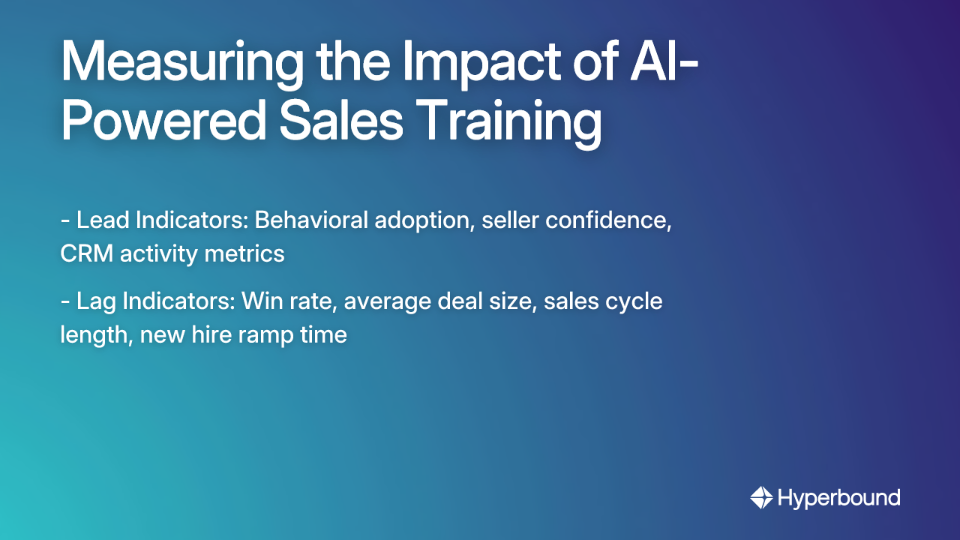
Lead Indicators (Are behaviors changing?):
Lag Indicators (Is it impacting the business?):
In the world of virtual employee sales training, the most effective programs are shifting from passive information delivery to active skill development. The seven techniques outlined provide a roadmap for this transformation.
AI roleplays offer a scalable, measurable, and engaging way to ensure your remote sales team is always prepared for the next conversation. They solve the critical problem of providing realistic, on-demand practice that builds real muscle memory.
Don't let your virtual training be a forgotten recording. Turn it into a competitive advantage.
AI-powered sales roleplay is a training technology that uses artificial intelligence to simulate realistic customer conversations. It acts as a "flight simulator for sales," allowing reps to practice calls, handle objections, and refine their messaging in a safe, on-demand environment without needing a manager or peer to participate.
AI roleplay is more effective because it provides active, repeatable practice rather than passive learning. Unlike webinars, it's interactive. Unlike peer roleplays, it's available 24/7, offers unbiased feedback, and can be scaled consistently across an entire sales organization, ensuring every rep masters the core playbook.
AI helps reps master objection handling by providing a space to practice without risk. You can create scenarios with the most common and difficult objections your team faces. The AI can be programmed to be skeptical and ask tough follow-up questions, moving reps from memorizing scripts to internalizing effective frameworks for any pushback they encounter.
Effective AI roleplay platforms allow for deep customization. You can tailor scenarios by creating custom AI buyer personas that match your Ideal Customer Profiles (ICPs), inputting your specific product information, common objections, and integrating your company's unique sales methodology into the AI's scoring and feedback system.
A specialized AI sales training tool is purpose-built for skill development, while a generic AI is designed for broad conversation. Specialized tools provide realistic pushback, score performance against a custom sales framework, track progress over time, and provide analytics for managers. Generic AIs often agree with the user and cannot provide the structured, objective feedback needed for effective coaching.
The entire revenue team can benefit. New hires can use it to reduce ramp time and build foundational skills. Tenured reps can refine techniques for high-stakes meetings or new product launches. Post-sales teams, like Customer Success and Account Managers, can practice renewal conversations, upsell pitches, and handling difficult customers.
The ROI is measured using a combination of leading and lagging indicators. Leading indicators show behavioral change, such as improved scores in the AI platform and increased seller confidence. Lagging indicators measure business impact, including increased win rates, larger average deal sizes, shorter sales cycles, and faster new hire ramp times.

Ready to build a top-performing virtual sales team? See a demo of Hyperbound's AI Sales Coaching Platform and experience the future of sales training today.








Use Cases
Legal