
You've just launched a virtual sales coaching program, and your team's skepticism is palpable. The eye-rolls during Zoom calls, complaints about "death by PowerPoint," and whispers of "this would be better in person" are hard to miss. Meanwhile, you're wondering if all this technology is actually helping or just creating distance between you and your team.
Here's the truth that most sales leaders miss: virtual coaching isn't just a compromise—it's an upgrade when executed correctly. The most forward-thinking sales organizations have discovered that remote coaching, powered by the right techniques and technology, doesn't just match traditional in-person training—it surpasses it in measurable, revenue-generating ways.
This isn't about making the best of remote work. It's about leveraging virtual tools to create coaching experiences that were impossible in the conference room.
Traditional in-person coaching relies heavily on the manager's subjective observations and memory. Did they catch that awkward transition? Did they notice how many times the rep said "um"? Did they accurately assess talk-to-listen ratios? Probably not.
Virtual sales coaching paired with AI conversation intelligence transforms this guesswork into precision feedback.
Platforms like Hyperbound use AI to analyze both live calls and recordings, delivering data-driven insights that human coaches simply cannot track manually. By integrating with video conferencing platforms, tools like Hyperbound and Gong can automatically score calls against your sales methodology and highlight:
The results speak for themselves. Organizations implementing AI-powered coaching see a 20-25% improvement in rep proficiency and 15% faster ramp time for new hires.
But what about the common objection that "AI provides knowledge but lacks the ability to execute sales actions effectively"? The best implementation doesn't replace the human coach—it supercharges them. AI handles the diagnostics, while your coaches focus on the development strategies that require human intuition and experience.
The most valuable coaching doesn't always happen in scheduled sessions. Virtual environments enable something in-person training can't match: asynchronous learning experiences that create "a low-stakes space to practice high-stakes moments," as one sales leader aptly described on Reddit.
Here's how to implement this approach:
Recorded Call Analysis: Have reps record their sales calls (with client permission) for later review. This creates a library of real-world examples that becomes an invaluable training asset. Coaches can provide detailed feedback without the pressure of live observation, while reps can revisit and reflect on their performance objectively.
AI-Powered Simulation: Advanced platforms like Hyperbound create hyper-realistic role-play environments where reps can practice conversations with AI buyer personas that respond dynamically to their approach. This allows for:
Companies using AI simulation for sales training have seen an accelerated onboarding process by over 50% compared to traditional methods.

Microlearning Modules: Break down complex sales concepts into digestible, 5-10 minute video modules that reps can access on-demand. This approach respects different learning paces and prevents the information overload that so often occurs during full-day in-person training events.
As one Reddit user complained about traditional training: "Overwhelming new hires with too much information via email leads to confusion and disengagement." Microlearning solves this by delivering the right information at the right time.
We've all suffered through those "PowerPoint lessons everyone hates" that one sales rep mentioned in a forum discussion. Virtual training earns its negative reputation when it becomes a passive experience. The antidote? Deliberately engineering interactive elements that surpass what's possible in physical training rooms.
Mandate Camera Usage: According to The Good Coach, requiring cameras creates accountability and allows coaches to read body language and engagement levels. Make this non-negotiable for training sessions.
Implement Rapid-Fire Engagement Tactics:
Gamify Learning Experiences: As recommended by sales professionals on Reddit, "make it as fun and engaging as possible" by incorporating competitive elements. This might include leaderboards, badges for skill mastery, or team-based competitions that simulate real-world sales challenges.
The interactive capabilities of virtual platforms allow for engagement techniques that would be logistically impossible in traditional settings. When properly leveraged, these create more memorable, impactful learning experiences.
The most sophisticated sales technology fails without a foundation of trust between coach and rep. This human element becomes even more critical in virtual environments where physical distance can create emotional distance.
Make Coaching Conversations Coachee-Centric: Training Industry emphasizes that effective coaching requires vulnerability. Begin sessions by focusing on the rep's personal goals and aspirations, not just the company's quota expectations. Ask questions like:
Use Reflective Questioning: Rather than telling reps what they did wrong, guide their self-discovery with questions that promote reflection:
Foster Psychological Safety: According to research by Pfeffer and Sutton in "The Knowing-Doing Gap," people learn best when they feel safe to make mistakes. AI-powered role-play environments are a perfect example of this principle in action, providing a space for reps to practice and fail without risking live deals. In all virtual coaching, this means:
This approach directly addresses the concern that "AI cannot provide the emotional support and mindset coaching that human sales coaches offer." While technology enhances the process, the human connection remains irreplaceable.
.png)
The final advantage of virtual sales coaching is the ability to build a systematized, repeatable process supported by an integrated digital toolkit. This creates consistency that in-person coaching—often dependent on individual manager styles—struggles to achieve.
Essential Components of Your Virtual Coaching System:
Ensure Technical Readiness: The Good Coach recommends contacting participants 24 hours before sessions to confirm technology readiness and establish a backup communication plan in case of technical issues.
Continuously Evolve Your Approach: Treat your virtual sales coaching program as a living system. Regularly gather feedback, analyze performance metrics, and refine your methods. The digital nature of virtual coaching provides data points impossible to capture in traditional settings, allowing for more precise program optimization.
Beyond the performance benefits, virtual sales coaching delivers undeniable financial advantages:

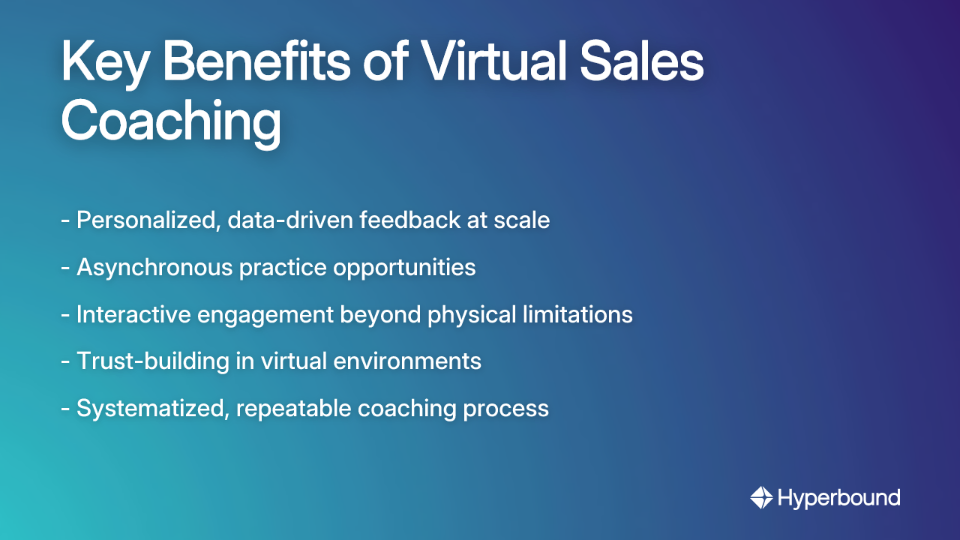
The most effective sales organizations aren't looking back at in-person training with nostalgia—they're embracing the superior capabilities of virtual sales coaching enhanced by cutting-edge technology. By leveraging AI for data-driven insights, creating asynchronous practice opportunities, engineering high-engagement live sessions, intentionally building trust, and systematizing the entire process, they're creating learning experiences that traditional methods simply cannot match.
The future of sales excellence isn't found in a conference room. It's in the powerful combination of human coaching expertise and digital capabilities that virtual environments uniquely enable. The question isn't whether virtual sales coaching can be as good as in-person training—it's how quickly your organization will embrace the techniques that make it demonstrably better.










Use Cases
Legal