
The majority of M&A value destruction doesn't happen in the boardroom. It happens in the field — in the 90 days after the deal closes, when your sales reps are updating their résumés instead of updating their CRM, when customers are getting two different pitches from two different reps, and when deals are quietly dying because no one can answer the question, "So... what does the combined company actually do?"
According to McKinsey's research on sales force integration, the sales organization is the primary source of post-merger value leakage — through lost deals, rep attrition, and customer confusion. And the clock starts ticking the moment the press release drops.
You're not just merging two pipelines. You're merging two methodologies, two tech stacks, two comp plans, and two deeply ingrained sets of habits. Meanwhile, your reps are fielding questions from prospects, fielding calls from recruiters, and watching to see what leadership does first.
This isn't just a process problem. It's a people problem. And the sales leader — not the integration manager — needs to own it.
Here's a practical 30-60-90 day playbook to stabilize, unify, and activate a newly merged sales organization without letting your pipeline bleed out in the process.
Your goal in the first two weeks is triage. Before you can unify anything, you need to understand what you've actually inherited.
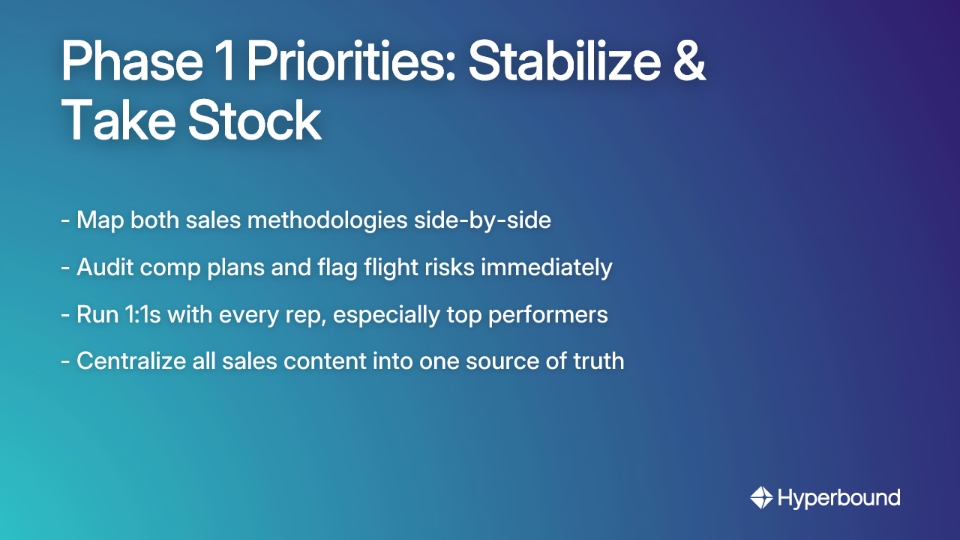
Start by auditing both teams side-by-side. Document everything:
This audit isn't about picking a winner from Team A or Team B. It's about identifying what actually works in each methodology and building something better from both. The best practices aren't always where you expect them to be.
Compensation misalignment is one of the fastest ways to lose your top performers after an acquisition. If one team is on a higher base, has better accelerators, or a more favorable quota structure, you will hear about it — and if you don't act, those reps will vote with their feet.
Pull both comp plans immediately. Look for discrepancies in base salary, commission rates, accelerator thresholds, and quota attainment. Then do something even more important: talk to your people.
The anxiety is real. Reps are wondering whether their role even exists in the combined org. They're fielding calls from recruiters who've already figured out the acquisition happened. Concerningly, discussions on Reddit around merger experiences reveal a consistent theme: "concerns about job security due to anticipated layoffs" are top of mind for employees going through any acquisition.
Run 1:1s with every rep — especially your top performers. Be transparent about what you know and honest about what you don't. Overcommunication at this stage isn't overkill. It's retention strategy.
Two sales teams mean two sets of decks, one-pagers, case studies, battle cards, and email templates — most of which are now outdated or contradictory. This content chaos is a direct cause of customer confusion and wasted rep time. Research from sales teams on Reddit consistently surfaces "fragmented resources creating difficulties in access and organization" as a top productivity killer.
Create a single source of truth immediately. Archive or lock the old repositories. Even if the new unified content isn't perfect yet, the act of consolidating signals decisiveness and gives reps one place to go. Modern sales enablement platforms are essential for centralizing training materials and keeping the team aligned during transitions like these.
With the bleeding stopped and your assessment complete, Month 1 is about making decisive choices and codifying what "one team" actually means on the ground.
This is the most important output of Month 1. Your reps cannot sell something they can't explain — and right now, they're winging it. You need a master narrative that every rep can deliver consistently, answering three critical questions prospects will ask:
The output isn't a slide deck. It's a field-ready story: a new pitch, updated discovery questions, refreshed objection-handling scripts, and revised email sequences. This is the raw material your sales team needs before they can show up confidently in front of a buyer.
Your market position has changed. You have new product capabilities, potentially new competitors, and likely a broader (or more focused) ideal customer profile. Don't assume the old ICP still applies to the combined company — and don't let two teams chase different targets indefinitely.
Run a cross-functional workshop with sales, marketing, and product leaders from both former companies. Map out the new ICP: who you're going after, why, and what pain the combined solution uniquely solves. The institutional knowledge sitting on both sides of the table is a competitive asset — use it. McKinsey's research on merger integration consistently points to this kind of joint alignment as a driver of post-merger revenue performance.
Here's what doesn't work: announcing "we're one team now" and expecting it to be true.
The Tyson Group calls this "identity lag" — where reps cling to their legacy team identity and an "us vs. them" mentality persists long after org charts are redrawn. Unity is a design challenge, not a mindset issue.
To actually build one team, you need:
You've done the hard strategic work. Now comes the part most integration plans get wrong: getting 100% of the team to actually execute the new methodology consistently.
A playbook that lives in a slide deck is not a capability. It's a document. And the brutal truth of acquisition integration sales training is that 80% of training is forgotten within 30 days if it isn't reinforced through practice.
Manager-led coaching can't scale across two merged teams simultaneously — especially when your managers are themselves still adjusting to the new structure. Classroom sessions are one-and-done events that don't build durable habits. And asking reps to learn by burning real pipeline (making mistakes on live prospects) is the most expensive acquisition integration sales training method there is.
This is the adoption challenge that kills post-merger momentum.

The most effective way to close the gap between "we have a new playbook" and "our team can deliver it" is structured, repetitive practice against realistic scenarios. This is where AI roleplay-based training dramatically outperforms traditional approaches.
Hyperbound Practice is built specifically for this kind of skills transfer at scale. Instead of telling reps about the new pitch, they practice it — repeatedly, against AI buyer personas trained on 2M+ hours of real B2B sales conversations. The simulations don't feel like generic training modules. They feel like real calls, with realistic pushback, real objections, and dynamic responses that force reps to think on their feet.
The results are measurable. Teams using this approach see 50% faster ramp time and 2x faster time to first won deal. Vanta, for example, used practice-based AI training to reduce their sales ramp from 210 days to 72 days — a 60% reduction — while simultaneously scaling their BDR team 4x and growing pipeline 5x.
When you're trying to re-ramp an entire merged sales organization in 90 days, those numbers matter enormously.
The power of AI roleplay in a post-merger context isn't just speed — it's specificity. You can build practice scenarios that mirror the exact conversations your reps are having in the field right now, and certify them before those conversations happen with real buyers.
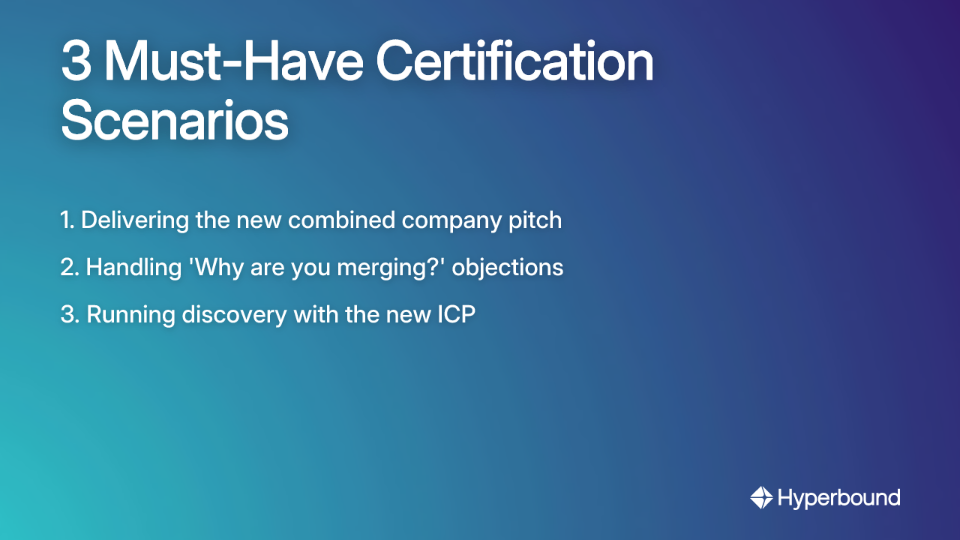
Here are three scenarios every rep in a newly merged org should be certified on:
Scenario 1: The New Combined Company Pitch Can your rep confidently articulate the new value proposition in under two minutes? Can they explain why the two companies merged in a way that sounds strategic — not defensive? This is the foundation. Every rep needs to be able to nail this before their next outbound call goes out. With Hyperbound Practice, you can build this exact simulation, run it across the entire team simultaneously, and score every rep against the same AI scorecard — with no manager time required.
Scenario 2: Handling "Why Are You Merging?" Objections Every single prospect and existing customer is going to ask this. "Are you going to raise prices?" "Is my account going to change?" "Is my rep staying?" These aren't objections you can wing. Use Bitesized Roleplays to drill this specific conversation — a short, focused simulation that tenured reps can complete in minutes without sitting through a full onboarding curriculum. This is especially effective for your experienced reps who don't need full re-onboarding but do need to master this new conversation.
Scenario 3: Running Discovery with the New ICP Your combined solution solves problems that neither company could solve alone. But your reps are still asking the old questions. Use roleplay to practice the new discovery framework — the questions that uncover the pains your updated ICP actually has, and position your new capabilities accordingly. AI Scorecards inside Hyperbound Practice give instant, objective feedback on methodology adherence, ensuring every rep is hitting the same marks — not just the reps whose managers happen to coach well.
The final piece of the activation phase is measurement. You need to show that this integration is working — both for your own confidence and for the organization's leadership.
AI-powered practice creates the data visibility that traditional training never could. You can see exactly which reps have completed which scenarios, how they're scoring against methodology benchmarks, and where gaps still exist. This directly addresses one of the core frustrations in post-merger enablement: the inability to tie acquisition integration sales training to actual business outcomes.
Pair this with a simple dashboard tracking pipeline health, new deal velocity, and ramp time for reps going through the certification program. When the numbers start moving — and they will — you'll have the proof points leadership needs to validate the integration strategy.
.png)

Successfully integrating two sales teams after an acquisition is one of the hardest things a sales leader will ever do. It's chaotic, it's political, and the stakes are enormous. But it's also a rare window of opportunity — a chance to build something better than what either company had before.
The leaders who come out ahead are the ones who move fast without being reckless: who stabilize before they unify, who unify before they activate, and who invest in scalable practice to make the new methodology stick. The 90-day clock is already running. The best time to start was the day the deal closed. The second best time is now.
The most critical first step is to stabilize the team by assessing both sales methodologies, auditing compensation plans, and over-communicating with every sales rep. This initial triage phase prevents top talent attrition and customer confusion, which are the biggest risks in the first 90 days. Before you can build a new unified process, you must understand the existing people, processes, and content you've inherited.
To prevent top sales reps from leaving, you must address their anxieties about compensation and job security head-on through transparent 1:1 meetings and by quickly auditing and aligning compensation plans. Uncertainty is the primary driver of attrition. Reps are receiving calls from recruiters the moment a deal is announced. Proactive, honest communication about their role, their compensation, and the future of the company is the most effective retention strategy.
The biggest mistake is assuming that creating a new playbook is the same as getting the team to adopt it. Many leaders focus heavily on the strategic work of defining new messaging and processes but fail to invest in the scalable training and practice required for reps to actually execute that new methodology consistently. This leads to a failure to realize the deal's value.
A 30-60-90 day plan provides a structured framework to manage the chaos of a merger by breaking the integration into three distinct phases: Assessment (Days 1-30), Unification (Days 30-60), and Activation (Days 60-90). This phased approach ensures you stabilize the situation before making changes, define the new strategy before rolling it out, and focus on adoption once the strategy is set. It prevents leaders from trying to do everything at once, which often leads to failure in all areas.
A unified sales culture is built deliberately through action, not just words. It requires creating clear roles and rules of engagement, standardizing a single sales methodology, and ensuring all managers are coaching from the same playbook. Unity comes from shared processes and goals. By defining who owns which accounts, how deals are handled, and what "the way we sell" looks like, you eliminate the "us vs. them" mentality and build a new, shared identity.
AI-powered roleplay training accelerates integration by allowing the entire merged sales team to practice and master the new messaging, value proposition, and objection handling at scale, without requiring manager bandwidth. Unlike traditional training, AI simulations provide a safe, repeatable environment for reps to build confidence and competence in the new methodology. This practice-based approach significantly reduces ramp time and ensures consistent execution across the newly formed team.
Want to see how Hyperbound Practice can accelerate your post-merger skills transfer? Learn more here.










Use Cases
Legal