
You've scheduled the call with a promising prospect. Now comes that crucial pre-call preparation phase. But as you stare at your computer screen, brain fog sets in. Where do I even start? What should I research? How deep should I go?
The ambiguity in what to research leads to procrastination, and suddenly it's 30 minutes before the call and you're scrambling to understand their business.
Sound familiar?
Here's the truth: 79% of business buyers consider it crucial to interact with a salesperson who is a trusted advisor, not just another rep pushing a product. The difference between winging it and winning it often comes down to preparation.
This article provides a simple yet powerful framework to quickly research your prospect's company, role, and industry. You'll learn how to build genuine rapport and demonstrate empathy before you even say hello, allowing you to transform from an average sales rep into a trusted advisor who truly gets your prospect's world.
Let's be honest—research can feel like a chore when you have quotas breathing down your neck. But consider this: companies that perform prospect research are 45% more likely to achieve their sales targets.
Why? Because research isn't just about gathering information—it's about building credibility and trust. When you demonstrate a deep understanding of your prospect's business challenges, you immediately differentiate yourself from the majority of sales reps who come across as heavy handed on the product side.
Research also allows you to:
Most importantly, 78% of sales professionals using social media for research outsell their peers. The data is clear: research isn't just nice to have—it's a competitive advantage in B2B sales.
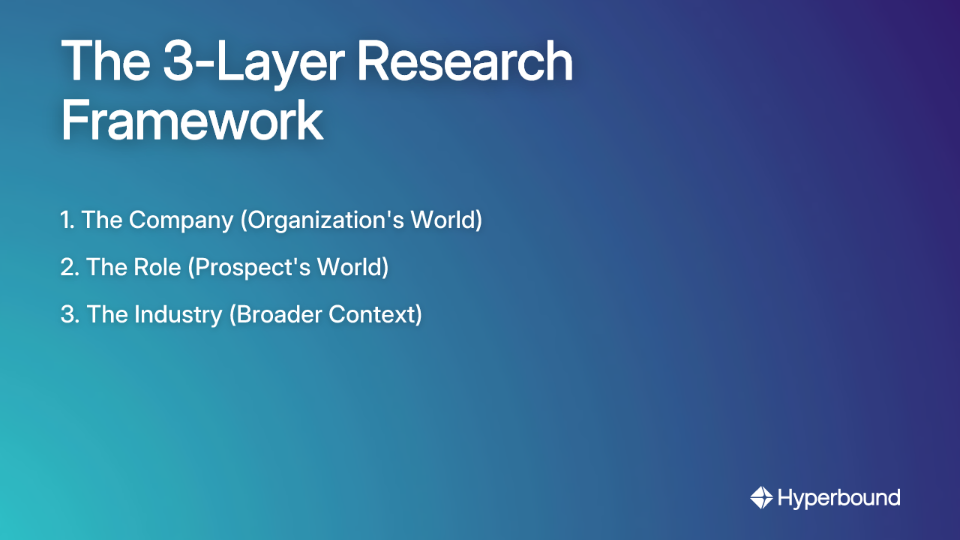
When faced with a high volume of prospects, the overwhelm is real. Where do you even start? This structured 3-layer framework will give you clarity and a repeatable process that takes just 15-20 minutes per prospect:
What to research:
Where to find it:
Pro tip: Look for recent press releases or news that you can mention in your call. According to Alore.io, mentioning a recent company achievement can instantly build rapport by showing you've done your homework.
What to research:
Where to find it:
Pro tip: Pay special attention to what your prospect is posting or engaging with on LinkedIn. This reveals what's top-of-mind for them right now and gives you conversation starters that feel natural, not forced.
What to research:
Where to find it:
Real-world example: If you're selling HR technology to a manufacturing company, understanding the current labor shortage in that industry allows you to frame your solution as addressing a critical business challenge, not just a nice-to-have tool.
Research is useless if it doesn't inform your conversation. Here's how to transform those insights into meaningful dialogue:
Don't just ask generic questions. Use your research to formulate specific, insightful questions that demonstrate you've done your homework:
These questions not only show you've done your research but also guide the prospect to articulate their pain points in their own words—a crucial step in any sales methodology.
To avoid brain fog and ensure a structured meeting, use this proven agenda format:
By starting with an executive overview that demonstrates your understanding of their business, you establish credibility immediately. This structured approach also ensures you don't miss critical components of an effective sales conversation.

The right tools can automate and accelerate your research process, letting you focus on strategy and connection. Here are some essential tools to add to your arsenal, with tool data and recommendations primarily sourced from Persana.ai:
These tools don't replace the human element of sales—they enhance it by giving you more time to focus on building meaningful connections while automating the data-gathering process.
.png)
The goal of research isn't to be a know-it-all, but to be a "show-you-care-at-all." It's about being genuinely curious about your prospect's world and the challenges they face.
Moving from a generic pitch to a personalized, consultative conversation is what separates top performers in b2b sales. It's how you become the trusted advisor that 79% of buyers are looking for.
So stop procrastinating on prospect research. Pick one prospect right now and apply the 3-Layer Framework. Spend just 15-20 minutes gathering insights that will transform your next call from an awkward product pitch to a valuable consultation.
Because in sales, understanding your prospect's world isn't just about closing a deal—it's about earning the right to become a part of it.

Remember: The most successful sales professionals aren't those who talk the most about their products—they're the ones who listen most intently to their prospects and demonstrate genuine understanding of their challenges.
Prospect research is important because it enables you to transition from a generic sales rep to a trusted advisor. By understanding a prospect's company, role, and industry challenges, you can build credibility, personalize your outreach, and significantly increase your chances of hitting sales targets.
The 3-layer research framework is a structured approach to quickly understand your prospect by examining three key areas. It involves researching: 1) The Company (their organization's world), 2) The Role (their specific professional world), and 3) The Industry (the broader context and trends affecting them).
A sales rep should aim to spend 15-20 minutes on pre-call research for each prospect. Using a structured framework, like the 3-layer approach, allows you to efficiently gather the most critical insights without getting overwhelmed, ensuring you're well-prepared for a meaningful conversation.
Use your prospect research to craft insightful, open-ended questions that demonstrate you've done your homework. For example, you can reference a recent company announcement, an article they shared on LinkedIn, or a major industry trend and ask how it's impacting their specific role or team.
The best places to find information about a company are its official website and blog, its LinkedIn Company Page, and Google Alerts set up for the company name. These sources provide official news, real-time updates, and insights into the company's mission, values, and recent activities.
If a prospect has a limited online presence, focus your research on their company and industry. Look for company press releases, industry news, and competitor activities. You can also leverage your own network by talking to current customers in the same industry to understand common challenges and pain points.
Have you found other effective techniques for quickly understanding your prospects' worlds? Share your experiences in the comments below!









Use Cases
Legal