
You've sent countless emails that disappear into the void. You've left voicemails that never get returned. You've watched your carefully crafted outreach get ignored by busy C-Level executives who receive hundreds of similar messages every week.
If this sounds familiar, you're not alone. In today's hyper-connected world, cutting through the digital noise has become the greatest challenge for sales professionals targeting decision-makers, especially when selling complex solutions like capital equipment to F50 or even F10 companies.
The solution? A powerful technique called the "Triple" (or "Triple Threat") - a strategic combination of outreach channels executed with military precision that dramatically increases your chances of breaking through.
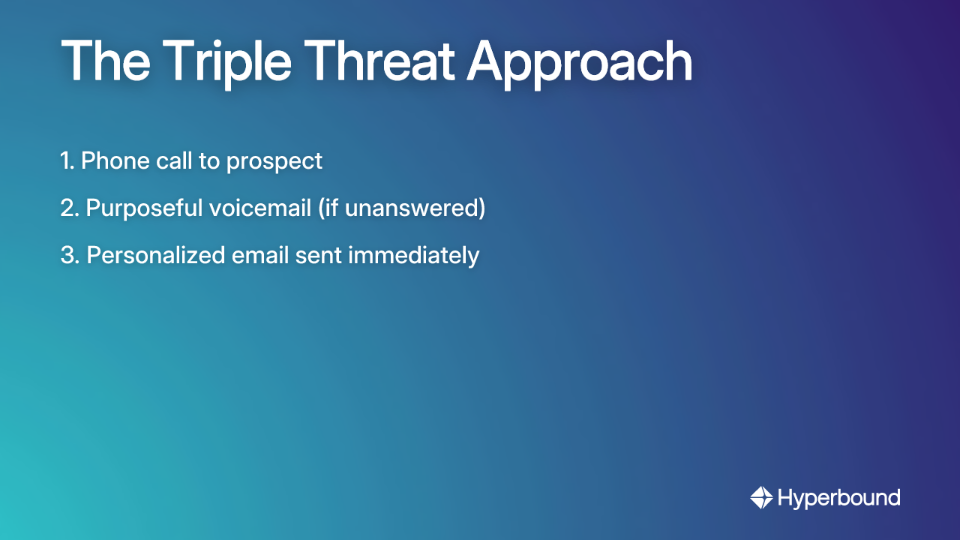
A Triple in sales is a coordinated, multi-channel outreach approach that combines three distinct touchpoints delivered within a tight 90-second window:
This technique, popularized by sales expert Tony Hughes in his book "Combo Prospecting," represents the perfect fusion of old-school phone techniques with new-school digital methods. It's not about bombarding prospects with generic messages - it's about creating a strategic pattern interrupt that captures attention and establishes your credibility.
The Triple is a targeted spear, not a wide net. It's designed as the opening sequence of what sales professionals call combo prospecting - a disciplined approach that blends multiple communication channels to reach busy decision-makers effectively.
The Triple leverages three psychological principles that make it significantly more effective than single-channel outreach:

When these three elements combine, they create what marketing experts call "resonance" - the ability of a message to break through the noise and make a lasting impression.
Think of this as a Venn diagram where these three circles overlap:
The 90-second window is crucial. When a prospect receives a call notification, voicemail alert, and email in rapid succession, it creates a cluster of signals that's difficult to ignore. The brain naturally assigns more importance to information that arrives through multiple channels simultaneously.
This approach works particularly well for reaching C-Level executives in B2G and enterprise environments where traditional drip campaigns often fail. The Triple creates what JMM™ methodology refers to as a "pattern interrupt" - breaking through the prospect's normal routine and capturing their attention.
Let's break down exactly how to implement the Triple in your sales process:
Before executing a Triple, you need to identify worthy targets:
Remember: The Triple is a targeted spear, not a shotgun approach. Quality research dramatically increases your chances of success.
Now comes the critical part - executing all three touches within 90 seconds:
"Hi [Name], this is [Your Name] from [Company].

I'm reaching out because [reference to relevant challenge or opportunity].

I just sent you a quick email with more details, and I'd appreciate a few minutes of your time to discuss how we've helped similar companies achieve [specific result].

My number is [your number]. Thanks, [Name]."
The entire sequence should follow the agoge sequence - rigorous, disciplined, and executed with precision. Using a sales engagement platform can help automate parts of this process while maintaining personalization.
The Triple is just the beginning. Your follow-up strategy is equally important:
To execute the Triple efficiently, you'll need the right technology stack:

While the Triple is powerful, it must be executed thoughtfully to avoid alienating prospects. Here are critical pitfalls to avoid:
According to sales professionals on Reddit, "I would HATE being thrown into a sequence like this and write off your product immediately." This sentiment is common when Triples are executed without personalization.
Solution: Invest time in researching each prospect. Reference specific challenges their company is facing or insights from their LinkedIn activity. The personalization is what transforms the Triple from spam to a valuable outreach.
Some sales reps make the mistake of executing too many Triples in quick succession. As one capital equipment sales professional noted, "If I was a potential client and I was blown up like this I would hate it... I would be annoyed with DAILY phone calls, voicemails, and emails."
Solution: The Triple is a single, coordinated event - not a daily occurrence. Space your follow-ups appropriately, especially for enterprise or capital equipment sales with longer cycles.
Many sales professionals overlook technical aspects like DKIM and SPF authentication, leading to emails landing in spam folders.
Solution: Work with your IT team to ensure proper email authentication. As one successful practitioner noted, "I'm very careful of DKIM, DMARC, SPF, and DNS..." This attention to technical details dramatically improves deliverability.
The Triple approach has demonstrated remarkable success across various sectors:
A major enterprise software company implemented the Triple methodology for their account executives targeting F50 companies. The result: a 3X increase in meeting booking rates compared to their previous outreach approach.
In the capital equipment sector, where sales cycles are notoriously long and complex, one company saw a 27% improvement in first-meeting rates after implementing a disciplined Triple approach for their top 50 target accounts.
Government sales face unique challenges with bureaucracy and multiple decision-makers. A technology provider to government agencies implemented the Triple with a focus on educational content, resulting in a 42% increase in initial conversations.
The Triple represents the perfect balance between persistence and professionalism in modern sales. It combines the best of traditional phone techniques with digital communication to create a powerful, attention-grabbing approach.
To succeed with this method:
As Tony Hughes writes, "Create desire, attract attention, and become interesting rather than interested." The Triple helps you achieve this by demonstrating both your professionalism and your understanding of the prospect's world.
Remember that success in sales isn't just about techniques - it's about becoming a trusted advisor who genuinely helps clients solve problems. The Triple is simply a way to open the door to those valuable conversations.
A "Triple," also known as the "Triple Threat," is a multi-channel sales outreach technique where you make a phone call, leave a purposeful voicemail (if unanswered), and send a personalized email, all within a 90-second window. This coordinated approach is designed to create a "pattern interrupt" for busy decision-makers. By combining three touchpoints in rapid succession, it leverages psychological principles like recency and frequency to significantly increase the chances of your message being noticed and acted upon compared to single-channel outreach.
The Triple technique is effective because it leverages the psychological principles of Recency, Frequency, and Relevancy to create resonance and cut through digital noise. When a prospect receives a phone call, voicemail, and email from you in a tight timeframe, it creates a cluster of signals that the brain perceives as more important. The recency of the touches keeps you top-of-mind, the frequency across channels reinforces your presence, and the relevancy of your personalized message makes it compelling.
The Triple should be used only once as the opening move in your outreach sequence for a specific prospect. Using the Triple daily or even multiple times a week would be overwhelming and counterproductive, likely annoying the prospect. The Triple is a powerful pattern interrupt designed to start a conversation. Subsequent follow-ups should be part of a broader, well-paced cadence that adds new value with each touchpoint, alternating between different channels like bump emails or LinkedIn messages.
If the prospect answers the phone, you proceed with your planned call script and do not continue with the voicemail or email steps of the Triple. The primary goal of the Triple is to initiate a live conversation. If you achieve that on the first call, the technique has succeeded. You can then mention that you were prepared to send a follow-up email with details, which you can still do after the call to summarize your conversation and outline the next steps.
Yes, parts of the Triple can be automated using a sales engagement platform, but the personalization aspect must be manual. Tools can help you queue up the call, have a pre-written email template ready, and even use voicemail drop features. However, the effectiveness of the Triple hinges on personalization. You must manually research your prospect and customize the messaging in both your voicemail and email to address their specific challenges or context. Over-automation leads to generic outreach, which undermines the entire strategy.
While the Triple is highly effective for reaching C-level executives, it can be adapted for any busy, high-value decision-maker who is difficult to reach through single channels. The technique is particularly well-suited for complex sales environments like enterprise technology, capital equipment, or B2G, where getting the attention of key stakeholders is a major challenge. The key is to reserve this high-effort technique for prospects where the potential return justifies the strategic, personalized approach.

Start small by identifying five target accounts, researching three prospects in each, and executing your first Triple. Measure the results, refine your approach, and watch your response rates climb as you master this powerful combo prospecting technique.










Use Cases
Legal