Are you drowning in an ocean of sales books, YouTube videos, and conflicting advice? You're not alone. Many aspiring and current salespeople struggle to find a clear learning path, frustrated by the lack of structure and the fear of investing in programs that, as one professional put it, are "scams or charge way too much for their worth."
The good news? The right training program can dramatically accelerate your sales career and help you stop struggling. In fact, organizations that implement formal salesperson training see a 19% improvement in sales performance and an average ROI of 353%.
This guide cuts through the noise to bring you the top 10 salesperson training programs for 2025, helping you make an informed choice that aligns with your specific goals, experience level, and budget.
Sales training isn't merely about teaching closing techniques. It's a comprehensive approach to equipping teams with the skills, knowledge, and methodologies needed to excel in today's competitive landscape. This includes communication, relationship-building, negotiation, product knowledge, and understanding buyer psychology.
The data supporting investment in salesperson training is compelling:
Finding the perfect program isn't one-size-fits-all. Here's a framework to help you make the best choice:
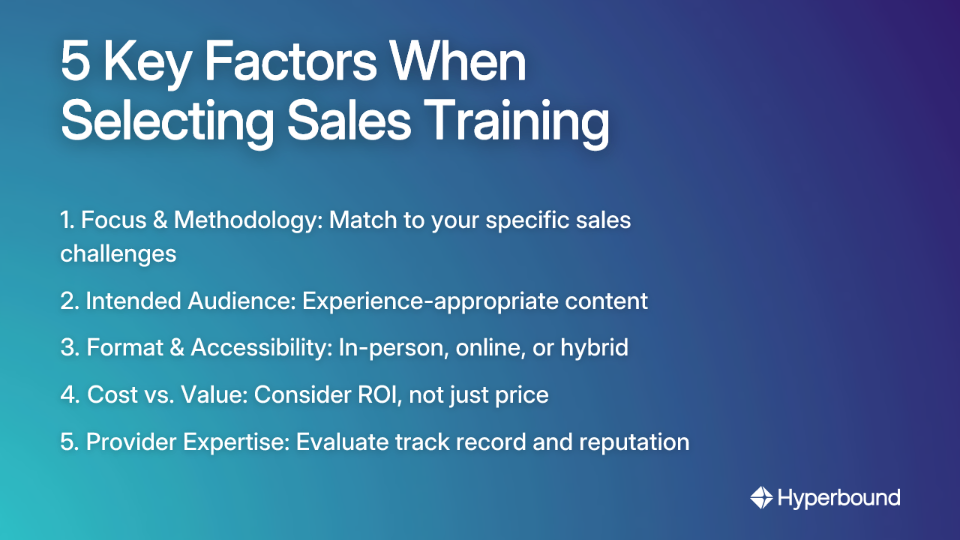
What specific skills do you need to build? Is it cold calling, negotiation, or strategic account management? Look for programs that teach proven methodologies. Some focus on consultative approaches like SPIN Selling, others on disruptive models like the Challenger Sale.
For B2B sales especially, does the program teach a qualification framework? One sales professional noted their company adopted MEDDIC to systematize how they qualify opportunities, highlighting the need for a clear procedure.
Is the program designed for a new SDR/BDR or a seasoned account executive? Training should be tailored to the experience level of the participants to maximize effectiveness.
Prices range from a few hundred dollars to tens of thousands. Don't just look at the price tag—consider the potential ROI. A $2,000 program that helps you close one extra deal could pay for itself many times over.
Look for providers with a proven track record and positive reviews. Who are their clients? Do they offer certifications?
Be wary of programs whose own salespeople can't sell effectively. As one frustrated buyer noted, "If a member of my sales team failed to respond to TWO messages from a seemingly interested prospect, I'd fire them." The training provider's own sales process speaks volumes about their methods.
It's worth addressing a sentiment echoed by many seasoned sales professionals: "The only training that was worth a damn was actually doing the job and falling on my face."
This perspective holds truth. There is absolutely no substitute for real-world application. The lessons learned from rejection, failed pitches, and lost deals create neural pathways that no classroom can replicate.
However, formal training serves as a powerful accelerator to this natural learning process. Think of it as the difference between learning to swim by being thrown into the deep end versus receiving proper instruction before entering the water. Both approaches will eventually teach you to swim, but the latter is more efficient and less painful.
Good salesperson training provides the frameworks, techniques, and mindset to:
The best programs combine theoretical knowledge with practical application, creating a feedback loop that accelerates improvement. This is where AI coaching platforms like Hyperbound come in, allowing reps to practice what they learn in realistic roleplays and get instant feedback on real calls, effectively bridging the gap between training theory and real-world execution.
Navigating the world of sales training can feel overwhelming, but choosing the right program is one of the most strategic investments you can make in your career or for your team.
The benefits are clear and compelling:
Whether you're looking to master a systematic process with Sandler, build powerful relationships with Dale Carnegie, or challenge customer thinking with Challenger, there's a program designed to address your specific needs and help you overcome common sales challenges.
Use this guide to evaluate your options, speed up your learning curve, and start building the skills that will define your success in 2025 and beyond. Remember that the right training isn't an expense—it's an investment with measurable returns that will pay dividends throughout your sales career.
The most successful salespeople combine structured training with real-world experience, creating a powerful formula for sustained success. Which of these training salesperson programs will you choose to elevate your skills and results in 2025?
Sales training is important because it directly improves sales performance, gives companies a competitive edge, and enhances the customer experience. Organizations with formal training see a 19% improvement in performance and a 353% average ROI. It equips salespeople with the structured methodologies, communication skills, and confidence needed to navigate complex sales cycles, handle objections, and build lasting customer relationships, ultimately leading to higher net sales and better employee retention.
For beginners, the best sales training program often focuses on foundational skills and building confidence. Programs like Dale Carnegie are excellent for developing core interpersonal and relationship-building skills. The Salesforce Sales Representative Certification is another great starting point, as its core training is free on Trailhead and provides a widely recognized, entry-level credential focused on customer-centric sales processes.
A good sales training program can cost anywhere from a few hundred to several thousand dollars. For example, online access to a program like RAIN Group starts around $199/month, while comprehensive programs from providers like Sandler or Dale Carnegie can range from $1,000 to $5,000. It's crucial to evaluate the cost against the potential return on investment (ROI), as a program that helps you close even one additional deal can easily pay for itself.
Yes, you can learn sales through real-world experience, and many successful salespeople learn by "falling on their face." However, formal training acts as a powerful accelerator. It provides proven frameworks and techniques that help you learn from mistakes more quickly, understand what went wrong, and rebound faster. Combining structured training with on-the-job experience is the most efficient and effective path to long-term success.
A sales methodology is a systematic, repeatable framework that guides how a salesperson approaches each stage of the sales process. It matters because it provides a clear procedure for qualifying leads, handling conversations, and closing deals. Methodologies like the Challenger Sale, Sandler Selling System, or N.E.A.T. Selling™ give sales teams a common language and process, leading to more consistent and predictable results.
The best way to apply what you learn is through consistent practice and real-world application. Immediately use the new techniques on calls and in meetings. Role-playing is also a powerful tool for building confidence and mastering new skills without risking live deals. Modern AI coaching platforms like Hyperbound can bridge the gap between training and execution by providing unlimited practice roleplays and instant feedback on real sales calls, helping you implement your learnings effectively.










Use Cases
Legal