Summary
- Most sales methodology programs fail at reinforcement, not design: CRM fields turn into compliance, and manual prompt rewriting recreates the same inconsistency.
- A persistent Guideline is a structured behavior rule that an AI agent applies automatically across roleplays, scorecards, and call analysis, without being reminded.
- Teams can encode methodology by typing When/Then rules or uploading up to five documents (PDF, DOCX, TXT, MD) for the agent to draft, then reviewing and approving the output.
- Proof points: Klaviyo cut roleplay creation time from weeks to about five minutes; Staff Domain identified coaching needs in four weeks instead of 90 days.
- Start by identifying the most inconsistently applied part of your methodology, creating a Guideline, approving it, and verifying real behavior change. Hyperbound offers Kota CMS as a paid add-on in private preview for this workflow.
Most sales methodologies fail at the reinforcement stage, not the design stage. Enablement teams invest in MEDDPICC training, build the documentation, run the workshops, and then watch adoption drift within a quarter. The CRM fields get filled in, but the behavior does not change. Across sales communities, the pattern is consistent: when MEDDIC lives in a CRM field, it becomes compliance. When a rep uses it to gut-check a deal before a forecast call, it works.
Generative AI was supposed to help. Instead, many teams have found a new version of the same problem. Rather than typing methodology notes into a CRM, enablement managers now type them into a prompt box each time they need a roleplay, a scorecard, or a call analysis. The methodology is still being re-entered manually. The result is the same: inconsistent application, no audit trail, and several conflicting interpretations of one framework with no source of truth.
The solution is persistent methodology, not a better prompt.
What "Persistent" Actually Means
A persistent rule is one an AI agent applies every time it performs a specific workflow, without being reminded. In Kota CMS, Hyperbound's system for agentic content management, these persistent rules are called Guidelines.
Guidelines are not documentation. They are not files stored for reps to find. They are structured behavior rules that tell the Kota agent exactly how to act when creating a roleplay bot, building a call scorecard, or generating a report. Legacy content platforms store files for humans to retrieve. Kota CMS turns those files into rules for an agent to apply. The distinction matters because connecting an app to Kota does not produce behavior rules automatically. That is the function of a separate layer: Connectors.
Connectors give Kota read access to existing tools, such as Notion, Google Drive, SharePoint, Seismic, and Highspot. They define what the agent can see. Guidelines define how the agent behaves. Connecting Google Drive so that Kota can read your methodology deck does not instruct Kota to enforce BANT weighting on discovery scorecards. That requires a Guideline. The two layers are intentionally separate, and that separation is what makes governance possible. For the specifics of scoping those connections, see How to Connect Notion, Google Drive, and SharePoint to Your Sales AI; for what happens after the rules are in place, see Content Governance for Sales Teams That Hand Work to an AI.
This architecture parallels how modern AI platforms handle persistent behavior more broadly. Anthropic's Claude Projects, for instance, separates project instructions (tone, expertise, perspective) from files and knowledge (content the model reads). Behavior rules and knowledge sources are distinct inputs, not interchangeable ones.
Two Ways to Create Guidelines in Kota CMS
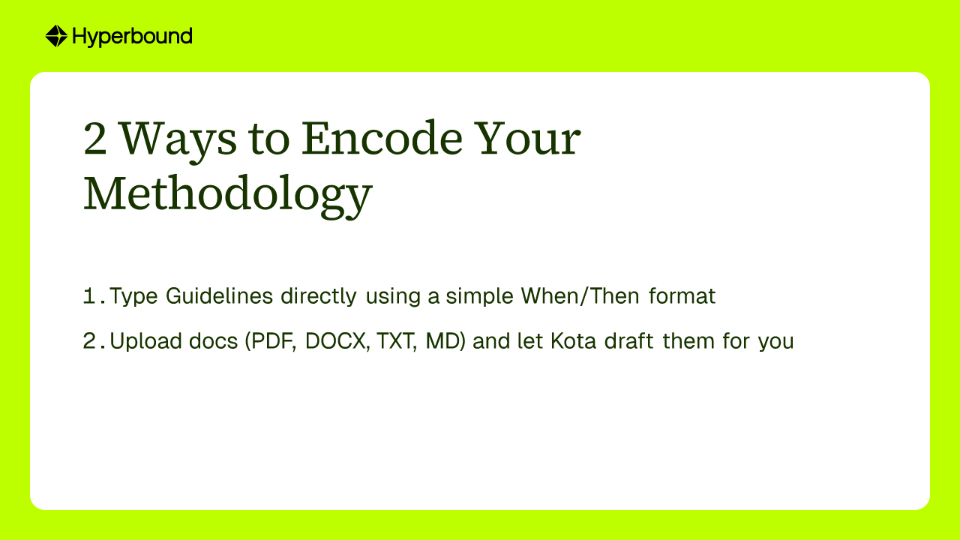
There are two paths for encoding your sales methodology as persistent Guidelines.
Method 1: Type Them Directly
For rules that are already explicit and well-understood, typing them directly is the fastest path. The format is straightforward:
When [workflow or action], [enforced behavior].
This structure keeps Guidelines unambiguous and directly actionable. Two examples from Kota CMS's own documentation:
Guideline: Persona
"When creating cold call bots, assume we sell to a VP Sales persona at mid-market SaaS companies who has already evaluated a competitor."
Every AI-generated cold call simulation, including those used for AI sales roleplay guidelines and rep certification, reflects the correct buyer profile, competitive context, and likely objections, without the creator needing to re-specify any of it.
Guideline: Qualification Framework
"When creating scorecards, use BANT: Budget, Authority, Need, and Timing. Weight Need and Timing over Budget on first calls."
This does more than enforce BANT as the qualification framework. It encodes the strategic prioritization the team has decided on, so every scorecard generated reflects actual coaching intent rather than a generic template.
Both Guidelines follow the same format. Both apply every time the relevant workflow runs. Neither requires a prompt.
Method 2: Upload Your Documents and Let Kota Draft the Guidelines
This is the path that eliminates retyping entirely.
Upload up to five files in any of the accepted formats: PDF, DOCX, TXT, or MD. The Kota agent reads those documents and automatically drafts a proposed set of Guidelines based on the content. In practice, feeding a methodology deck to Kota auto-extracts frameworks like BANT or MEDDPICC and proposes them as scorecard Guidelines, complete with the weighting and prioritization embedded in the source material.
Before any of those drafted Guidelines become active, a human on the team reviews, edits, and approves them. Nothing applies until that review is complete. This human-in-the-loop step keeps the enablement team in control of what the agent enforces, and it ensures that nuance in the documents, such as qualification exceptions for strategic accounts or tone requirements for specific verticals, is preserved rather than flattened.
The upload path is designed for teams whose methodology already lives in existing documents: playbooks, call frameworks, onboarding decks, or certification rubrics. Instead of manually translating those into prompts, teams give the documents directly to Kota and review what it proposes.
Encoding Is Upstream of Enforcement
The question of whether reps are following a methodology is separate from the question of how it is encoded. This article covers the encoding step. Enforcement, meaning whether the Guidelines are producing measurable behavior change on real calls, belongs to a different part of the workflow.
What encoding does is establish the foundation. When Guidelines are in place, every AI-generated asset, whether a roleplay bot, a discovery scorecard, or a call analysis, is built from the same rules. That consistency is what makes the next stage, verification, possible at all.
Hyperbound's Practice -> Perform loop is built on this foundation. Reps practice against roleplay bots constructed using the same Guidelines that generate real-call scorecards. When both the practice environment and the evaluation environment use identical rules, gaps become visible across the full picture rather than appearing only in isolated coaching sessions.
Several teams have structured their programs around this loop. Finally requires SDRs to complete 60 Hyperbound practice reps per day, 30 in the morning and 30 after lunch, and pass a cold call certification with the VP of Sales and CRO before they are permitted to use any other tool. Nivoda certifies reps against methodology criteria before they take live calls. ALKU added Hyperbound Perform specifically to connect practice repetitions to real-call execution, giving managers visibility into whether what reps practice shows up in the field.
The consistency these programs depend on requires that the rules used in practice match the rules used in evaluation. Guidelines are what make that match possible.
Speed is also a factor. Klaviyo's enablement team cut roleplay creation time from weeks to approximately five minutes using Kota. That compression means teams can respond quickly when gaps are identified, updating Guidelines, regenerating assets, and re-running practice cycles without waiting for a manual rebuild. Staff Domain identified coaching needs in four weeks instead of the previous 90 days after implementing Hyperbound. That timeline shift depends on having a consistent measurement framework in place, which persistent Guidelines provide.
Traditional approaches to sales methodology enforcement, whether through CRM field audits, LMS completion tracking, or manual call review, treat methodology adherence as a reporting problem. The agentic approach treats it as a rules problem: encode the methodology correctly once, and the enforcement surface expands automatically across every workflow that runs.
What to Do Next
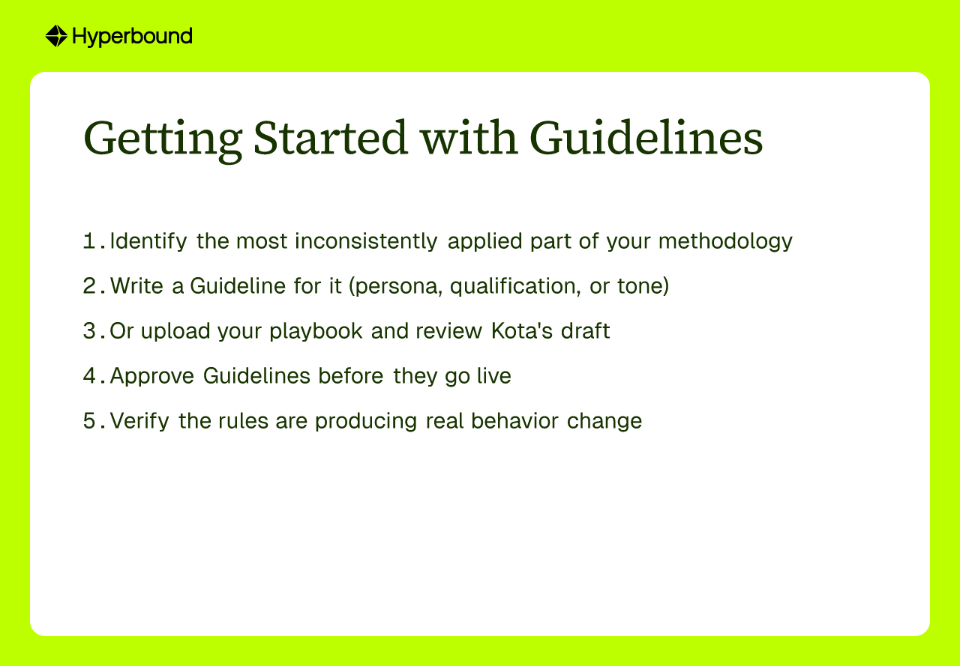
The starting point is identifying which part of the methodology is most inconsistently applied today. That is usually the right place to write the first Guideline.
If the inconsistency is in how roleplay simulations define the buyer persona, write a persona Guideline. If it is in how scorecards weight qualification criteria, write a qualification framework Guideline. If the methodology already exists in a playbook or onboarding document, upload that file and review what Kota proposes. The review step is mandatory. Treat the AI's draft as a first pass, not a final output.
After the first Guideline is live, the question shifts from encoding to verification: are the rules producing the behavior encoded? That is the enforcement question, and it belongs to a separate conversation.
Kota CMS is available as a paid add-on to Hyperbound, currently in private preview.
Private preview capabilities, scope, and availability are subject to change as we continue development and incorporate customer feedback.
To encode your methodology and start building a consistent practice environment, request access through your Hyperbound account manager.
Frequently Asked Questions
What is a persistent Guideline in Kota CMS?
A persistent Guideline is a structured behavior rule that the AI agent applies automatically every time it performs a specific workflow, such as creating a roleplay bot or building a call scorecard. Unlike a prompt, which must be re-entered each time, a Guideline is stored once and enforced consistently across all AI-generated assets, ensuring methodology adherence without manual repetition.
How do Guidelines differ from documentation or knowledge sources?
Guidelines define how the AI should behave, while documentation and knowledge sources define what the AI can read. For example, connecting Google Drive gives Kota read access to a methodology deck, but a Guideline is what instructs Kota to enforce BANT weighting on scorecards. This separation ensures governance: content availability can be controlled without changing the rules, and vice versa.
How can I create Guidelines in Kota CMS?
There are two ways: Guidelines can be typed directly using a simple "When [workflow], [behavior]" format, or existing documents (PDF, DOCX, TXT, MD) can be uploaded for Kota to draft proposed Guidelines for review, editing, and approval. The upload path is especially useful when the methodology already lives in playbooks, decks, or onboarding materials.
What is the human-in-the-loop step for drafted Guidelines?
When documents are uploaded, Kota automatically drafts Guidelines based on the content, but these drafts are not active until a human on the team reviews, edits, and approves them. This step ensures that nuances, exceptions, and strategic choices from the source material are preserved, and gives enablement teams final control over what the agent enforces.
Can I use Kota CMS with my existing sales enablement tools?
Yes. Kota CMS uses Connectors to integrate with tools like Notion, Google Drive, SharePoint, Seismic, and Highspot. Connectors give the agent read access to existing content. However, simply connecting a tool does not create behavior rules; teams still need to define Guidelines that tell the agent how to apply the methodology when generating roleplays, scorecards, or reports.
How do Guidelines support the Practice -> Perform loop?
Guidelines ensure that the same rules used to build practice roleplay bots are also used to generate real-call scorecards and analyses. This consistency makes gaps between practice and live execution visible, enabling managers to coach reps more effectively and verify that methodology training translates to field behavior.
What is the difference between encoding and enforcing a sales methodology?
Encoding is the process of turning a methodology into persistent Guidelines that the AI can apply. Enforcement is the later stage of measuring whether those Guidelines produce measurable behavior change on real calls. Encoding creates the foundation; enforcement verifies the outcome. This article focuses on the encoding step.
Who should use Kota CMS Guidelines?
Sales enablement leaders, revenue operations teams, and sales managers who are responsible for maintaining consistent sales methodology across roleplay, certification, scorecarding, and call analysis will benefit most. If a team struggles with methodology drift, inconsistent scorecards, or time-consuming roleplay creation, Guidelines can help standardize and accelerate those workflows.
Is Kota CMS available now?
Kota CMS is currently available as a paid add-on to Hyperbound, in private preview. Capabilities, scope, and availability are subject to change. To request access, contact your Hyperbound account manager through the pricing page or book a demo.
Want to see Hyperbound in action?
Try it now