Are you tired of hearing "budgets are tight" from prospects? Do you find potential clients take your price, do a little research, and then go with a cheaper competitor? If you're losing deals on price, here's the hard truth: you're not actually losing on price—you're losing because you haven't established your value properly.
Total Cost of Ownership (TCO) analysis is your most powerful tool for reframing these conversations from "your product costs too much" to "your solution delivers the best long-term value." This article will provide you with a comprehensive guide on how to calculate and present TCO for your premium product, helping you overcome price objections and win deals, even with budget-constrained organizations like nonprofits.
Total Cost of Ownership is a financial estimate designed to help buyers and owners determine the direct and indirect costs of a product or service over its entire lifecycle—not just the upfront purchase price. According to Wikipedia, TCO provides a comprehensive overview of all expenses, helping buyers understand the long-term value and protect against unforeseen risks.
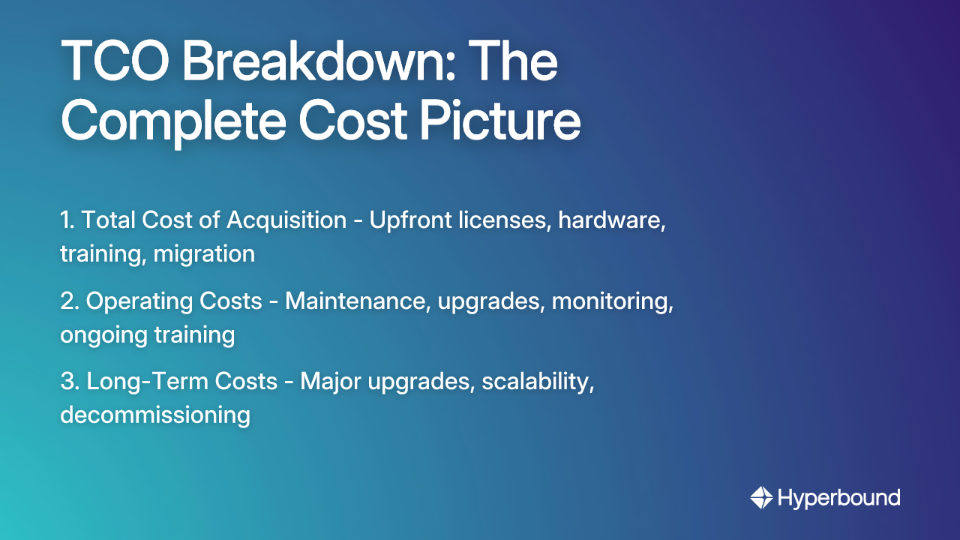
The TCO framework can be broken down into three primary components:
As the CIO.com guide on TCO for enterprise software explains, failing to account for these hidden costs can result in significant budget overruns and unpleasant surprises down the line.
Let's break down the process of creating a compelling TCO analysis for your premium solution:
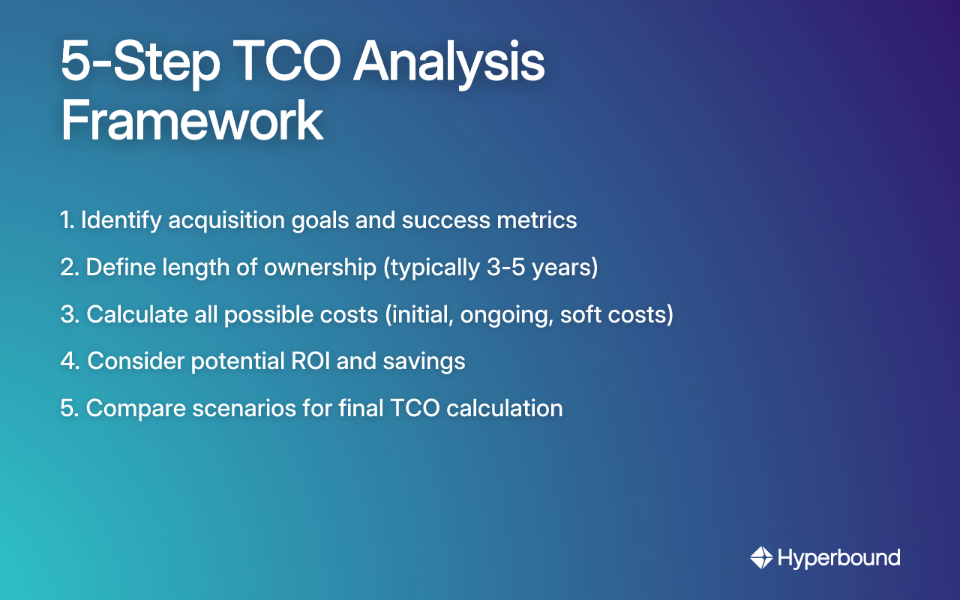
Define clear, SMART goals for the purchase. What specific business problem is the software meant to solve? According to Indeed's TCO guide, establishing these objectives upfront provides a framework for evaluating true value.
Determine the analysis period. For technology solutions, a three-to-five-year TCO analysis is recommended to account for the product lifecycle. This timeframe allows you to demonstrate how initial savings from cheaper alternatives often evaporate (or reverse) over time.
This is the most critical step. Create a side-by-side spreadsheet for your solution versus the competitor's, including:
TCO isn't just about cost; it's about value and return on investment. Calculate the financial benefits of your solution:
Sum up all costs and subtract all savings/income for both your solution and the competitor's over the defined lifecycle.
Once you have the data, the next step is mastering the conversation. The most effective TCO analysis is one that is delivered with confidence and clarity.
Once you've calculated the TCO, how you present it becomes crucial to your sales success:
Avoid overwhelming the prospect with a massive spreadsheet. Your job is to tell a story with the data. A common pitfall in value selling is overloading prospects with information, which can confuse rather than convince.
Let's look at how TCO analysis helped a nonprofit overcome price objections and make a smart investment decision:
DoSomething.org, a leading nonprofit that mobilizes millions of young people for social change, faced typical nonprofit budgeting constraints. Their previous data architecture (using Postgres as a data warehouse) was slow and rigid. Analytical queries "took all night to process," crippling their ability to use data effectively and leading to high implicit costs from wasted time and missed opportunities.
According to a MotherDuck case study, DoSomething adopted MotherDuck not because it was the cheapest option upfront, but because it offered a significantly lower Total Cost of Ownership. The results were transformative:
As Dave Crusoe, VP of Product & Engineering at DoSomething stated: "MotherDuck solved our analytics challenge outright, and the TCO was significantly lower."
This example perfectly illustrates how TCO analysis can help even the most price-sensitive organizations like nonprofits make decisions based on long-term value rather than upfront cost.
Price objections aren't roadblocks—they're invitations to have a deeper conversation about value. Total cost of ownership analysis is your most powerful tool for this conversation, allowing you to quantify your product's long-term benefits and expose the true cost of "cheaper" alternatives.
For your next qualified prospect complaining about price, don't offer a discount. Instead, offer to build a TCO analysis with them. Change the conversation from cost to investment, address both rational considerations and emotional buying factors, and watch your results transform.
Remember: differentiation in sales isn't just about having better features—it's about demonstrating better value. TCO helps you do exactly that, making it your secret weapon against even the toughest price objections.
Total Cost of Ownership (TCO) is a financial calculation that includes the initial purchase price of an asset plus all direct and indirect costs over its entire lifecycle. It provides a more accurate picture of long-term value by accounting for acquisition costs (licenses, hardware), ongoing operating costs (maintenance, support, training), and long-term costs (upgrades, decommissioning). This helps you look beyond the initial sticker price to understand the true cost of a solution.
To calculate TCO for software, you must identify all costs over a defined period (typically 3-5 years), including initial acquisition, ongoing operations, and potential "soft costs" like lost productivity. A comprehensive calculation involves defining acquisition goals, setting the ownership period, listing all possible costs (licenses, hardware, migration, training, maintenance, upgrades, support), factoring in the potential ROI your solution provides, and comparing the final TCO against competitors.
Present your TCO analysis as a clear and compelling story using strong visuals, focusing on the key takeaways rather than overwhelming the prospect with complex spreadsheets. Use simple bar charts or waterfall graphs to visually compare your solution's TCO against a competitor's. Start with an executive summary, highlight the competitor's hidden costs, detail the top areas where you provide value, and tie the conclusion back to the client's specific business goals.
The best time to introduce a TCO analysis is after you have fully qualified the prospect and they raise a price objection or ask for a detailed cost comparison. Introducing it at this stage shows you are responding directly to their concerns about budget. Instead of offering a discount, you can pivot the conversation by offering to build a TCO analysis with them, positioning the discussion around long-term value and investment.









Use Cases
Legal