
If you're a Customer Success Manager in B2B SaaS, you already know the feeling. The renewal date is circled on the calendar, and a quiet dread starts to build. Will the executive champion still be there? Did that support ticket from Q3 permanently sour the relationship? Is the account a "dark account" that's gone radio silent — and if so, what does that mean?
Reddit's r/CustomerSuccess community puts it plainly: "Renewal periods create significant anxiety and stress for customer success managers." And it's not just nerves — it's structural. Churn risk is often ambiguous, executives have different concerns than end users, and the renewal meeting itself is frequently too late in the process to meaningfully change the outcome.
The traditional preparation playbook is broken. Shadowing a senior CSM on one or two calls doesn't scale. Rewatching call recordings is passive — it shows you what went wrong but doesn't give you the reps to fix it. Roleplaying with your manager once a quarter is inconsistent and uncomfortable.
What does work? Deliberate, repeatable renewal conversation practice — ideally in a realistic, low-stakes simulation before anything is on the line.
AI conversation practice tools are making that possible at scale. But here's the catch: not all tools are built for the nuanced, relationship-heavy world of post-sales. Some are designed for cold calling. Others are contact center tools. A few are just data dashboards dressed up as training platforms.
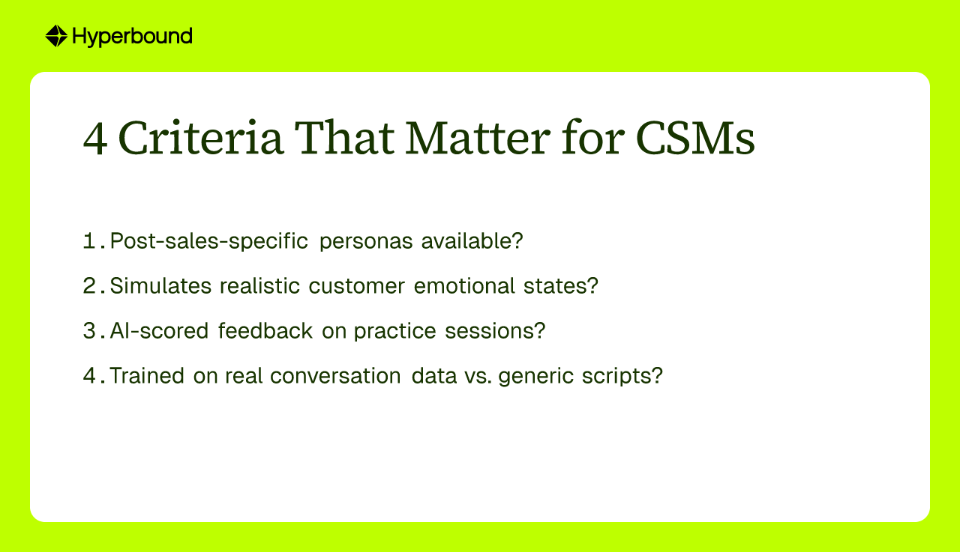
In this article, we'll break down the top 5 tools for practicing customer renewal conversations and evaluate each one against four criteria that actually matter for CSMs:
Let's dig in.
Best for: CSMs and Account Managers who want to practice the exact conversations that drive retention and expansion.
When most AI roleplay tools were built for top-of-funnel sales motions — cold calls, discovery, demos — Hyperbound was built to cover the full revenue lifecycle, including post-sales. Its AI Post-Sales Roleplays are purpose-engineered for the conversations CSMs dread most: renewals, upsells, QBR presentations, de-escalation, and navigating churn risk.
Here's how it stacks up against the criteria:
Post-Sales-Specific Personas: ✅ Yes Hyperbound offers a library of AI customer personas tailored specifically for post-sales scenarios. You can practice against a frustrated churning customer who's questioning ROI, a happy expansion candidate ready to grow, or an executive stakeholder in a QBR who wants to see business impact — not feature updates. These aren't generic "buyer" personas retrofitted for post-sales; they're built for it.
Simulates Customer Emotional States: ✅ Yes he AI doesn't just recite a script. It reacts dynamically, simulating the emotional shifts of a real customer mid-conversation — including the moment they pivot from polite to skeptical, or from engaged to disengaged. This directly addresses one of the biggest pain points CSMs report: difficulty gauging a client's current satisfaction levels and adjusting your approach in real time.
AI-Scored Feedback: ✅ Yes After every simulation, you receive instant, objective feedback via AI Scorecards. These track talk ratios, key value-communication moments, methodology adherence, and specific coaching areas. You can build custom scorecards aligned to your renewal playbook, so the feedback reflects your metrics, not a generic sales rubric.
Trained on Real Conversations: ✅ Yes This is the core differentiator. Hyperbound's AI is trained on over 2 million hours of real B2B sales and success conversations — not fabricated scripts. The platform understands the language and tactics that actually work in renewal conversations, because it's learned from them.
The result: CSMs stop going into renewal calls hoping for the best. They go in having already handled pricing pushback, navigated a frustrated stakeholder, and practiced articulating value in the language their customer actually uses. That preparation directly impacts Net Revenue Retention (NRR).
Try it yourself: Explore Hyperbound's AI Post-Sales Roleplays →

Best for: Analyzing what happened in past renewal calls, not preparing for future ones.
Gong is a widely used conversation intelligence platform in B2B SaaS, and for good reason. Its ability to capture, transcribe, and surface insights from real customer calls is genuinely powerful. But here's the problem: Gong is a library, not a practice field.
Post-Sales-Specific Personas: ❌ No Gong records real customer conversations, but it cannot create interactive AI simulations of those customers that you can practice against. You can watch how a churn-risk conversation unfolded — you can't rehearse how you'd handle the next one.
Simulates Customer Emotional States: ❌ No It can analyze sentiment in recorded calls after the fact, which is genuinely useful for coaching. But it cannot simulate emotional states in a live practice environment. There's no frustrated customer to respond to your value proposition in real time.
AI-Scored Feedback: ⚠️ On live calls only Gong provides powerful analytics on completed conversations — but has no mechanism for scoring a practice session. You learn from what already happened. That's valuable. It's just not preparation.
Trained on Real Conversations: ✅ Yes (for analysis) Gong's strength is analyzing your own team's real data. That data, however, is used for review and coaching review — not interactive training.
The verdict: Gong is indispensable for identifying skill gaps in renewal conversations. But identifying a gap and closing it are two different things. As Hyperbound puts it, Gong is "a giant library of data" — you need a practice layer to act on what it surfaces.
Best for: Practicing top-of-funnel sales conversations like cold calls and initial discovery.
Second Nature is a capable AI roleplay platform that's found a solid audience among sales teams. It simulates conversations, provides feedback, and allows managers to assign scenarios. The challenge is that its DNA is fundamentally wired for early-stage sales motions — and applying it to the nuanced world of customer success and renewals is a workaround, not a core feature.
Post-Sales-Specific Personas: ❌ No There's no built-in library of post-sales personas — no churning customer, no disengaged "dark account," no executive who cares more about budget than features. Teams can attempt to build custom personas from scratch, but the AI's underlying responses are anchored in generic sales scenarios, not the specific dynamics of long-term customer relationships.
Simulates Customer Emotional States: ⚠️ Limited The AI can follow a conversational path and vary tone, but it lacks the emotionally aware, dynamic responses of a system trained specifically on the complex emotional terrain of retention and expansion conversations.
AI-Scored Feedback: ✅ Yes Second Nature does provide automated scoring after sessions. The limitation is that the feedback framework is anchored in generic sales methodology — not the specific signals that matter in a renewal: empathy, value reinforcement, proactive risk acknowledgment.
Trained on Real Conversations: ❌ No The AI is primarily built around scripted training scenarios, not a large dataset of real B2B customer success interactions. That gap shows in the nuance of its responses.
The verdict: A solid tool if your CSMs need to brush up on general communication skills or handle basic objections. Not specialized enough for the high-stakes, relationship-driven work of renewals.
Best for: Training CSMs on how to use software, not how to handle a difficult customer conversation.
Whatfix Mirror is a digital adoption platform that creates interactive simulations of software interfaces. It's excellent at teaching someone how to navigate a CRM, process a renewal in Salesforce, or run through a workflow step-by-step. But it's solving a fundamentally different problem than renewal conversation practice.
Post-Sales-Specific Personas: ❌ No Whatfix simulates software interfaces — not human counterparts. There's no customer on the other side of the conversation.
Simulates Customer Emotional States: ❌ No Emotional simulation is entirely outside its design scope.
AI-Scored Feedback: ⚠️ On process adherence only It can confirm you clicked the right buttons in the right sequence. It cannot evaluate how well you articulated your customer's ROI or handled a surprise budget objection.
Trained on Real Conversations: ❌ No Whatfix is trained on software workflows, not customer conversations.
The verdict: Useful for technical onboarding and process training. Irrelevant for the core challenge of preparing CSMs for the human dynamics of a renewal call.
Best for: High-volume, script-heavy customer service training in call center environments.
Zenarate is a capable AI simulation platform built primarily for contact center training. Its strength is helping large teams deliver consistent, compliant responses at scale. The challenge for B2B SaaS CSMs is that the consultative, relationship-driven nature of enterprise renewals is a different beast than a scripted support interaction.
Post-Sales-Specific Personas: ⚠️ Limited Personas tend to be oriented toward common support scenarios and transactional conversations — not the complex strategic discussions of contract renewals, multi-year deal negotiations, or expansion conversations with economic buyers.
Simulates Customer Emotional States: ⚠️ Limited The platform can simulate frustrated customers, but primarily in the context of support de-escalation rather than high-stakes contract discussions. The emotional range doesn't typically extend to nuanced churn-risk scenarios.
AI-Scored Feedback: ✅ Yes Feedback is provided, though it often skews heavily toward script and process adherence — which can be too rigid for the fluid, consultative nature of B2B CSM conversations.
Trained on Real Conversations: ❌ Varies Often trained on company-specific call center scripts and best practices, rather than a broad, diverse dataset of B2B customer success conversations.
The verdict: An excellent choice for standardizing agent responses in high-volume support environments. Less well-suited for the strategic, relationship-heavy renewals handled by CSMs in complex B2B accounts.
.png)
The table tells a clear story: Hyperbound is the only tool that checks all four boxes — and the only one purpose-built for the post-sales conversation specifically.
Renewal conversations don't have to be a source of dread. With the right preparation, they become opportunities to strengthen partnerships, demonstrate value, and drive expansion revenue. Here's how to go from zero to practicing your first renewal scenario in under 10 minutes.
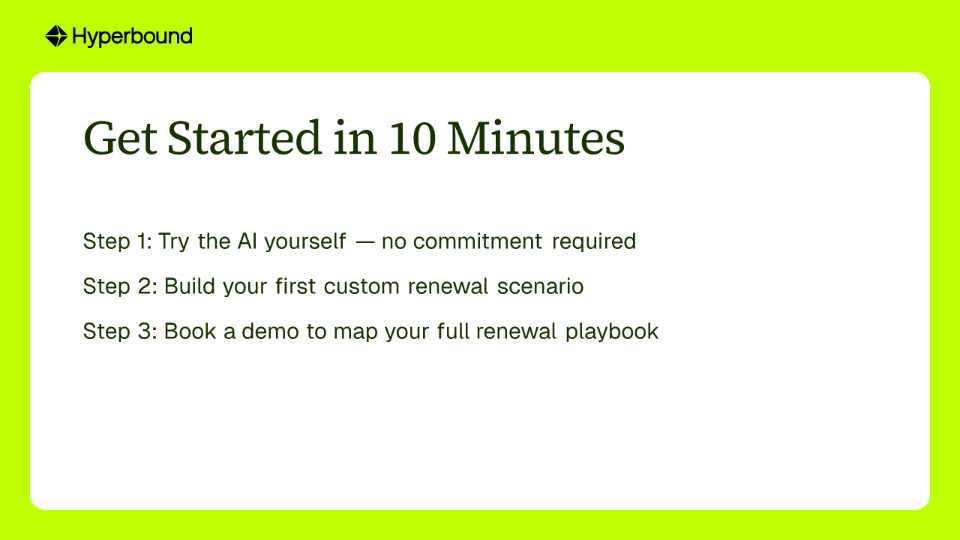
Step 1: Try the AI Yourself — No Commitment Required
The fastest way to understand what purpose-built renewal conversation practice feels like is to experience it firsthand. Hyperbound offers a free interactive demo that lets you jump straight into a live simulation — practice handling a pricing objection, navigating a churn-risk conversation, or positioning a renewal with an executive stakeholder. No credit card. No lengthy sales process.
👉 Try the free interactive demo here →
Step 2: Build Your First Custom Scenario
Once you've experienced the AI, building your first custom bot and scorecard takes less than 10 minutes. You can configure a persona based on your actual customer archetypes — a skeptical CFO, a disengaged end-user champion, a competitor-evaluating account — and set the scoring criteria to reflect your renewal playbook. Your team can be practicing against realistic, account-specific simulations the same day.
Step 3: Book a Personalized Demo to Map Your Full Renewal Playbook
Ready to see how Hyperbound can model your most challenging customer conversations at scale? A live demo session with the Hyperbound team covers how to model your ICPs, build post-sales personas, and design a practice program that directly moves the needle on NRR.
👉 Book your personalized demo here →
Practicing renewal conversations is crucial because it helps CSMs build confidence, reduce anxiety, and improve performance in high-stakes situations. Deliberate practice in a low-stakes environment allows managers to handle objections, navigate difficult emotions, and articulate value more effectively, which directly leads to higher Net Revenue Retention (NRR) and lower churn.
An AI conversation practice tool is a platform that uses artificial intelligence to simulate realistic customer conversations. For CSMs, these tools provide a safe space to practice renewal discussions, upsell pitches, and de-escalation scenarios against AI personas that mimic real customer behaviors, emotions, and objections.
AI simulations help by recreating the unpredictable emotional shifts that occur in real conversations. A purpose-built tool like Hyperbound can simulate a customer's journey from calm to frustrated, or from engaged to skeptical, based on the CSM's responses. This allows the CSM to practice adapting their strategy in real-time, learning to de-escalate tension and manage the conversation flow without risking a real customer relationship.
A good tool for practicing renewals should be purpose-built for post-sales motions. Key features to look for include: a library of post-sales-specific personas (e.g., churn-risk accounts, expansion candidates), the ability to simulate realistic customer emotional states, AI-scored feedback based on renewal playbooks, and an AI trained on real B2B success conversations rather than generic scripts.
No, you cannot use Gong for interactive practice. Gong is a conversation intelligence tool that is excellent for analyzing past calls to identify what went right or wrong. However, it functions as a library of past events and does not offer a simulation environment where CSMs can actively practice and rehearse future conversations against an AI counterpart.
Yes, leading platforms like Hyperbound allow you to build custom AI personas and scenarios in minutes. You can configure the AI to reflect your actual customer archetypes, such as a skeptical CFO focused on budget, a disengaged champion, or an executive who is actively evaluating competitors. This ensures the practice is highly relevant to the real-world challenges your team faces.
A team can get started with Hyperbound almost immediately. You can try an interactive demo instantly to experience the AI firsthand. Building your first custom scenario and scorecard typically takes less than 10 minutes, meaning your CSMs can be practicing realistic, tailored renewal conversations on the very same day.
The uncomfortable truth about most CSM preparation is that it happens live — on real calls, with real customers, with real revenue on the line. The first time a CSM faces a budget-challenged renewal, a frustrated executive, or a competitor-evaluating account is often in the actual meeting. That's not preparation. That's improvisation.
The tools that come closest to solving this range from genuinely useful (Gong for post-call analysis) to partially applicable (Second Nature for general communication skills) to entirely off-target (Whatfix for process training). But none of them were built for what CSMs actually need: a safe, realistic, AI-scored environment to practice the specific conversations that drive customer retention and expansion revenue.
Hyperbound's AI Post-Sales Roleplays are the only purpose-built solution for this. Not a repurposed sales training tool. Not a call recording platform with a coaching module bolted on. A platform designed from the ground up to help post-sales teams master renewal conversations, de-escalation, upsells, and QBR delivery — before any of it matters for real.
If your team is ready to turn renewal conversation practice from an afterthought into a strategic advantage, the 10 minutes it takes to try Hyperbound is the best investment you'll make this quarter.

👉 Start practicing renewal conversations with Hyperbound today →










Use Cases
Legal