
You already know who your top reps are. You can see it in the CRM. You can see it in the quota attainment numbers. The gap between your best performers and everyone else is not a mystery — it is right there in the data.
What is a mystery is why.
When you ask managers to explain the difference, you get answers like "she has great instincts" or "he's just a natural closer." When you look at the research, the picture gets even murkier. As one widely-discussed thread in r/sales points out, many of the attributes people associate with top performers "may not differentiate between an average salesperson and a top performer" at all. Vague traits like "grit" and "charisma" are not coachable. They are not scalable. And they will not help you lift the bottom 80% of your team.
The problem is not that your team lacks talent. The problem is that you are trying to diagnose a behavioral gap with subjective observations instead of systematic data.
That is exactly what a top rep behaviors analysis is designed to solve.
Instead of relying on manager surveys, gut feelings, or generic best practices from a sales book, Hyperbound Perform's Winning Behaviors Analysis extracts the specific, measurable actions your top reps are actually taking on calls, right now, and builds a system to teach those behaviors to everyone else on the team.
This article breaks down two of the most critical behaviors this analysis consistently surfaces: multi-threading and call persistence. More importantly, it walks through how to close the gap.
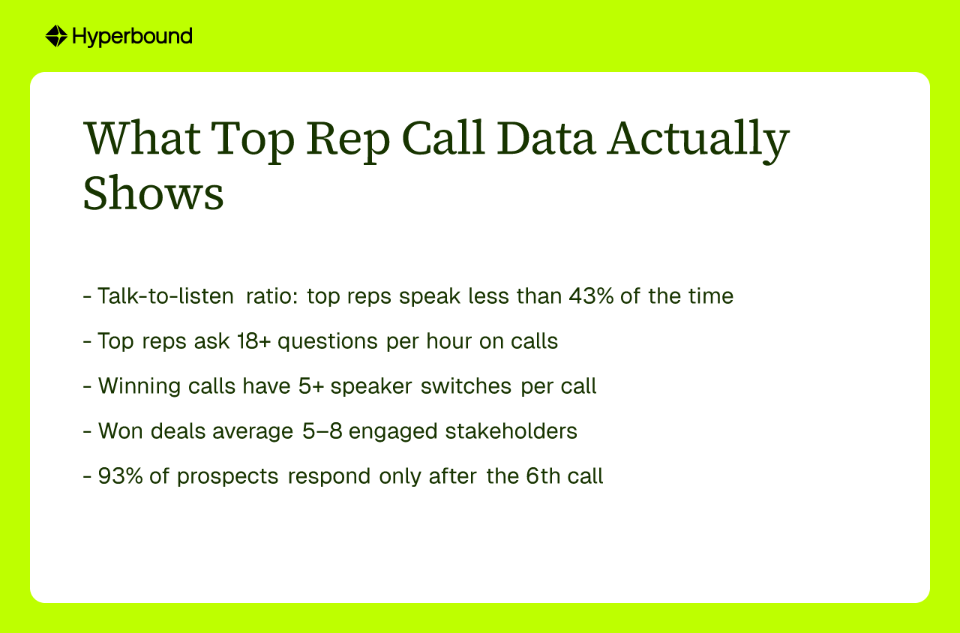
Traditional sales coaching has a structural flaw. It focuses almost entirely on lagging indicators. Closed deals, quota attainment, pipeline velocity. These tell you what happened. They do not tell you how or why.
To change behavior, you need to look at leading indicators: the specific actions reps take before a deal closes or dies. The good news is that data already exists in your call recordings, emails, and CRM activity logs. The challenge is extracting meaningful signal from the noise.
When you do, the patterns are striking:
These are not suggestions from a leadership book. These are behaviors extracted from thousands of real sales calls. And your top reps are already doing them. The question is whether you have a system to teach the rest of your team to do the same.
Two behaviors stand out above the rest when it comes to separating won deals from lost ones: how many people your reps engage, and how long they stay in the conversation.
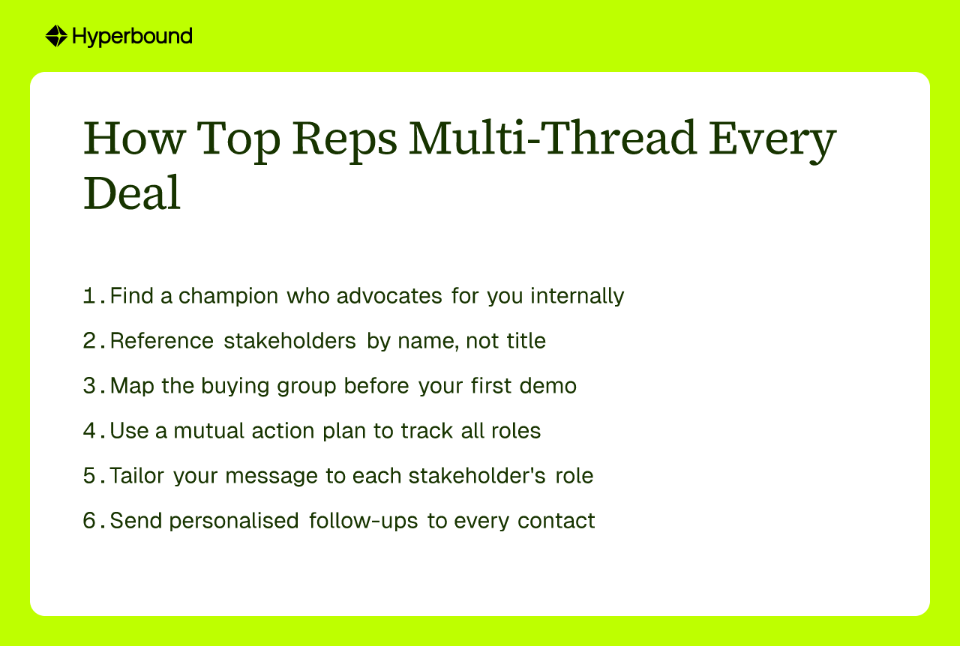
Multi-threading is the practice of building relationships across the entire buying committee rather than depending on a single contact inside an account. In a world where the average B2B deal now involves 7 to 10 decision-makers, relying on one champion is not a strategy. It is a liability.
The data from Hyperbound's Winning Behaviors Analysis makes this concrete:
That is not a marginal difference. That is a completely different approach to how a deal is run.
When your rep has one contact and that contact goes dark, the deal is over. When they have five to eight engaged stakeholders, they have built consensus. They have surfaced the blockers early. They have reduced the single point of failure that kills so many deals in the final stages of the sales cycle.
Teams that execute multi-threading well see a 34% lift in win rates. That is not a small improvement. That is a structural advantage.
The good news is that multi-threading is a learnable skill, not a personality trait. Here are the moves your top reps are already making, sourced from industry best practices and real practitioner advice shared in r/sales:
If multi-threading is about width, call persistence is about depth. It is about staying in the conversation long enough for the deal to actually happen.
There is a common misconception that persistence means being pushy. It does not. The top reps in your Winning Behaviors Analysis are not hammering prospects with the same pitch on repeat. They are making more touchpoints, staying longer in each conversation, and bringing value every time they show up.
The data on persistence is one of the most jarring in all of sales research:
Your average reps are stopping at call two. Your top reps are making it to call six and beyond. Thatalone explains a significant portion of the performance gap you see in your CRM.
Persistence is not only about volume. It is also about the quality of engagement at each touchpoint. Average reps who do follow up often fall into the trap of talking too much and listening too little. They pitch instead of probe. They push instead of pull.
Top reps who stay in the conversation tend to:
Industry research identifies the mindset traps that kill persistence in average reps: giving up too easily after setbacks, expecting success to come quickly, lacking a clear vision for the account, and treating every "no" as a final answer. Top reps have internalized something different. They hate losing. They stay curious. And they keep showing up.
This matters for your training program because grit cannot be taught in a vacuum. But specific behaviors, like making the sixth call, asking two more discovery questions, or switching speakers more frequently, can be coached, practiced, and measured.
Here is where most sales teams stop. They run the analysis, identify the winning behaviors, circulate a summary, and hope the team absorbs it. They do not.
The missing piece is a closed-loop practice system that takes insights from the analysis and turns them into repeatable, measurable training.
Ask your team about role-playing right now and you will hear the same complaints: the scenarios feel artificial, the feedback is vague and unhelpful, and walking away from a session with "you need to work on closing" tells a rep absolutely nothing about what to do differently next Tuesday on a real call.
Hyperbound Perform is built around a four-step loop that closes this gap entirely.
The platform ingests your team's actual call data and extracts the specific behaviors that distinguish your top reps. Not generic best practices. Not industry benchmarks. The actual tactics your best reps are using in your market with your buyers.
Hyperbound builds roleplay scenarios based directly on those behaviors.
For example: the analysis reveals that your top rep consistently overcomes pricing objections by anchoring cost to a specific ROI metric she uncovered during discovery. That becomes a scenario. Other reps are placed into that exact situation and tasked with applying her technique. The scenario is not invented. It is lifted from your own winning calls.
This is what makes the practice feel real. Because it is.
Reps run through the scenarios and are scored objectively on their adoption of the target behavior. Did they use the ROI framing? Did they ask enough discovery questions? Did they attempt to engage additional stakeholders? The scoring is concrete and specific, solving the problem of vague feedback that plagues traditional role-playing sessions.
Finally, the system tracks whether adoption of these behaviors moves real-world outcomes. Meeting conversion rates. Deal win rates. Pipeline velocity. The loop closes. Training is no longer a cost center. It becomes a lever you can actually pull.
The performance gap on your team is not a talent problem. It is not about territory or timing or luck. It is a behavioral gap, and behavioral gaps are solvable.
Your top reps are already running a playbook. They are threading multiple stakeholders across every deal. They are staying in conversations longer and making more touchpoints than their peers. They are listening more than they are talking. And they are doing all of this consistently, in your market, with your buyers.
A systematic top rep behaviors analysis takes that playbook off their hard drive and puts it into a training system that the entire team can access, practice, and be measured against.
Stop importing generic best practices from a book. Start cloning what already works inside your own organization.
See how Hyperbound Perform's Winning Behaviors Analysis works and start turning your top reps into a template.
A top rep behaviors analysis is a data-driven process that identifies the specific, measurable actions your best-performing salespeople take during calls and other interactions. Instead of relying on subjective traits like "charisma," this analysis uses data from call recordings and CRM activity to pinpoint concrete behaviors—like asking a certain number of questions or engaging multiple stakeholders—that correlate with winning deals. The goal is to create a playbook of these winning behaviors that can be taught to the entire sales team.
Traditional sales coaching is often ineffective because it focuses on lagging indicators like quota attainment and relies on subjective feedback from managers. This approach tells you what happened but not why it happened. Vague advice like "be more confident" isn't actionable. A data-driven analysis, by contrast, focuses on leading indicators—the specific actions reps take on calls—providing a clear, coachable roadmap for improvement for the rest of the team.
Two of the most critical behaviors that separate top sales reps from the rest are multi-threading and call persistence. Multi-threading involves building relationships with multiple stakeholders (5-8 on average for won deals) to de-risk the deal. Call persistence is the practice of making enough follow-up attempts (often six or more) to get a response, as most prospects don't engage after just one or two calls.
To implement multi-threading, your team should focus on systematically identifying and engaging every member of the buying committee early in the sales cycle. Key tactics include finding an internal champion, mapping the buying group before the first demo, using a mutual action plan to track all stakeholders, and tailoring your message to each person's specific role and concerns. This turns a single point of failure into a network of support for the deal.
A sales rep should plan to make at least six calls, as data shows that 93% of prospects only respond after the sixth touchpoint. The vast majority of reps give up far too early, with 90% stopping by the second call. Top performers understand that persistence is key. However, it's not just about the number of calls; each interaction must provide value and focus on discovery rather than just repeating the same pitch.
The ideal talk-to-listen ratio for a successful sales call is approximately 43:57, meaning the sales rep should be speaking less than 43% of the time. Top reps talk less and listen more. This allows them to ask more questions (around 18+ per hour) and better understand the prospect's needs. By letting the customer talk, reps can uncover crucial information and build rapport, turning a monologue into a productive conversation.
Data-driven roleplaying improves sales training by creating realistic scenarios based on a company's own winning calls and providing objective, measurable feedback. Unlike traditional role-playing with artificial scenarios and vague feedback, this approach uses insights from your top reps' actual behaviors. Reps can practice specific techniques, like overcoming a common objection or multi-threading a contact, and get scored on their adoption of these proven tactics, closing the loop between analysis and real-world performance.










Use Cases
Legal