
If you've ever been told by a recruiter that you absolutely need a pharmaceutical sales training certificate before they can even consider you for an entry-level position, you're not alone — and your skepticism is warranted.
A quick scroll through Reddit's r/sales surfaces a recurring thread: reps questioning whether these certification requirements are legitimate or just a "money pit." As one user put it, "These recruiters probably have some type of incentive to refer these training programs. Seems fishy but I could be wrong."
Here's the truth: the best pharma sales training program depends entirely on who you are and what you're trying to accomplish.
There are really two distinct buyer types in this space:
Both personas need training — but they need different training. This list covers the best options for each.
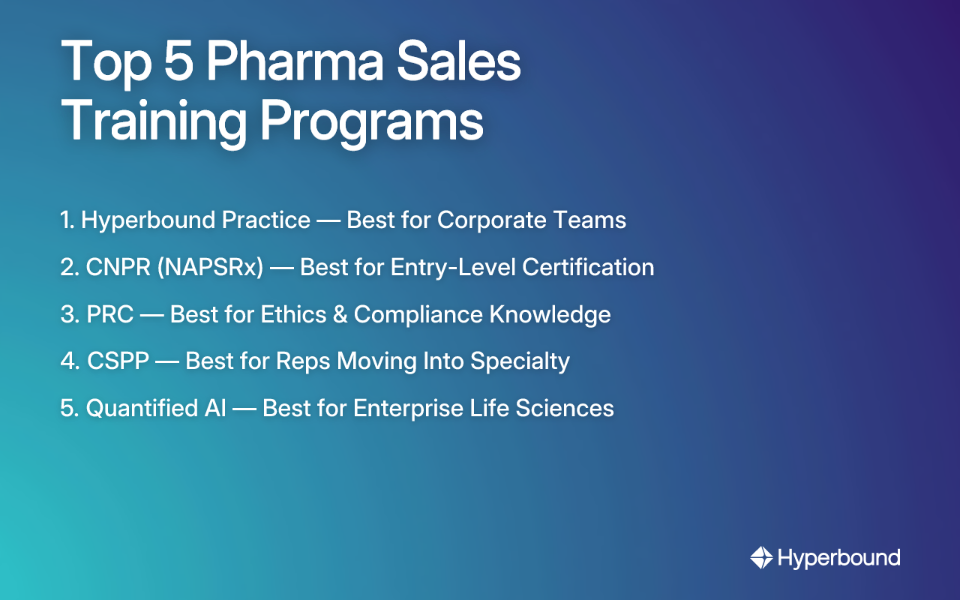
Best for: Sales managers and enablement leaders at pharmaceutical and medical device companies whose reps need to move from product knowledge to confident, compliant field execution.
Traditional pharma sales training too often relies on "perfect world" scenarios that leave reps flat-footed the moment a real HCP pushes back with a data objection, cuts the visit short, or asks a compliance-sensitive question. That gap between what reps know and what they can do under pressure is where deals — and relationships — are lost.
Hyperbound Practice is purpose-built to close that gap. It's an AI roleplay platform that lets reps rehearse real, high-stakes conversations in a risk-free environment — over and over, at scale — until confident execution becomes muscle memory.
How it works for pharma and medical device teams:
Proven results: Hyperbound delivers 50% faster ramp, a 150% increase in DM-to-demo conversion rates, and 2x faster time to first won deal — validated across 45,000+ active users at companies including LinkedIn, Vanta, and Autodesk.
For medical device and pharma teams specifically, Hyperbound is actively expanding into this vertical with targeted HCP engagement scenarios, making it the go-to choice for any sales enablement leader who needs reps to master complex product conversations at scale.
Best for: Individuals new to pharmaceutical sales who want an industry-recognized credential to strengthen their resume and get past initial hiring filters.
The CNPR (Certified National Pharmaceutical Representative) program, offered by the National Association of Pharmaceutical Sales Representatives (NAPSRx), is one of the most widely recognized pharmaceutical sales training certificates available to aspiring reps. If a recruiter is asking for a certification, this is likely the one they have in mind.
What you'll learn:
Program details:
The bottom line: The CNPR is a legitimate credential that can help entry-level candidates signal foundational knowledge and commitment to the field. Just go in with clear eyes — it's a door-opener, not a guarantee, and it won't replace the practical conversation skills you'll need to succeed once you're in the role.
Best for: Aspiring pharma reps who want a certification with a strong emphasis on the ethical, regulatory, and conduct-related aspects of the role.
The PRC (Pharmaceutical Representative Certification), offered through pharmasalestraining.org, is another solid option for individuals entering the industry. Where CNPR leans toward product knowledge and selling technique, PRC focuses more heavily on pharmaceutical industry data, ethics, and professional codes of conduct — which is increasingly relevant as compliance scrutiny in the field intensifies.
What stands out:
If you want a certification that demonstrates you understand how to operate ethically in this industry — not just what the products do — the PRC is worth considering.
Best for: Tenured pharmaceutical sales reps transitioning into specialty roles, where the products are more complex, the clinical conversations go deeper, and the stakeholder landscape is more sophisticated.
The CSPP (Certified Specialty Pharmaceutical Professional) program moves well beyond entry-level foundational knowledge. It's designed for reps who already understand the basics and need to develop competency in the advanced clinical and financial dynamics that define specialty pharma sales.
What the curriculum covers:
This is a meaningful credential for any rep looking to level up within the industry or differentiate themselves in a competitive specialty territory.
Best for: Corporate L&D leaders at large life sciences organizations that need AI simulation training for both sales reps and Medical Science Liaisons (MSLs).
Quantified is an AI-powered simulation platform trusted by pharmaceutical companies including Novartis, Bayer, and Sanofi. It addresses the same core problem as Hyperbound — the failure of static LMS modules and inconsistent manual roleplays — but is positioned primarily for large enterprise life sciences organizations.
Reported outcomes:
Quantified is a strong option for organizations that need to train across both commercial and medical affairs functions in a single platform.
.png)
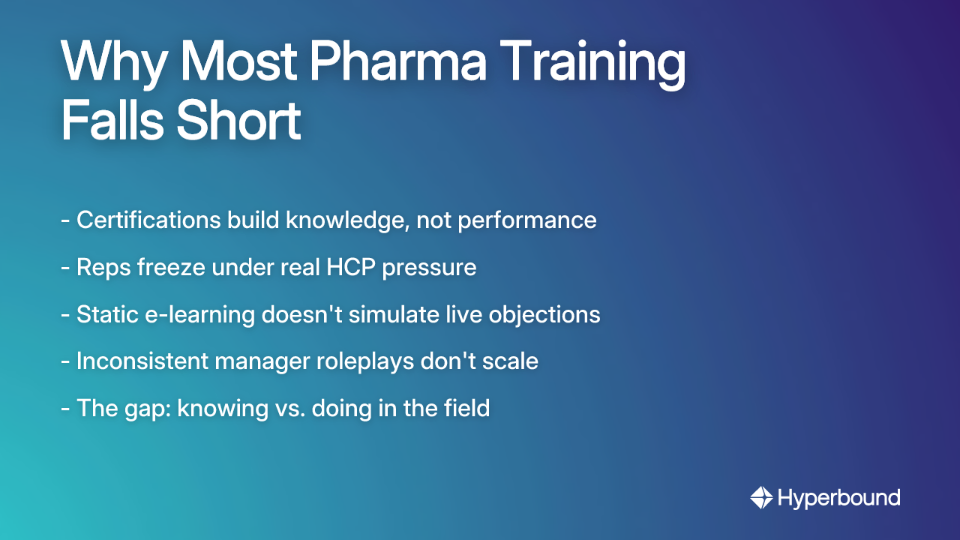
Certifications like the CNPR and PRC serve a real purpose — they help aspiring reps build a foundational knowledge base and clear the initial hurdle of getting noticed by hiring managers. If you're trying to break into pharma sales and a recruiter is asking for a pharma sales training certificate, these programs are legitimate and worth evaluating on their merits.
But here's where many training programs — even well-intentioned ones — fall short: knowledge and performance are not the same thing.
Your reps can pass every certification test, recite every clinical data point, and still freeze up when a cardiologist challenges their efficacy claims with a competing trial, or when a rushed office manager questions whether the visit is worth the physician's time. The gap between what a rep knows and what they can do in a live, high-pressure conversation with an HCP is the real performance problem facing most pharma and medical device sales teams.
That's the gap AI simulation platforms like Hyperbound are purpose-built to close. Unlike passive e-learning or one-off roleplay sessions with a manager, Hyperbound enables reps to practice the specific conversations they'll face in the field — repeatedly, with immediate feedback, at scale — until confident execution is the default, not the exception.
Not always, but it can significantly help. A certificate like the CNPR or PRC is often required by recruiters for entry-level positions, especially for candidates without a strong science background. It serves as a signal to hiring managers that you have foundational knowledge of medical terminology, industry regulations, and sales processes, making you a more credible candidate.
The best program depends on your specific goals. For individuals trying to enter the industry, a certification program like CNPR (for general recognition) or PRC (for an ethics and compliance focus) is ideal. For corporate sales teams aiming to improve field performance, an AI-powered practice platform like Hyperbound is best for turning existing product knowledge into confident, real-world conversation skills.
Recruiters often use certifications as a screening tool to identify serious candidates who have invested in learning the fundamentals of the pharmaceutical industry. For them, a certified candidate is perceived as lower risk and more likely to have the baseline knowledge required to succeed, reducing the initial training burden on the hiring company.
Managers can improve team performance by moving beyond knowledge-based training to skill-based practice. The most effective method is to provide reps with a safe environment to rehearse realistic, high-stakes conversations with Healthcare Professionals (HCPs). AI simulation platforms like Hyperbound allow teams to practice handling tough objections, navigating compliance issues, and mastering their messaging at scale, with instant, objective feedback to accelerate skill development.
Both the CNPR and PRC are valuable for new reps, but they have different areas of emphasis. The CNPR program is widely recognized and focuses broadly on product knowledge, medical terminology, and sales techniques. The PRC program places a stronger emphasis on the ethical and regulatory aspects of the role, focusing on industry compliance and professional codes of conduct.
AI roleplay helps by closing the critical gap between knowing product information and being able to deliver it effectively under pressure. Reps can practice realistic conversations with AI-powered HCP personas, handle difficult objections, and refine their messaging in a risk-free environment. This repeated practice builds muscle memory and confidence, ensuring they are prepared for real-world interactions in the field.
If your team already has product knowledge but struggles to convert it into confident HCP conversations, see how Hyperbound delivers 50% faster ramp for field sales teams.










Use Cases
Legal