
Gong is the undisputed heavyweight of conversation intelligence. It pioneered the category, set the standard for call recording, and gave sales teams their first real window into what happens on the phone. If you're in sales, you've heard of it — and there's a good reason for that.
But here's the uncomfortable truth teams are discovering after they've lived with Gong for a year or two: call recording is not deal inspection.
And the cost? The frustration is real. Teams report that "Gong got way too expensive for us," and many simply "couldn't justify the thousands of dollars of setup and recurring cost." Even for those who can afford it, the deeper problem persists — Gong gives you an excellent rearview mirror of individual conversations, but it doesn't tell you whether your deal is actually healthy, why it's stalling, or what your rep should do differently before the next call.
This distinction matters more than most teams realize. A call summary tells you what was said. A sales deal inspection tool tells you what's at risk — and what to do about it.
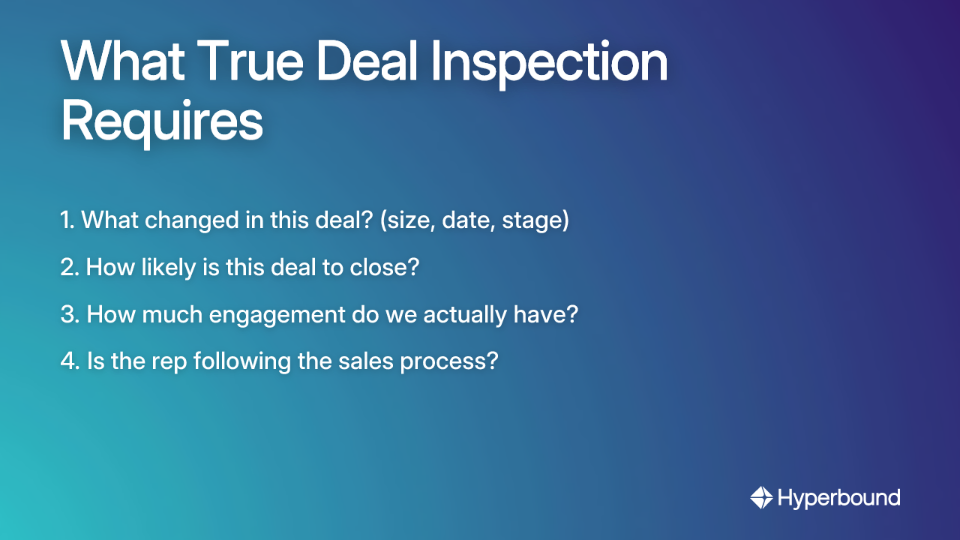
True deal inspection is a systematic process of analyzing behavior and data across an entire deal lifecycle — not just one call — to assess health, identify early risk signals, and prescribe actions to improve win rates. According to Clari's 4-Point Deal Inspection Framework, genuine inspection demands answers to four questions:
That requires three capabilities that go well beyond standard call analysis:
This is the lens we'll use to evaluate every tool on this list.
Best for: Revenue teams that want to move beyond analyzing calls and start using conversation data to actively change deal outcomes.
Hyperbound Perform was built specifically to close the gap between call-level analysis and deal outcomes — making it the strongest pure-play sales deal inspection tool on this list. Where most call intelligence platforms stop at the individual conversation, Perform rolls up insights across every touchpoint in a deal to surface what's helping, what's hurting, and what to do next.
Key deal inspection capabilities:
The operational loop Hyperbound enables is unlike anything else on this list: Score Real Calls → Identify Skill Gaps → Practice Roleplays → Score Again. Behavior drives coaching. Coaching drives deal momentum. Deal momentum drives revenue.
Customers like Vanta saw a 60% reduction in ramp time (from 210 to 72 days) and 5x pipeline growth after adopting the platform. Nivoda reported a 50% ramp reduction and 150% increase in demo conversion rates.

The verdict: Hyperbound Perform is the only platform here that provides a dedicated deal inspection layer and an integrated practice environment — making it the strongest choice for teams ready to stop just analyzing deals and start winning them.
Best for: Enterprise revenue teams focused on pipeline visibility and forecast accuracy.
Clari is a serious deal inspection platform — arguably the most sophisticated pure-play pipeline intelligence tool available. Its AI-driven opportunity scoring aggregates CRM activity, historical close rates, and deal stage movement to give leadership a highly reliable view of which deals will close. The 4-Point Deal Inspection Framework it's built around is exactly the kind of structured analysis that separates real deal inspection from basic call logging.
Where it falls short: Clari is exceptional at telling you that a deal is at risk. It's less equipped to explain the conversational behaviors causing that risk — and it offers no integrated coaching or practice mechanism to fix them. It's a "what and when" tool, not a "how to fix it" platform.
Best for: RevOps and sales teams who want to automate deal workflows and real-time alerts within Slack.
Momentum takes a different angle on deal intelligence: instead of deep analysis, it focuses on orchestration. It connects Gong, Salesforce, and other tools to trigger smart notifications — alerting a manager when a deal stalls, auto-creating follow-up tasks, or pushing CRM updates based on call signals.
Where it falls short: Momentum is a workflow automation engine, not a behavioral analysis platform. It moves data and alerts teams efficiently, but it doesn't perform the cross-call analysis to diagnose why a deal is trending down from the conversation data itself. It's a great complement to a deal inspection tool, not a replacement for one.
Best for: Large sales teams needing a direct Gong competitor with strong call transcription and ZoomInfo data integration.
Chorus delivers solid call-level conversation intelligence — transcription, speaker analytics, and performance dashboards are all competitive. For teams already inside ZoomInfo's ecosystem, the native data enrichment adds useful context.
Where it falls short: As noted in Hyperbound's Perform launch analysis, Chorus primarily focuses on single-call evaluations without tying insights to deal progression effectively. There's no dedicated mechanism for rolling up insights across a deal's full lifecycle or generating a coaching recommendation specific to an active opportunity.
Best for: SMBs and mid-market teams looking for real-time coaching cues during live calls.
Salesken's approach is tactical and in-the-moment. It analyzes calls as they happen and surfaces live prompts for things like objection handling and talk track adherence — useful for newer reps who need guardrails during high-stakes calls.
Where it falls short: The focus on live, single-call assistance means Salesken doesn't provide the strategic, longitudinal view of deal health over time. It helps win the moment, but doesn't inspect the overall health of an in-flight deal across multiple touchpoints or stakeholders.
Best for: Managers who want to use call recordings as a collaborative coaching tool with their teams.
Jiminny makes call review a team sport — AI-driven scoring, shareable playlists, and collaborative annotation tools help managers train reps using real conversations. It's one of the more intuitive coaching interfaces available, particularly for teams that leverage call libraries for onboarding.
Where it falls short: Jiminny is built around coaching from individual calls, not inspecting the health of deals across multiple calls. There's no structured deal inspection framework that aggregates behavioral signals across an entire opportunity to assess risk or recommend deal-specific next steps.
.png)
.png)
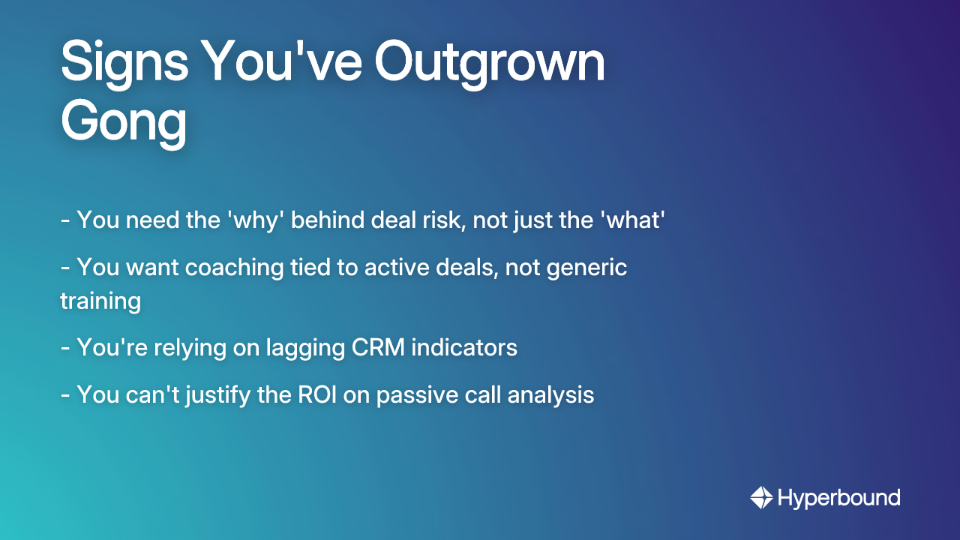
Not every team needs to make a change. But if any of these sound familiar, it's worth looking hard at what you're actually getting from your current stack:
Call recording is becoming a commodity. Transcription is table stakes. The real differentiation — and the future of sales technology — lies not in passively analyzing data, but in activating it to change rep behavior and drive deal outcomes.
Gong pioneered the first wave of conversation intelligence. But the question teams are asking now isn't "what happened on that call?" — it's "what do I do next to win this deal?"
That's the gap Hyperbound was built to close. With Hyperbound Perform scoring 100% of real calls against your methodology, surfacing deal-level risk signals from behavioral data, and connecting directly to targeted AI roleplays in Hyperbound Practice — the loop from insight to action is finally complete.
Call recording captures what was said on a single call, providing a transcript and summary. Deal inspection, on the other hand, is a strategic analysis of behavior, data, and trends across all interactions within a deal's lifecycle to assess health, identify risks, and guide reps on the next best actions to improve win rates.
Gong is a powerful call recording and conversation intelligence tool, but it primarily focuses on analyzing individual calls in isolation. True deal inspection requires connecting insights across multiple touchpoints to understand the deal's overall momentum and health. Gong doesn't inherently provide a longitudinal view of deal risk based on behavioral trends or offer an integrated coaching loop to fix issues in active deals.
A robust deal inspection tool goes beyond transcription and should include three core capabilities:
AI deal coaching helps teams win more by moving from reactive analysis to proactive improvement. It automatically scores 100% of calls against a team's sales methodology, identifies specific skill gaps (like poor objection handling or weak discovery) within a live deal, and then prescribes targeted AI roleplays for the rep to practice before their next call. This closes the gap between identifying a problem and fixing it, directly impacting deal momentum.
No, you do not have to replace your existing systems. A major advantage of platforms like Hyperbound Perform is that they are designed to be an intelligence and activation layer that integrates with and enhances your current call recording tools, including Gong, Chorus, and Salesloft. This allows you to get more value from your existing tech stack without a disruptive change.
Your team has likely outgrown basic call recording if you're experiencing these challenges:
Ready to see what true deal inspection looks like in your pipeline?
Book a demo of Hyperbound Perform →










Use Cases
Legal