
You've just wrapped up your third call of the day. You know some parts went well, but you're stuck wondering: Did you talk too much? Did you miss buying signals? What objections did you handle poorly?
If you're like most sales reps, you're either relying on your manager's subjective feedback (if you're lucky enough to get it) or you're attempting to evaluate your own calls—while fighting that nagging voice that says, "I'm biased!"
The good news? AI call scoring tools have evolved dramatically, offering objective, data-driven insights that can transform how your team analyzes conversations and improves performance.
Traditional call coaching has serious limitations: managers can only review a fraction of calls, feedback often varies between coaches, and the process simply doesn't scale with growing teams. AI call scoring solves these challenges by providing:
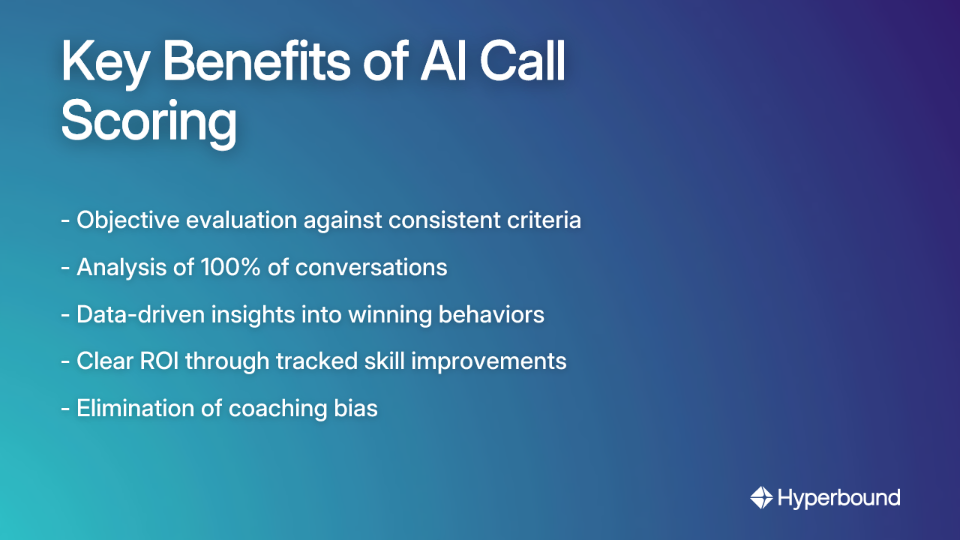
AI uses predefined scorecards to evaluate every call against the same criteria, eliminating human subjectivity. As one sales rep mentioned in a Reddit discussion, "I thought about creating my own cold call scorecard... but I'm biased!" AI removes this problem entirely.
Even the most dedicated sales manager can't listen to every call. AI automatically reviews 100% of conversations, ensuring no coaching opportunity is missed and no rep is left behind.
By analyzing thousands of calls, AI identifies the specific talk tracks, questions, and behaviors that correlate with successful outcomes. This data-driven approach reveals exactly what your top performers do differently.
Modern platforms track skill improvements over time and measure their impact on metrics like meeting book rate and quota attainment, creating a clear ROI for coaching efforts.
Not all AI call scoring tools are created equal. Here are the essential capabilities to consider when evaluating platforms for 2025:
The foundation of any good platform is accurate speech-to-text conversion and analysis of key metrics like talk-listen ratios, conversation flow, and topic coverage.
Look for tools that allow you to tailor scoring criteria to your specific sales methodology—whether that's MEDDIC, BANT, Challenger, or your own proprietary framework.
Time-saving features like AI-generated call summaries extract key moments, objections, and buying signals, allowing managers to quickly review calls without listening to every minute.
Some platforms provide on-screen prompts during live calls, while others focus on deep analysis after the conversation. Consider which approach aligns with your team's needs.
The platform should seamlessly connect with your existing tools (Salesforce, HubSpot, Zoom, etc.) to automate data logging and provide a holistic view of performance.
Forward-thinking platforms go beyond analysis to help reps prepare for future calls through AI roleplay simulations, creating a complete feedback loop.
Description: An AI Sales Coaching platform that uniquely combines call analysis with hyper-realistic AI roleplays to create a complete sales readiness solution.
Key Features:
Best For: Sales teams focused on practical skill development, consistent onboarding, and scaling effective coaching across the organization.
Pros: Creates a continuous improvement loop (analyze → practice → improve), supports 25+ languages, and offers both call scoring and skill development in one platform.
Cons: More focused on skill development than pure revenue forecasting.
Description: An industry-leading revenue intelligence platform that analyzes customer interactions across calls, emails, and meetings.
Key Features:
Best For: Enterprise sales teams needing comprehensive revenue intelligence and forecasting capabilities.
Pros: Powerful analytics, extensive integration capabilities, robust market intelligence.
Cons: Premium pricing that may be prohibitive for smaller teams, complex implementation process.
Description: A conversation intelligence tool that delivers actionable insights for improving team performance, now enhanced with ZoomInfo's market data.
Key Features:
Best For: Sales organizations already using ZoomInfo that want to enrich call data with market intelligence.
Pros: User-friendly interface, strong CRM integration, excellent content sharing.
Cons: Higher price point, occasional syncing issues reported by users.
Description: An AI-powered communication platform that integrates call scoring as part of its broader suite of services.
Key Features:
Best For: Teams looking for an all-in-one communication and coaching solution.
Pros: Provides immediate coaching opportunities, comprehensive communication platform.
Cons: Call scoring features are part of higher pricing tiers, some transcription accuracy issues with accents.
Description: A real-time guidance platform providing live prompts and checklists to reps during active calls.
Key Features:
Best For: High-volume call centers and teams focused on immediate performance improvement and compliance.
Pros: Immediate impact on call outcomes, reduces training time for new reps.
Cons: Can feel intrusive to some agents, less focused on deep historical analysis.
Description: A flexible and cost-effective call recording and scoring solution with multiple deployment options (cloud, on-premise, hybrid).
Key Features:
Best For: Businesses needing a cost-effective, compliance-focused solution, especially those with specific on-premise requirements.
Pros: Cost-effective option for teams on a budget, strong compliance features.
Cons: AI capabilities may be less advanced compared to newer, specialized services.
Your ideal platform will depend on your specific role, team size, and primary objectives. Here's a decision guide based on common use cases:
.png)
Priority: Revenue intelligence, forecasting accuracy, and market trends.
Top Choices: Gong.io or Chorus.ai. These platforms excel at connecting conversation data to deal outcomes and providing high-level strategic insights.
Why: You need comprehensive analytics that tie conversation patterns to revenue outcomes and provide visibility across large, distributed teams.
Priority: Coaching efficiency, playbook adherence, reducing ramp time, and certifying reps on messaging.
Top Choice: Hyperbound. Its combination of real call scoring and AI roleplays provides a complete feedback loop: analyze performance, identify gaps, and close them with targeted practice.
Why: Hyperbound addresses a key challenge mentioned by sales professionals—creating structured evaluation frameworks that eliminate bias. Its AI-powered scorecards provide objective assessment while the roleplay capabilities allow reps to practice improvements in a safe environment.
Priority: Objective feedback, self-improvement, and affordability.
Top Choices: MiaRec for cost-effectiveness or platforms like Hyperbound that offer self-serve practice capabilities.
Why: Budget constraints are real—especially for teams outside the US, as one Reddit user mentioned. These solutions provide valuable insights without enterprise-level investment.
Priority: Improving renewal rates, identifying upsell opportunities, and handling difficult customer conversations.
Top Choices: Look for platforms with dedicated post-sales capabilities. Hyperbound's AI Post-Sales Roleplays specifically help CSMs practice renewal and upsell conversations.
Why: Customer success conversations have different objectives and dynamics than sales calls, requiring specialized coaching approaches.
The era of subjective, inconsistent call coaching is ending. As we approach 2025, AI call scoring tools are becoming a standard part of high-performing sales organizations' tech stacks—not just for analysis but for comprehensive skill development.
The most effective platforms don't just tell you what happened in past conversations; they help you prepare for future ones by combining:
When choosing an AI call scoring tool, consider your team's primary needs—is it forecasting, compliance monitoring, or skill development? Use this guide to shortlist vendors and start your journey toward a more data-driven coaching culture.
Remember that the ultimate goal isn't just better call scores—it's better conversations that lead to stronger relationships, more closed deals, and accelerated revenue growth. The right AI call scoring tool is the one that helps you achieve these outcomes in a way that works for your unique team and selling environment.
AI call scoring is the process of using artificial intelligence to automatically analyze and evaluate sales conversations against a predefined set of criteria. It replaces subjective, manual call reviews with objective, data-driven insights. The technology transcribes calls, identifies key moments, and scores performance on factors like talk-listen ratio, question-asking, objection handling, and adherence to a sales methodology, providing consistent feedback across every call.
AI call scoring improves sales performance by providing objective, consistent, and scalable feedback that helps reps identify weaknesses and learn from the winning behaviors of top performers. Unlike traditional coaching where managers can only review a few calls, AI analyzes 100% of conversations. This data reveals what specific talk tracks and techniques correlate with success, allowing teams to connect coaching efforts directly to results like higher meeting book rates.
While related, call scoring focuses specifically on evaluating the performance and skills demonstrated within a conversation, whereas revenue intelligence takes a broader view, connecting conversation data to deal health, pipeline risk, and sales forecasting. Think of call scoring as the "how" of a conversation (e.g., "Did the rep ask good discovery questions?"). Revenue intelligence platforms use this data to answer bigger questions like, "Is this deal likely to close?"
Yes, small businesses can significantly benefit from AI call scoring, as many modern platforms offer affordable and scalable solutions. For small teams, AI coaching provides a level of analysis and feedback that would otherwise require a dedicated sales enablement manager. Tools like MiaRec or Hyperbound provide cost-effective options that help smaller companies compete with larger organizations without an enterprise-level investment.
The most important features include accurate transcription, customizable scorecards, AI-powered summaries, seamless CRM integration, and capabilities for practice or role-playing. Customizable scorecards are crucial for tailoring analysis to your specific sales methodology. Features that connect analysis with practice (like AI roleplays) are also vital, as they create a complete feedback loop that accelerates skill development.
You should choose the right tool by first identifying your primary goal—whether it's revenue forecasting, agent compliance, or practical skill development—and then matching it to a platform's core strengths. For example, enterprise leaders focused on forecasting might choose Gong.io, while sales managers focused on coaching and skill certification would benefit from a solution like Hyperbound that combines analysis with practice.
To see how AI-powered scoring and roleplay can transform your team's readiness and performance, explore what platforms like Hyperbound can offer. With the right tools in place, you can create a culture of continuous improvement where every call becomes an opportunity to learn, grow, and win.










Use Cases
Legal