
You've felt the dread before. Another product launch, another slide deck, another day of watching your sales team's eyes glaze over during "death by PowerPoint" training. As one sales professional put it on Reddit, "PowerPoint training for new products is basically the industry standard and honestly it's pretty broken." The reality? These sessions often waste "very productive worktime" with information that "90% of the time won't be shared during sales consulting."
But here's the truth: A successful product launch hinges entirely on your sales team's ability to confidently articulate value, navigate tough questions, and handle new objections from day one. Without effective training, your reps lack the muscle memory to perform under pressure, putting your revenue goals at serious risk.
The solution isn't more slides—it's better tools focused on practice, reinforcement, and data-driven coaching. Research shows well-structured training helps new hires achieve productivity up to 40% faster, and teams leveraging AI-powered training tools see a 20-30% increase in win rates.
Let's explore the eight best tools to ensure your next product launch training actually sticks.
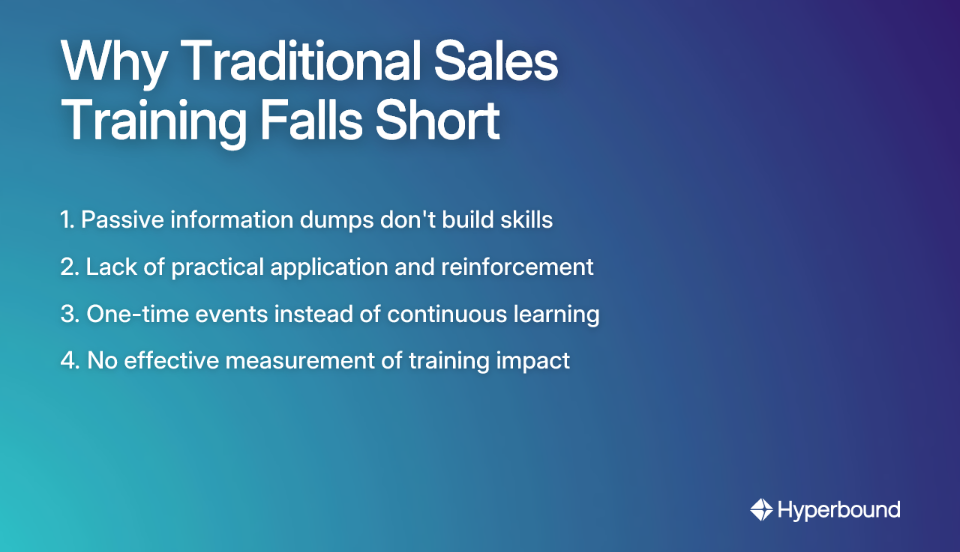
Before diving into the solutions, let's acknowledge why conventional training methods fall short:
The best modern tools address these shortcomings by creating continuous cycles of practice, feedback, and improvement that drive real-world performance.
Best for: Building conversational mastery and certifying reps on new product messaging through hyper-realistic AI role-plays
Hyperbound stands out as an advanced AI Sales Coaching platform designed to bridge the critical gap between knowing product features and being able to sell them effectively. It addresses the core challenge of ensuring the entire team can consistently deliver new messaging and handle customer objections from day one.
Key Features for Product Launch Training:
Why it works for product launches: It provides unlimited, risk-free practice, building the "muscle memory" reps need to be confident and effective from the very first call about the new product. It solves the problem of "how to have reps actually practice the conversations" in a scalable way.
Best for: Analyzing real-world customer conversations to validate and refine new product messaging post-launch
Gong is a leading conversational intelligence platform that records, transcribes, and analyzes sales calls. For a product launch, it's the ultimate source of truth to understand how the new messaging is actually landing with prospects and customers.
Key Features for Product Launch Training:
Why it works for product launches: It provides the data-driven feedback loop needed to iterate on the new playbook in real-time. While invaluable, some teams find the cost prohibitive, a common pain point mentioned in user research.
Best for: Building comprehensive sales readiness programs that certify reps are prepared to sell a new product
Mindtickle is a sales readiness and enablement platform focused on ensuring reps have the knowledge and skills they need before they engage with customers. It's ideal for creating structured learning paths around a new product.
Key Features for Product Launch Training:
Why it works for product launches: It provides a structured way to manage and measure a rep's readiness, moving beyond simple "training complete" metrics to actual skill certification.
Best for: Centralizing new product collateral and providing just-in-time training content
Showpad is a sales enablement platform that combines content management with training and coaching. It ensures that when a new product launches, reps have one centralized place to find the right content and refresh their knowledge.
Key Features for Product Launch Training:
Why it works for product launches: It solves the content chaos that often accompanies a product launch, ensuring reps are always using the latest, on-brand materials.
Best for: Automating the creation of personalized content and measuring its impact during a product launch
Similar to Showpad, Seismic is a powerful sales enablement platform focused on content automation and analytics. It excels at helping reps tailor the new product's story to each specific buyer.
Key Features for Product Launch Training:
Why it works for product launches: It empowers reps to deliver a highly relevant and personalized message about the new product at scale, improving buyer engagement.
Best for: Creating and tracking simple, interactive learning modules for foundational product knowledge
Lessonly is a user-friendly Learning Management System (LMS) designed for team training. It's perfect for building the foundational knowledge base that reps need before they can start practicing their pitch for a new product.
Key Features for Product Launch Training:
Why it works for product launches: It ensures a consistent baseline of knowledge across the entire team before moving on to more advanced, skill-based training like role-playing.
Best for: Agile, asynchronous video training and peer-to-peer pitch practice
Loom is a video messaging tool that allows for quick and easy screen and camera recording. For a product launch, it's a flexible and modern tool for managers to share updates and for reps to practice and get feedback.
Key Features for Product Launch Training:
Why it works for product launches: It offers a low-friction, scalable way to conduct ongoing training and coaching that fits into a rep's daily workflow.
Best for: Creating score-based, on-demand video training and coaching content
Brainshark is a sales enablement and readiness platform that specializes in helping companies create and deliver data-driven video coaching content. It's designed to make training more formal and measurable.
Key Features for Product Launch Training:
Why it works for product launches: It formalizes video-based training, providing clear metrics on rep readiness and ensuring everyone has mastered the core pitch before engaging with customers.
.png)
Choosing the right tool depends on your team's specific needs. Before you invest, consider these factors based on industry best practices:
Launching a new product successfully requires more than a great slide deck. It requires a sales team that is confident, consistent, and competent in every customer conversation. The days of passive, time-consuming training are over.
The most effective modern training tools bridge the critical gap between knowing what to say and knowing how to say it. They create a continuous cycle of practice, feedback, and improvement that drives real-world performance.
The most critical element is providing sales representatives with opportunities for realistic practice. While foundational knowledge is important, the ability to confidently articulate value, handle objections, and navigate real-world conversations is what truly drives success. Tools that offer practice, such as AI-powered role-plays, build the "muscle memory" needed for reps to perform under pressure from day one of the launch.
Traditional PowerPoint training fails because it is a passive learning experience that doesn't build practical selling skills. Sales reps retain very little from information dumps that lack application. These one-time events don't allow for practice, reinforcement, or skill development, leaving reps without the confidence and conversational fluency to effectively sell the new product.
AI improves sales training by providing scalable, personalized, and data-driven practice and coaching. AI-powered tools can simulate realistic sales conversations, allowing reps to practice pitching the new product and handling objections in a risk-free environment. AI can also analyze real and practice calls to provide objective feedback that helps reps improve much faster than with traditional methods alone.
A sales enablement platform focuses on content management and knowledge delivery, while an AI coaching tool focuses on developing conversational skills through practice. Sales enablement platforms like Showpad or Seismic are excellent for organizing product collateral and providing just-in-time learning modules. AI coaching platforms like Hyperbound are designed to build performance skills, letting reps actively practice applying that knowledge in simulated conversations to master the new messaging. The two types of tools are often complementary.
You can measure training effectiveness by tracking both leading and lagging indicators, such as rep certification rates, content adoption, and sales performance metrics. Modern training tools provide robust analytics for leading indicators like rep scores on practice scenarios and quiz results. Lagging indicators, tracked with conversation intelligence tools, include metrics like pipeline generated for the new product and win rates for deals involving the new offering.
The best way to ensure mastery is through a continuous cycle of practice, feedback, and reinforcement. Reps must internalize new messaging by practicing it repeatedly in realistic scenarios. Tools that offer AI role-plays allow for this scalable practice, which should be combined with feedback from call recordings and coaching to refine their delivery and ensure the entire team can consistently and confidently articulate the product's value.
To ensure your team can master new product messaging and handle any objection through realistic, AI-powered practice, see how Hyperbound can transform your next product launch.









Use Cases
Legal