
You've listened to hundreds of sales calls, but the takeaways often feel subjective. One manager says your rep built "great rapport," while another criticizes them for "too many questions." Without an objective system, how can you consistently measure what actually works?
This problem plagues sales organizations everywhere. Traditional call coaching based on "gut feel" is impossible to scale, creates inconsistent feedback, and perpetuates sales myths that don't hold up to data. Case in point: A Reddit analysis of 100+ top-performing sales calls revealed that "top salespeople have almost zero rapport" and ask "less than 5 questions in discovery" — challenging conventional wisdom about what makes a successful call.
The solution? AI-powered call scoring tools that analyze every conversation against a consistent, data-driven framework. These platforms uncover the specific behaviors that separate your top performers from the rest, providing objective feedback that can transform your coaching approach.
This article breaks down the 8 best tools to help you implement objective call scoring, build consistency across your team, and create a scalable system for sales excellence.
Overview: Hyperbound stands out as an advanced AI Sales Coaching platform that moves beyond simple scoring. It analyzes your team's actual winning behaviors and uses those insights to create a full-circle coaching loop — from analysis and scoring to hyper-realistic AI practice roleplays.
Key Features for Call Scoring & Coaching:
Key Benefits:
Overview: A leader in the revenue intelligence space, Gong analyzes customer-facing interactions across phone, email, and web conferencing to deliver insights that help close more deals.
Key Features for Call Scoring:
Key Benefits: Helps identify successful sales strategies and replicates high-performing behaviors across the team. Proven to increase revenue and shorten sales cycles.
Overview: Chorus is a conversation intelligence platform that records, transcribes, and analyzes sales meetings to help teams understand what drives performance.
Key Features for Call Scoring:
Key Benefits: Provides detailed analysis of sales conversations, uncovers coaching opportunities, and helps managers track team performance.
Overview: SalesLoft is a comprehensive sales engagement platform, and its Conversation Intelligence feature is built directly into its workflow.
Key Features for Call Scoring:
Key Benefits: Excellent for teams already using SalesLoft for their sales engagement, as it provides a seamless, integrated experience for call analysis.
Overview: Dialpad offers an all-in-one business communications platform with powerful, integrated AI features for real-time transcription and analysis.
Key Features for Call Scoring:
Key Benefits: Strong for teams that need both a phone system and integrated, real-time coaching and scoring capabilities in a single solution.
Overview: Jiminny is a conversation intelligence tool focused on helping sales teams record, transcribe, and analyze calls to improve performance.
Key Features for Call Scoring:
Key Benefits: Provides structured, metric-driven feedback and creates clear benchmarks for best practices across the team.
Overview: Clari Copilot focuses heavily on real-time assistance and integrates deeply with pipeline management and revenue operations.
Key Features for Call Scoring:
Key Benefits: Ideal for teams that want to prioritize real-time, on-the-fly coaching to improve rep performance during live conversations.
Overview: CallMiner is an enterprise-grade speech and interaction analytics platform that provides deep insights across multiple channels (voice, chat, email).
Key Features for Call Scoring:
Key Benefits: A powerful solution for large call centers or regulated industries where compliance and comprehensive quality assurance are critical.
Having the right tool is only half the battle. The real power of objective call scoring comes from using its data to solve the persistent, real-world problems your sales team faces every day. Let's look at what the data really says about what works.
.png)
The common belief: Reps need to build deep rapport and ask dozens of probing "salesy questions."
The data-driven reality: Analysis often shows the opposite. As one sales professional noted after reviewing 100+ calls, "the top sales people have almost zero rapport" and focus on a few basic qualifying questions. They don't ask annoying questions like "why is that important to you?" which puts buyers on the defensive.
How tools help: Call scoring tools can track talk-listen ratios, question patterns, and correlate them with win rates. Platforms like Hyperbound can analyze thousands of your calls to build a scorecard based on what your top reps actually do, not on generic sales advice from books.
The common pain: Reps get excited about the product and resort to "feature dumping," overwhelming the prospect without connecting features to their specific needs.
How tools help: Scorecards can include criteria like "Tied feature to customer pain point" or "Confirmed understanding before moving on." Conversation intelligence can track how much time is spent on monologue vs. dialogue, providing objective feedback to reps who dominate the conversation.
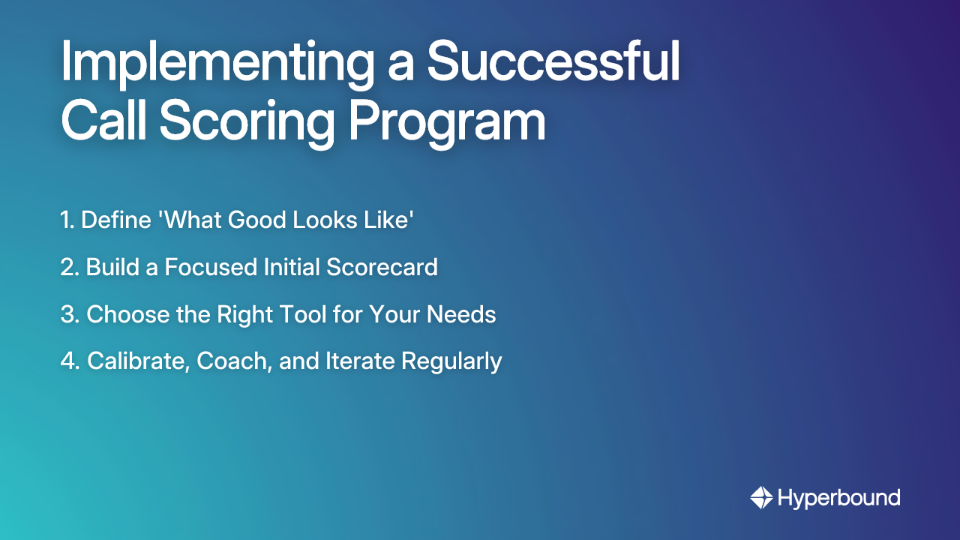
Before you buy a tool, define your goals. Are you trying to improve methodology adoption, increase discovery quality, or handle objections more effectively? Start with 1-2 key areas.
Don't try to score everything. Focus on 5-7 key behaviors. Use metrics like:
Refer back to the list. Do you need real-time coaching (Dialpad, Clari Copilot)? Deep enterprise analytics (CallMiner)? An all-in-one engagement platform (SalesLoft)? Or a complete coaching loop with analysis, scoring, and practice (Hyperbound)?
Moving from subjective feedback to objective, data-driven call scoring is no longer a luxury—it's a necessity for building a scalable and consistently high-performing sales engine.
These tools provide the insights to reduce ramp time, ensure message consistency, and ultimately drive more revenue. But remember that the ultimate goal isn't just to score calls, but to create a culture of continuous improvement.
The best platforms don't just tell you what happened; they provide the tools for your reps to practice and master the winning behaviors that lead to success. By combining AI-driven scoring with AI-powered practice—as seen in comprehensive solutions like Hyperbound—you create a powerful, scalable coaching loop that elevates your entire team.
Learn more about Hyperbound's AI Real Call Scoring to see how objective call scoring can transform your sales performance.
AI-powered call scoring is the process of using artificial intelligence to automatically analyze sales conversations against a predefined set of criteria to measure performance objectively. Unlike manual reviews, which are subjective and time-consuming, AI tools can analyze 100% of calls for specific behaviors, such as adherence to a sales methodology (like MEDDPICC), talk-listen ratio, key question-asking, and objection handling. This provides consistent, data-driven feedback for coaching.
Objective call scoring is better because it replaces subjective "gut feel" with consistent, data-driven feedback, making coaching scalable and fair. Traditional coaching often relies on a manager's personal opinion, which can be inconsistent from one manager to another. An objective system ensures every rep is evaluated against the same standard, which is based on the actual behaviors that lead to wins, not on outdated sales myths.
To create a sales call scorecard, start by defining 5-7 key behaviors that are critical to a successful call in your organization, then choose a tool to track them. Focus on core competencies like setting a clear agenda, uncovering specific customer pain points, adhering to your sales methodology, handling objections effectively, and establishing clear next steps. Avoid trying to score everything at once; start simple and refine your scorecard over time.
You can avoid making reps feel micromanaged by positioning call scoring as a developmental tool for their benefit, rather than a punitive one. The goal is to provide objective, personalized feedback that helps them close more deals and earn more commission. When reps see that the scoring is fair, consistent, and based on what top performers actually do, they typically embrace it as a way to improve their skills.
Key features to look for include automated transcription and analysis, customizable scorecards, integration with your CRM and existing call recording systems, and coaching workflows. Look for a platform that can automatically score calls against your specific sales methodology. Advanced platforms like Hyperbound go a step further by not only scoring real calls but also providing AI-powered roleplays for reps to practice and apply the feedback in a safe environment.
Conversation intelligence broadly analyzes what was said in a conversation, while call scoring specifically evaluates performance against a structured set of standards. Conversation intelligence tools are excellent for surfacing topics, keywords, and trends across all customer interactions. Call scoring is a more focused application that uses this intelligence to measure and grade specific rep behaviors and skills according to a predefined scorecard, making it a powerful tool for targeted coaching.







Use Cases
Legal