
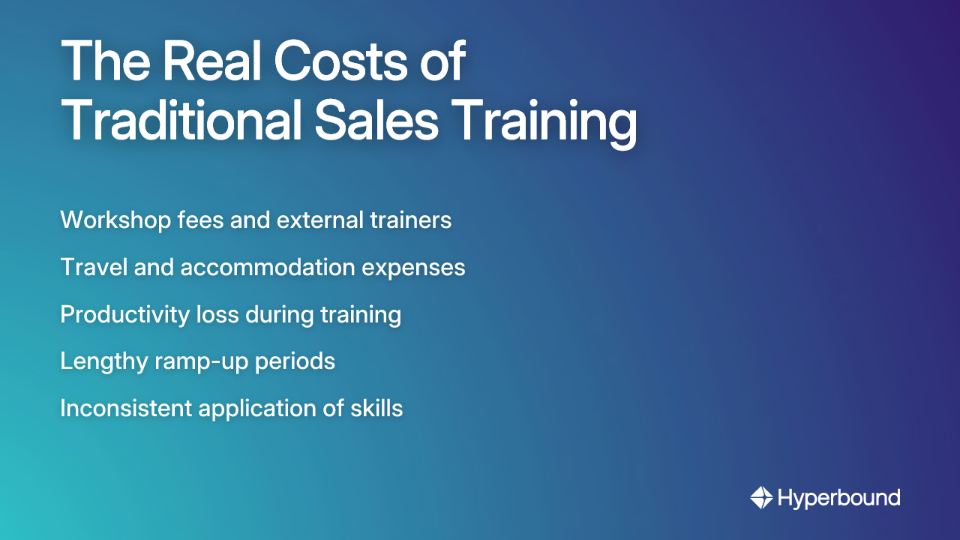
Effective sales training is crucial for driving revenue, but traditional methods are expensive, time-consuming, and often don't deliver the ROI you need. Between workshop fees, travel expenses, and the productivity loss during lengthy ramp-up periods, the costs add up quickly—both financially and in missed opportunities.
If you're like most sales leaders, you're probably frustrated with fragmented tools that make it difficult to scale effective coaching. You might struggle to "analyze patterns across multiple calls for effective coaching" or get "actionable feedback from call transcripts" that actually improves performance. Perhaps you need a realistic practice environment where reps can master handling objections without risking live deals.
The good news? Modern technology offers solutions that make training continuous, data-driven, and seamlessly integrated into your reps' daily workflow. The right tools can slash training costs while dramatically improving sales readiness and performance.
Let's explore eight powerful tools that can help your organization move beyond one-off training events to create a culture of constant improvement—directly impacting metrics like quota attainment and revenue.
Description: Hyperbound is an advanced AI Sales Coaching platform designed to transform how sales teams learn, practice, and perform by analyzing real conversations and providing hyper-realistic practice scenarios.
How it Reduces Training Costs:
Key Features:
.png)
Best for: Fast-growing B2B sales teams, remote or large sales organizations, and sales enablement leaders who need a scalable and consistent way to onboard, upskill, and coach their reps.
Description: A comprehensive Revenue Enablement Platform that combines training, content, and conversational intelligence in a single solution.
How it Reduces Training Costs:
Key Features:
Best for: Enterprises looking for an all-in-one revenue enablement solution to streamline their sales tech stack and processes.
Description: A leading Conversation Intelligence tool that records, transcribes, and analyzes sales meetings to uncover coaching insights.
How it Reduces Training Costs:
Key Features:
Best for: Sales teams that want to build a data-driven coaching culture based on insights from their own customer conversations.
Description: A Revenue Intelligence platform that captures and analyzes the full range of customer interactions across calls, emails, and web conferences.
How it Reduces Training Costs:
Key Features:
Best for: Enterprise sales organizations that need a powerful, market-leading platform to analyze all customer-facing interactions and drive revenue strategy.
Description: An easy-to-use training software designed for teams to quickly create and share learning materials.
How it Reduces Training Costs:
Key Features:
Best for: Teams needing a straightforward, user-friendly learning management system (LMS) to rapidly create and deploy training without a steep learning curve.
Description: A sales enablement platform that emphasizes peer-to-peer learning and collaborative coaching.
How it Reduces Training Costs:
Key Features:
Best for: Organizations that want to build a strong culture of peer coaching and collaborative learning to scale their training efforts.
Description: A sales readiness platform focused on preparing reps for any interaction through content creation and video-based coaching.
How it Reduces Training Costs:
Key Features:
Best for: B2B sales teams that rely heavily on formal presentations and need to ensure message consistency and rep readiness at scale.
Description: An on-demand library of high-quality online courses taught by industry experts.
How it Reduces Training Costs:
Key Features:
Best for: Companies of all sizes looking for a highly cost-effective solution for foundational and continuous sales skill development.
The days of expensive, one-size-fits-all sales training workshops are numbered. The future of sales readiness is agile, data-driven, and embedded in the daily workflow.
By adopting tools like the ones listed, you can move beyond simply cutting costs to building a more effective, consistent, and high-performing sales organization. These platforms provide scalable coaching, faster onboarding, and the analytics needed to prove the ROI of your training programs.
Ready to see how AI-powered role-playing and automated coaching can revolutionize your team's performance while lowering training expenses? Discover how Hyperbound builds winning sales teams.
Sales training tools reduce costs primarily by automating repetitive coaching tasks, shortening new hire ramp-up times, and eliminating expenses related to travel and in-person workshops. They provide on-demand practice environments (like AI role-plays), create reusable libraries of best-practice calls, and scale the impact of sales managers. This allows teams to onboard faster and improve performance with data-driven feedback, reducing the productivity loss associated with traditional training methods.
AI sales coaching is the use of artificial intelligence to analyze sales conversations, assess performance against a set playbook, and provide reps with instant, personalized feedback to improve their skills. Unlike manual call reviews, AI coaching platforms like Hyperbound can automatically score calls, identify coachable moments, and deliver objective feedback at scale. It also powers realistic role-playing scenarios where reps can practice handling objections and mastering their pitch in a risk-free environment.
AI role-playing is more effective than traditional methods because it is scalable, consistent, and available on-demand, allowing for unlimited, risk-free practice. While traditional role-plays with managers are time-consuming to schedule and can be inconsistent, AI personas provide a standardized, objective environment for reps to practice an entire sales cycle any time they need it. This frequent, targeted practice builds muscle memory and confidence far more quickly.
Conversation Intelligence (CI) platforms analyze past conversations to provide insights, while AI Sales Coaching platforms use that data to actively train reps for future conversations through practice and feedback. CI tools like Gong and Chorus are excellent for reviewing what happened on a call (the "game tape"). AI Coaching platforms like Hyperbound are for "practice," using AI to create interactive training scenarios and role-plays that directly build skills to improve future performance.
You can measure the ROI of a sales training tool by tracking key metrics like a reduction in new hire ramp time, improvement in quota attainment, higher win rates, and increased deal size. Before implementation, benchmark your current performance in these areas. Afterward, monitor the changes. You can also calculate direct cost savings from reduced travel, fewer external trainers, and lower employee turnover.
No, these tools are designed to augment sales managers, not replace them. They automate time-consuming tasks to free up managers for high-impact strategic coaching. AI can handle repetitive call reviews and provide initial feedback, allowing managers to move from being call inspectors to strategic coaches. This helps them have more targeted, insightful 1:1s focused on deal strategy and career development.










Use Cases
Legal