
You've closed the initial deal, but the real revenue opportunity lies in what comes next. Upselling to existing customers isn't just more efficient than acquiring new ones—it's essential for sustainable growth and maximizing customer lifetime value.
Yet many sales teams struggle with upsell conversations. They're different from initial sales—more nuanced, relationship-dependent, and often more challenging to navigate without proper practice.
"People are weird man. You can only start figure out how to sell to them after dealing with lots of them, seeing how they react," notes one sales professional in a Reddit discussion. This sentiment highlights a common challenge: how do you get enough "at bats" to master these critical conversations?
Enter AI simulation tools—though not without controversy. Many sales professionals remain skeptical, with complaints that most tools feel "robotic and not realistic" or struggle to handle the unexpected questions that arise in B2B conversations. As another sales rep bluntly put it, "AI needs to get less robotic before it truly helps here."
The good news? Modern AI simulation platforms have evolved dramatically, and today's best tools are addressing these historical shortcomings. Let's explore why simulation matters and the top six tools that can help your team master the art of the upsell.
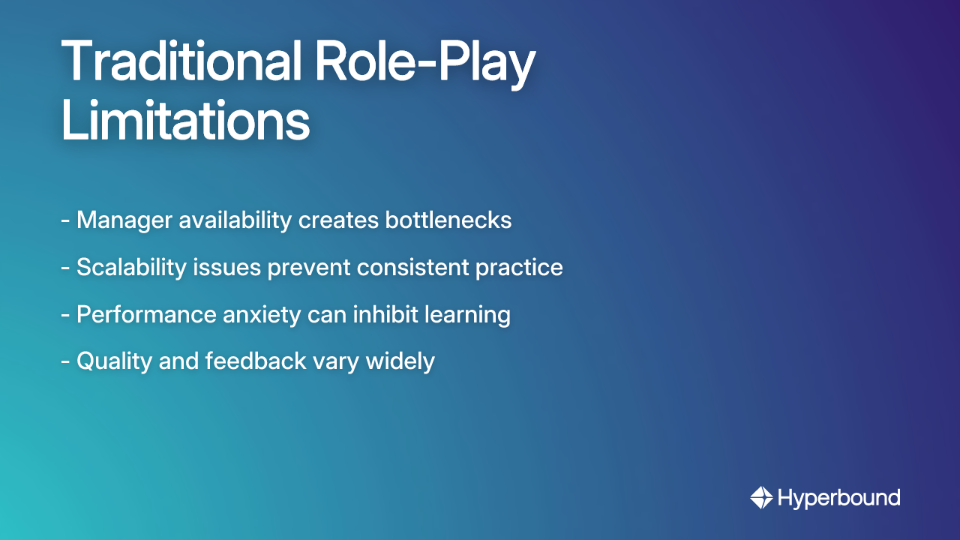
While traditional role-playing has its place, it comes with limitations:
Modern AI simulation tools offer compelling advantages:
The impact speaks for itself. According to ELM Learning, retention rates for digital learning increase significantly from 8-10% to 25-60% when using AI-powered practice tools.
Before investing in a solution, ensure it has these critical capabilities:
.png)
Now, let's examine the best tools on the market that meet these criteria.
Overview: Hyperbound stands out as an advanced AI Sales Coaching platform specifically designed to transform how teams practice critical conversations across the entire customer lifecycle.
How it Excels at Upsell Simulation: Unlike generic simulators, Hyperbound analyzes your actual sales calls to identify what works for your specific business. It then uses these insights to build hyper-realistic AI roleplays tailored to your company's unique products, customer base, and selling style.
Key Features for Upselling:
Best For: Companies serious about improving post-sales conversations at scale. Hyperbound is particularly valuable for organizations looking to standardize best practices, reduce churn, and increase net revenue retention through skilled customer conversations.
Overview: Second Nature offers an AI-powered simulation platform that uses conversational AI to create interactive practice environments.
Key Features for Upselling: The platform allows for natural discussions with AI personas and provides instant feedback on conversation quality. It integrates with popular CRM systems for a more seamless workflow.
Best For: Teams looking for a dedicated simulation tool with strong conversational AI capabilities but who may not require the deep call analysis and customization that Hyperbound offers.
Overview: While not a direct simulator, Gong is an essential conversation intelligence platform that captures and analyzes real customer interactions.
How it Helps with Upsell Practice: Use Gong to identify your team's best upsell conversations. Discover the exact language, timing, and discovery questions your top performers use, then apply these insights to your practice sessions.
Key Feature: The ability to track conversation trends and outcomes, providing the raw material for creating effective practice scenarios.
Best For: Sales teams that want to base their training and role-playing on data-driven insights from their real-world customer conversations.
Overview: Similar to Gong, Chorus.ai is a conversation analytics tool that provides insights into sales performance.
How it Helps with Upsell Practice: Chorus.ai enables coaching on effective upsell strategies by capturing and analyzing call data. Managers can identify coachable moments related to expansion opportunities.
Key Feature: The platform pinpoints trends in customer objections and successful talk tracks, which can inform simulation scenarios.
Best For: Organizations focused on a data-first approach to coaching, using real call analysis to guide their sales enablement programs.
Overview: PitchMonster focuses on pitch analysis and video-based role-playing for sales coaching.
Key Features for Upselling: The platform allows reps to practice their upsell pitch via video and receive AI-driven feedback on delivery, messaging, and persuasiveness.
Best For: Teams that want to focus specifically on refining the delivery and messaging of their upsell pitches.
Overview: SalesLoft is a comprehensive sales engagement platform with built-in coaching tools.
Key Features for Upselling: While not a dedicated simulator, SalesLoft offers call recording and scoring functionalities, along with AI-driven insights for performance improvement.
Best For: Teams already using the SalesLoft ecosystem who want to leverage its coaching features to improve upsell conversations.
.png)
Having the right tool is only half the battle. To maximize the effectiveness of your practice sessions, you need a framework for what to simulate.
Use this 7-step structure for your upsell practice scenarios, derived from proven sales methodologies:
By following this framework in your simulations, your team will develop the muscle memory needed for successful real-world upsell conversations.
Mastering the art of upselling is a skill that requires deliberate practice. While skepticism about AI role-playing tools is understandable based on past experiences, the new generation of platforms is changing the game.
By learning from real human conversations and creating dynamic, responsive scenarios, tools like Hyperbound are making sales simulation more realistic and effective than ever before. They provide the safe, scalable, and data-driven practice your team needs to build confidence and close more expansion deals.
Don't let your CSMs and AMs practice on live customers. The stakes are too high, and the opportunity cost of a botched upsell conversation can be substantial. Instead, leverage these simulation tools to equip your team with the skills they need to turn every customer interaction into a growth opportunity.
Remember, the most successful teams aren't just selling products—they're building partnerships. And that requires the kind of nuanced communication that only comes with practice.
Ready to transform your team's upselling capabilities? Start by evaluating which of these tools best aligns with your specific business needs, and begin building a culture of continuous practice and improvement.
Your customers—and your revenue growth—will thank you.
Practicing upsell conversations is crucial because these discussions are more nuanced and relationship-dependent than initial sales. It allows sales and customer success teams to master the skills needed to expand customer accounts, handle objections, and identify new opportunities without risking live customer relationships and real revenue.
The main advantages of AI simulation are scalability, consistency, and a safe, pressure-free practice environment. Unlike traditional role-playing, which depends on manager availability, AI tools provide unlimited, on-demand practice. They also offer objective, data-driven feedback, ensuring every team member receives the same high-quality coaching.
When choosing an upsell simulator, you should look for five key features: realistic and dynamic AI scenarios, deep personalization to match your products and customers, actionable feedback with custom scorecards, comprehensive analytics to track progress, and seamless integration with your existing CRM and sales tools.
AI simulators help teams handle objections by providing a safe, repeatable environment to practice responses to realistic, AI-generated customer pushback. This allows reps to build "muscle memory" for handling common concerns about pricing, timing, or value, so they can navigate these challenges confidently in real-world conversations.
Modern AI tools create realistic scenarios by analyzing your company's actual sales and customer calls. Platforms like Hyperbound use this data to understand your specific products, customer personas, and successful talk tracks, which it then uses to build dynamic AI role-players that respond naturally and are not bound to a script.
The most effective way to structure an upsell practice session is to follow a proven framework. Start by acknowledging the client's current success, use discovery questions to identify a new gap or need, present a clear value proposition for the upgrade, and then role-play handling potential objections before outlining a simple path to upgrade.










Use Cases
Legal