
The prospect hits you with it: "We're also looking at Competitor X. How are you different?" Your battle card is open in another tab, but frantically scanning a wall of text while on a live call is a recipe for disaster. Your mind goes blank, you stumble through a generic response, and you can feel the deal slipping away.
Sound familiar? You're not alone.
Many sales teams face this exact challenge. They invest heavily in creating detailed competitive battle cards, but when it comes to delivering that information confidently in high-pressure situations, reps often fall short. As one sales rep noted in a recent discussion, traditional role plays feel "unrealistic" and don't adequately prepare them for real-world pressure.
The key to winning competitive deals isn't just having intel—it's mastering its delivery. The good news? Modern tools, particularly AI-driven platforms, are now bridging this "practice gap."
A competitive battle card is a concise, actionable resource with insights on competitors, designed to guide reps on positioning and objection handling. But traditional battle cards are often static, hard-to-digest documents that reps struggle to use in the heat of conversation. As one product marketer pointed out, there's a persistent "difficulty in digesting and finding relevant information in the battlecards."
The market is evolving. We're moving away from static PDFs toward AI-powered solutions that not only manage competitive intel but also create environments where reps can practice using it effectively.
Let's explore the top tools that are transforming how sales teams prepare for competitive conversations.
.png)
Best For: Creating hyper-realistic, AI-powered simulations for reps to practice using battle card talk tracks in a safe, repeatable environment.
Hyperbound directly solves the "unrealistic role play" problem that plagues many sales teams. Sales leaders can create custom role-play scenarios based on specific competitors, where an AI buyer persona raises common objections cited by competitors. The rep must then use their battle card knowledge to respond effectively.
What makes Hyperbound stand out is the dynamic, human-like conversation its AI provides. Rather than reciting scripts, reps must think on their feet—just like in real calls. After each session, the platform delivers instant, objective feedback via AI-Powered Scorecards, highlighting whether the rep successfully positioned against the competitor, handled objections according to the sales playbook, and maintained control of the conversation.
Key Features:
Benefits:
Best For: Analyzing real-world sales conversations to understand how competitive mentions are handled and where battle card messaging is succeeding or failing.
Gong is for post-call practice and analysis. Its conversation intelligence engine automatically records, transcribes, and analyzes sales calls. Managers can set up trackers for competitor names. When a competitor is mentioned, Gong flags the call, allowing managers and reps to review exactly how the situation was handled.
This provides a library of real-world examples—both good and bad—of battle card usage. It helps identify patterns across many calls, addressing the user pain of "difficulty identifying skill gaps through isolated call analysis" that many teams experience.
Key Features:
Benefits:
Best For: Creating, managing, and distributing dynamic, AI-powered battle cards that are always up-to-date.
While not a direct practice tool, Crayon forms the foundation for effective practice. It automates the collection of sales intel from over 300 million sources, ensuring the content of your battle cards is fresh and accurate.
The key for "live scenarios" is Crayon's integrations. It can push battle card insights directly into tools reps live in, like Slack and Salesforce. A rep can quickly pull up a competitor's "landmine" question or key differentiator from within their CRM right before a call, facilitating last-minute practice and in-the-moment referencing.
Key Features:
Benefits:
Best For: Integrating battle card snippets and coaching notes directly into the sales engagement workflow for practice-in-action.
SalesLoft allows you to embed your sales playbook and battle card content directly into cadences and call workflows. As a rep makes calls or sends emails, relevant competitive talking points can appear on their screen. This serves as a form of guided, live practice.
Managers can create "Call Steps" in a cadence that include key bullet points from a battle card, prompting the rep to use them. The platform's conversation intelligence features can then be used to review if these points were mentioned.
Key Features:
Benefits:
Best For: Peer-to-peer coaching and video-based role-plays to practice battle card scenarios.
SalesHood is a sales enablement platform focused on collaborative learning. Managers can create coaching exercises where reps record themselves responding to a specific competitive objection (e.g., "Competitor X is cheaper"). Reps can then submit their video for feedback from both their manager and their peers.
This peer review process creates a culture of holistic coaching and allows reps to learn from each other's approaches to handling competitive situations.
Key Features:
Benefits:
Best For: Centralizing competitive intelligence and pushing actionable insights to reps for better adoption and live usage.
Similar to Crayon, Klue excels at collecting intel and creating dynamic battle cards. Its strength for practice lies in its robust browser extension and integrations. The Klue extension can recognize when a rep is on a competitor's website or viewing a competitive email and proactively surface the relevant battle card.
This just-in-time delivery of information helps reps internalize key differentiators and practice their responses in the context of their daily research and prospecting activities.
Key Features:
Benefits:
Having the right tools is only half the battle. Here's how to implement an effective battle card practice program:
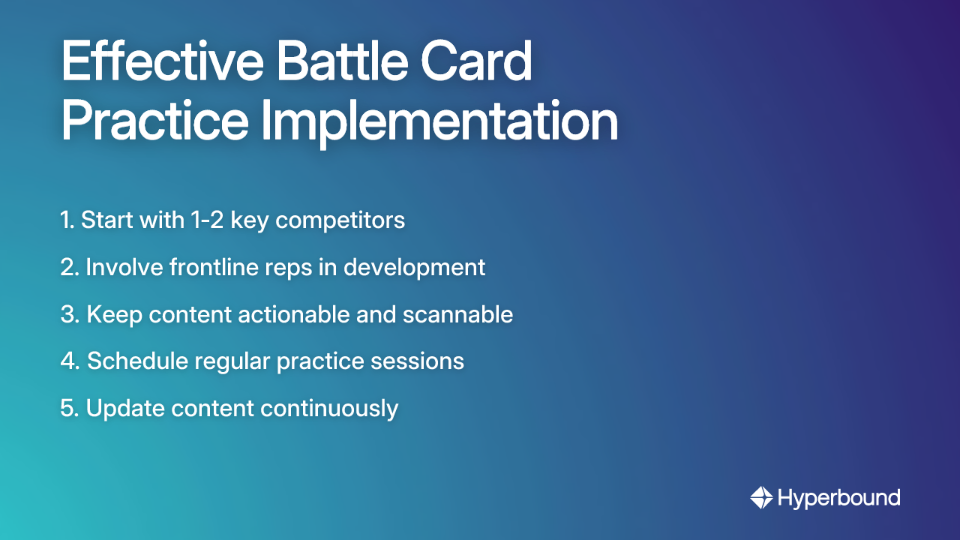
Focus on 1-2 key competitors first. Create detailed battle cards for your most common competitive scenarios before expanding. This prevents overwhelm and allows your team to master the fundamentals.
As highlighted in user discussions, a "lack of collaboration leads to ineffective battlecard development." Gather insights from reps on what they actually face on calls—the objections, questions, and competitor claims they encounter most frequently.
Limit battle cards to 1-2 pages of essential, scannable information. Focus on clear differentiation points, common objections, and specific talk tracks. Remember that a rep in a live scenario needs quick, actionable information—not a dissertation.
Practice and updates must be continuous, not one-off events. Set a cadence for:
Winning against competitors requires more than just data; it requires preparation and practice in realistic settings. The tools highlighted in this article provide various approaches to help your team master competitive conversations—from AI-powered simulations and peer coaching to just-in-time battle card delivery.
Platforms like Hyperbound, which provide AI role-play simulators, are no longer a luxury but a necessity for high-performing teams. By implementing a structured practice program with the right technology, you can ensure your reps are confidently equipped to handle any competitive situation that comes their way.
Remember: In competitive selling, it's not just what you know that matters—it's how effectively you can communicate it when it counts.
A competitive sales battle card is a concise, actionable resource with key insights about a competitor. It is designed to help sales reps effectively position their product, handle objections, and highlight key differentiators during conversations with prospects. While traditional battle cards are often static documents, modern tools are making them more dynamic and integrated into sales workflows.
Practicing with battle cards is crucial because simply having competitive intelligence is not enough; reps must be able to deliver that information confidently and effectively under pressure. Many reps struggle to recall and use information from static battle cards during live calls. Regular practice, especially in realistic scenarios, builds the muscle memory needed to handle competitor mentions, counter claims, and ultimately win deals.
AI role-play provides a safe, repeatable, and realistic environment for sales reps to practice using battle card talk tracks without the pressure of a live deal. Unlike traditional role-plays that can feel unrealistic, AI-driven platforms like Hyperbound create dynamic conversations where an AI buyer brings up specific competitor objections. This allows reps to think on their feet and receive instant, objective feedback on their performance, helping them master the messaging.
Competitive intelligence tools, like Crayon or Klue, focus on collecting, organizing, and distributing competitor information. In contrast, battle card practice tools, like Hyperbound or SalesHood, focus on helping reps actively use that information in simulated or coached scenarios. An effective strategy uses both: intelligence tools to create accurate battle cards and practice tools to ensure reps can use them effectively.
You can measure the success of a battle card practice program by tracking key performance indicators (KPIs) such as competitive win rates, deal cycle length in competitive situations, and rep confidence scores. Additionally, conversation intelligence tools can analyze call recordings to measure the adoption of approved talk tracks, while AI simulation platforms provide performance scores. Over time, you should see a clear correlation between consistent practice and improved outcomes in competitive deals.
The first steps are to start small by focusing on one or two key competitors, involve your frontline reps in creating the content, and keep the battle cards scannable and actionable. Once you have your initial battle cards, schedule regular, dedicated practice sessions using tools for AI role-play or peer coaching. The key is to make practice a continuous habit, not a one-time event, and to constantly update your content based on real-world feedback from the field.










Use Cases
Legal