
You cannot watch every customer call.
As a sales leader, you know this harsh reality all too well. Your calendar is packed with meetings, you're putting out fires daily, and somehow, you're still expected to develop your team through consistent, high-quality coaching.
The traditional model of 1:1 call reviews and ride-alongs simply doesn't scale. Sales managers spend approximately 20% of their time on coaching, yet only 26% of reps receive weekly one-on-one coaching. This disconnect highlights a massive scalability problem.
The most frustrating part? Finding the time to curate call libraries, identify systemic skill gaps across your team, and provide personalized feedback that goes beyond generic advice on a specific deal.
Fortunately, technology—particularly AI-driven platforms—can serve as a force multiplier, automating the tedious aspects of coaching while providing data-driven insights. The goal isn't replacing managers but empowering them to focus on strategic coaching that drives results. In fact, implementing a structured coaching program powered by technology can lead to a 28% increase in win rates.
Let's explore five powerful tools that can help you scale your sales coaching efforts without expanding your management team.
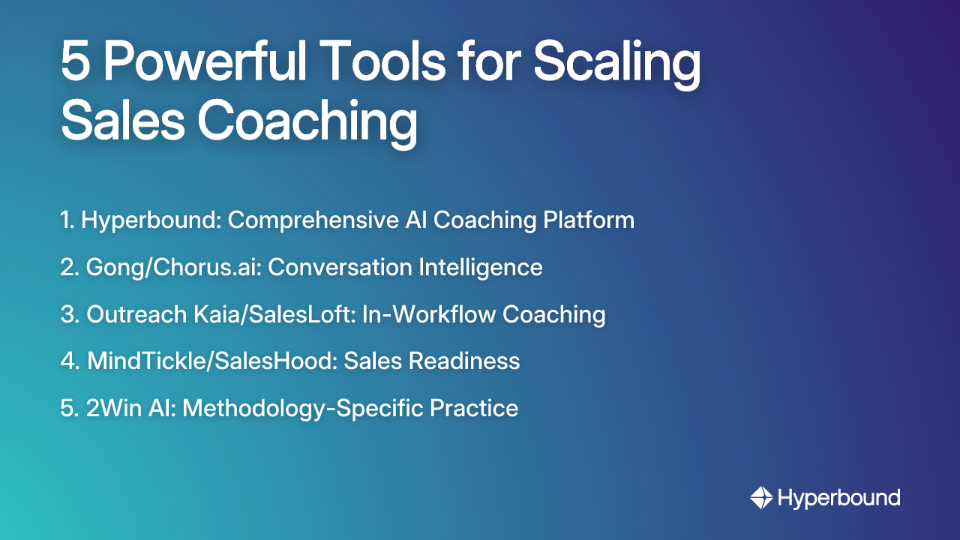
Hyperbound stands out as an all-in-one solution that connects practice, real-world call analysis, and personalized coaching into a seamless workflow.
Hyperbound's AI Sales Roleplays create a safe, repeatable environment for reps to practice every type of sales conversation—from cold calls to objection handling and renewals—with hyper-realistic AI buyer personas. Reps can practice on their own time, without needing a manager present, allowing for unlimited practice to master new playbooks or prepare for tough calls.
The platform's AI Real Call Scoring analyzes thousands of your actual sales calls to identify the talk tracks and behaviors of your top performers. It then automatically scores both roleplays and real calls against your custom methodology, solving two huge problems: automating the soul-crushing task of manual call review and identifying team-wide patterns instead of just flagging one-off mistakes.
Hyperbound delivers instant, personalized feedback after every call or roleplay, aligned with your specific sales methodology. This creates a continuous learning loop where reps get immediate, actionable advice to self-correct and improve. Managers are freed from providing repetitive, foundational feedback and can use their 1:1 time for more strategic conversations.
Beyond supporting AEs and SDRs, Hyperbound also offers AI Post-Sales Roleplays for CSMs to practice renewal and upsell conversations and AI Roleplay Hiring Assessments to screen sales talent objectively.
These tools function like having a dedicated research analyst for your sales calls, analyzing 100% of customer interactions to reveal market trends, competitive mentions, and rep performance patterns.
Instead of listening to calls randomly, managers can find every instance where a competitor was mentioned, a specific objection was raised, or a new feature was pitched. This allows them to build targeted coaching programs based on data, not hunches.
These platforms automatically surface "gold-standard" calls and call snippets, making it easy to build a dynamic call library without the manual curation that managers find so time-consuming.
While Gong has established itself as the market leader in this space, it's worth noting that these solutions often come with significant investments—"easily looking at six-figures per year," as one sales leader put it. They offer comprehensive features, but smaller organizations may find themselves paying for functionality they don't need.
These platforms embed coaching directly into the tools reps use every day for prospecting and managing their pipeline, providing real-time and contextual guidance.
Features like Smart Content Cards—found in platforms like Outreach—surface relevant information (such as a battlecard or pricing sheet) during a live call when a keyword is mentioned. This empowers reps to handle questions independently, reducing reliance on managers.
SalesLoft offers features like call whispering, where a manager can provide live feedback to a rep during a call that the customer can't hear. While this is still 1:1, the platform's ability to facilitate this remotely scales a manager's impact on live deals.
Both platforms use AI to generate meeting summaries and next steps, saving reps and managers administrative time that can be reallocated to selling and coaching.
These tools focus on scaling coaching through structured learning, certification, and peer-to-peer knowledge sharing—ideal for standardizing onboarding and ensuring ongoing readiness.
MindTickle delivers interactive learning modules, skill assessments, and simulations to get new hires up to speed. This automates foundational training, freeing up managers to focus on application and deal strategy.
SalesHood creates a collaborative environment where reps can share their own best practices, recordings, and success stories. This decentralizes coaching, turning top performers into mentors and taking the burden off managers to be the sole source of wisdom. The result is a scalable culture of continuous improvement.
This niche but powerful tool is designed for organizations that have invested heavily in a specific, proprietary sales methodology and need to ensure it's being used correctly in the field.
These AI agents create practice scenarios designed to reinforce specific sales techniques like the CDIM (Current, Desired, Impact, Metric) discovery framework or the "Tell-Show-Tell" demo method.
Reps can practice these nuanced, structured conversations in a private environment without the pressure of a manager or peer watching, allowing them to build muscle memory and confidence at their own pace.
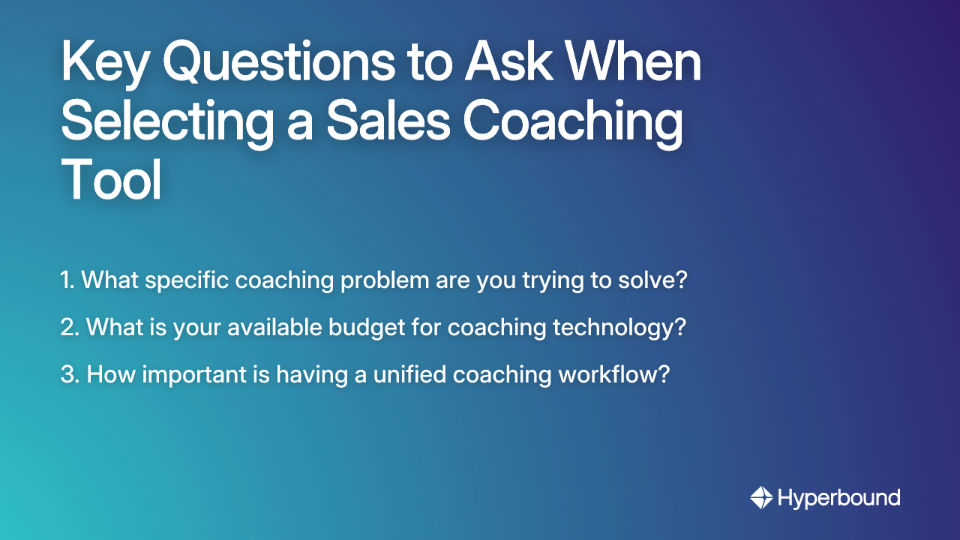
As one sales leader aptly noted, "It really depends on your team size, budget, and what you're trying to achieve." To determine which solution is best for your organization, ask these three questions:
Scaling sales coaching isn't about hiring more managers; it's about making your existing team more effective. The right technology transforms coaching from a time-consuming, manual task into a data-driven, scalable system.
The most effective sales organizations will blend the strategic wisdom of human managers with the analytical power and infinite patience of AI. These tools empower reps to take ownership of their development and free up leaders to focus on what they do best: strategy, motivation, and closing big deals.
Traditional sales coaching is difficult to scale because it relies heavily on time-consuming, manual tasks like 1:1 call reviews and ride-alongs, which managers have limited time for. This creates a "coaching gap" where reps don't get consistent, high-quality feedback needed to improve performance across the entire team.
AI helps scale sales coaching by automating repetitive tasks like call analysis, providing instant feedback, and enabling reps to practice independently. AI can analyze 100% of calls to identify trends, score performance against a set methodology, and provide a safe space for unlimited practice through AI roleplays, freeing up managers to focus on high-level strategy.
The main types of sales coaching tools include comprehensive AI coaching platforms (Hyperbound), conversation intelligence platforms (Gong), in-workflow coaching tools (Outreach Kaia), and sales readiness platforms (MindTickle). Each type addresses a different aspect of coaching, from proactive practice to post-call analysis and real-time assistance.
An AI sales roleplay is a practice simulation where a sales rep interacts with a hyper-realistic AI buyer persona to rehearse different sales conversations. It helps reps by providing a safe and repeatable environment to practice skills like cold calling or objection handling without needing a manager present, allowing them to build confidence and master playbooks at their own pace.
The primary difference is that conversation intelligence tools (e.g., Gong) focus on analyzing past customer calls for insights, while a comprehensive AI coaching platform (e.g., Hyperbound) integrates call analysis with proactive practice modules like AI roleplays and automated, personalized feedback to create a complete learning loop.
When choosing a sales coaching tool, you should first identify the specific problem you need to solve (e.g., skill practice vs. call analysis), consider your budget, and decide whether you need an all-in-one unified platform or are comfortable using multiple point solutions.
No, AI is not designed to replace sales managers but rather to augment their abilities. The goal of AI coaching tools is to automate tedious tasks, allowing managers to offload manual work and focus on high-impact, strategic activities like deal strategy, motivation, and career development that require human experience and wisdom.
Ready to stop drowning in call reviews and start building a team of top performers? Explore how Hyperbound's AI Sales Coaching platform can help you scale excellence without scaling your management team.










Use Cases
Legal