
You've spent hours perfecting your product pitch. Your slide deck is polished, your feature knowledge is solid, and you're ready to wow prospects with your demo call skills. There's just one problem: you need more practice, but you can't afford to use real prospects as guinea pigs.
As one sales professional shared on Reddit, "Real calls offer invaluable experience. However, with the stakes so high, I'm cautious about using real prospects for practice." This sentiment echoes across sales teams worldwide - the demo call is often the make-or-break moment in your sales process, yet it's risky to practice with actual customers.
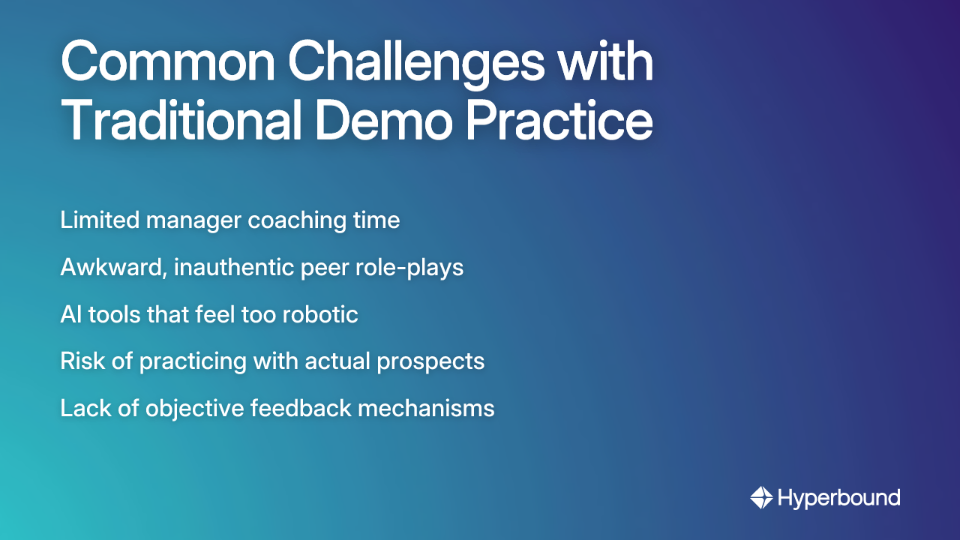
Traditional practice methods have significant drawbacks:
Fortunately, a new generation of tools has emerged to help sales professionals master their demo skills in safe, scalable environments. Let's explore the top five options that can transform your demo performance without risking real deals.
Hyperbound stands at the forefront of demo call practice solutions with its advanced AI-powered roleplay platform. What sets it apart is how it creates genuinely realistic practice scenarios customized to your specific sales context.
Unlike generic AI tools that "fail to adapt to unexpected inquiries during sales interactions," Hyperbound analyzes thousands of your team's actual sales calls to identify the specific techniques, talk tracks, and objection handling approaches that make your top performers successful. It then uses these insights to create dynamic AI buyer personas that respond naturally to your demo presentation.
"Hyperbound was recently implemented at my company and I love it," shared one sales professional on Reddit. "It really helped in practicing specific objections relevant to my industry."
Key Features:
Hyperbound is ideal for both new reps looking to ramp up quickly and experienced sellers wanting to refine their demo techniques without the pressure of real deals on the line.
While not a direct practice simulator, conversation intelligence is an invaluable "post-game analysis" approach that helps you learn from every real demo call to improve your future performances.
These platforms record, transcribe, and analyze actual customer interactions. By studying successful demos from your top performers, you can identify winning patterns and techniques to incorporate into your own presentations.
How Conversation Intelligence Aids Practice:
This approach is particularly powerful, and platforms like Hyperbound integrate this capability directly. You can use Hyperbound's AI Real Call Scoring to identify what works, then practice implementing those techniques in its AI Roleplays—all in one place.
SalesLoft offers a comprehensive sales engagement platform with features that enable demo call practice within your daily workflow. While primarily known for managing the entire sales outreach process, SalesLoft includes capabilities for recording, reviewing, and improving your demo delivery.
How SalesLoft Aids Practice:
SalesLoft is particularly valuable for teams who want to integrate their demo practice directly into the platform they already use daily, making practice a seamless part of the workflow rather than a separate activity.
Second Nature offers another strong AI-powered option for demo practice, with a focus on lifelike AI avatars that create engaging roleplay experiences. This conversational AI training platform provides a visual element to practice sessions that some reps find more immersive.
Key Features:
Second Nature is well-suited for teams looking for a visually engaging AI practice tool with pre-built scenarios to get started quickly. The platform addresses the common pain point that "many AI tools are perceived as being too robotic," by creating a more human-like interaction experience.
Despite the advanced technology available today, traditional peer role-play remains one of the most accessible and effective methods for practicing demo calls. This approach costs nothing but time and provides valuable human feedback that even the most sophisticated AI can sometimes miss.
How It Works:
As one sales professional noted on Reddit, "Some argue that actual call experiences are the most beneficial for learning," and peer practice gets you closest to that experience while remaining in a safe environment. This method is perfect for everyone, from solo practitioners to enterprise teams, and serves as an excellent complement to the high-tech tools listed above.
With several strong options available, how do you decide which tool is right for your specific needs? Consider this quick guide:
.png)
For most teams, the ideal approach combines multiple methods. For example, use Gong to identify what works in real calls, Hyperbound for unlimited realistic practice, and peer roleplay for human feedback and team building.
In today's competitive sales environment, you simply can't afford to "practice on the customer." Every demo call represents a significant opportunity cost and potential revenue impact. The key to mastering these critical conversations lies in consistent, deliberate practice using the right combination of tools.
Each tool we've covered offers unique benefits:
The sales professionals who consistently outperform their peers aren't necessarily more talented – they're often just more practiced. As one Reddit user put it, they desire "more realistic and challenging AI interactions" because they understand that high-quality practice translates directly to improved performance.
While all these tools offer unique benefits, teams looking for the most realistic, scalable, and impactful practice environment are increasingly turning to AI-powered roleplays. If you're ready to reduce ramp time, drive consistent messaging, and see a measurable improvement in your team's demo performance, explore how Hyperbound's AI Sales Roleplays can help.
Practicing product demos is crucial because it allows you to refine your pitch, handle objections effectively, and build confidence in a risk-free environment. Every real demo call is a high-stakes opportunity. Practicing beforehand prevents you from making critical mistakes with actual prospects, which could lead to lost deals. Consistent practice ensures you can deliver a polished, persuasive, and customer-centric presentation every time, directly impacting conversion rates and revenue.
The best way to practice demo calls is by using a combination of methods, including AI-powered roleplay tools, conversation intelligence, and traditional peer role-play. This blended approach allows you to get realistic, scalable practice with AI, learn from real-world calls, and receive valuable human feedback. Tools like Hyperbound offer hyper-realistic AI scenarios, while reviewing calls with conversation intelligence helps you understand what works best, and peer practice builds team collaboration.
AI roleplay tools use artificial intelligence to simulate realistic conversations with buyer personas, allowing sales reps to practice their demo calls on-demand. Platforms like Hyperbound analyze your company's actual sales calls to create AI buyers that use your industry's terminology, ask relevant questions, and raise common objections. The AI provides instant, objective feedback on your performance against key metrics, helping you improve much faster than with traditional methods.
A realistic AI sales practice tool is one that can adapt to the conversation, handle unexpected questions, and accurately mimic the specific challenges and language of your target buyers. Generic or "robotic" AI tools follow a rigid script. Advanced platforms like Hyperbound create dynamic AI personas by learning from your top performers' real sales conversations. This ensures the practice scenarios are not only realistic but also highly relevant to the specific deals your team is trying to close.
You can practice demo calls for free using peer role-play and self-recording. Partner with a colleague to run mock demos, taking turns playing the roles of the seller and the prospect. This provides invaluable human feedback. Additionally, you can use any video conferencing tool (like Zoom or Teams) to record yourself delivering a demo. Watching the playback helps you identify areas for improvement in your pacing, clarity, and overall delivery.
AI roleplay is for proactive practice in a simulated environment, while conversation intelligence is for reactive analysis of real customer calls. Think of conversation intelligence as "reviewing the game tape"—it helps you understand what happened in past demos. AI roleplay is like being in a "batting cage"—it's where you actively practice and refine the techniques you learned from that analysis. The most effective approach combines both: use conversation intelligence to identify winning behaviors, then use AI roleplays to master them.
Remember, the most expensive demo call isn't the one you practice – it's the one you lose because you didn't practice enough.










Use Cases
Legal