Ever feel overwhelmed trying to manage your own body language while also listening and interpreting someone else's? You're not alone. Many people find advice on nonverbal communication frustrating, with rules that feel arbitrary and impossible to manage in real-time.
"How am I supposed to pay attention to all these microscopic signals and interpret what they mean, all while listening to what the other person is saying AND being aware of what my own body language is conveying—all in real-time?" This common frustration reflects why many feel that "most body language stuff is garbage and not evidence-based."
But what if there was a method that made body language feel natural rather than forced? A technique that transforms conscious effort into unconscious competence?
Enter the Mirror Recitation Tool—not another set of rigid rules, but a powerful, private laboratory for developing authentic communication skills that become second nature.
The Mirror Method is more than just watching yourself talk. It's about engaging in direct eye contact with your reflection to promote introspection and self-discovery. This practice is deeply rooted in mindfulness principles that have been validated by research and embraced by Speech-Language-Pathologists worldwide.
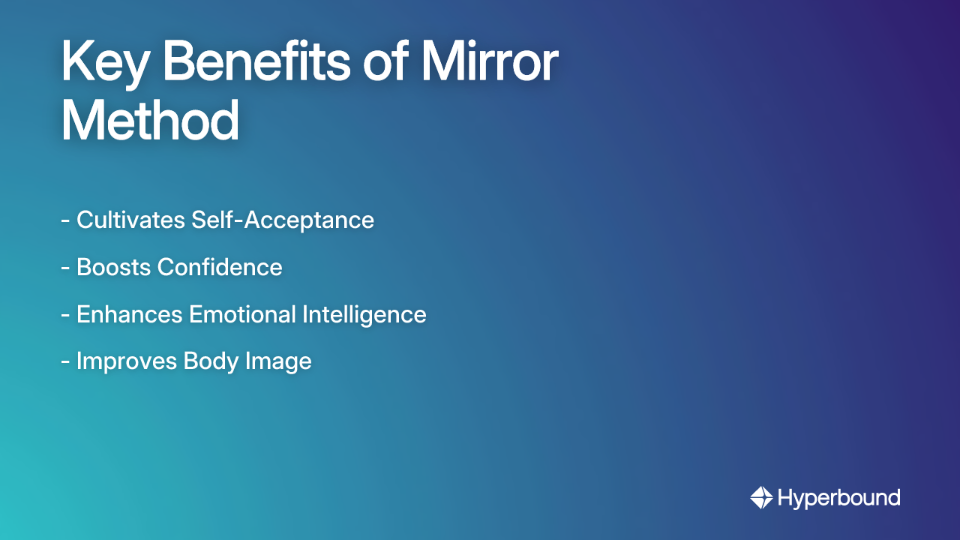
The technique works because it:
Before diving into the technical aspects of body language improvement, you need to establish a consistent practice environment:
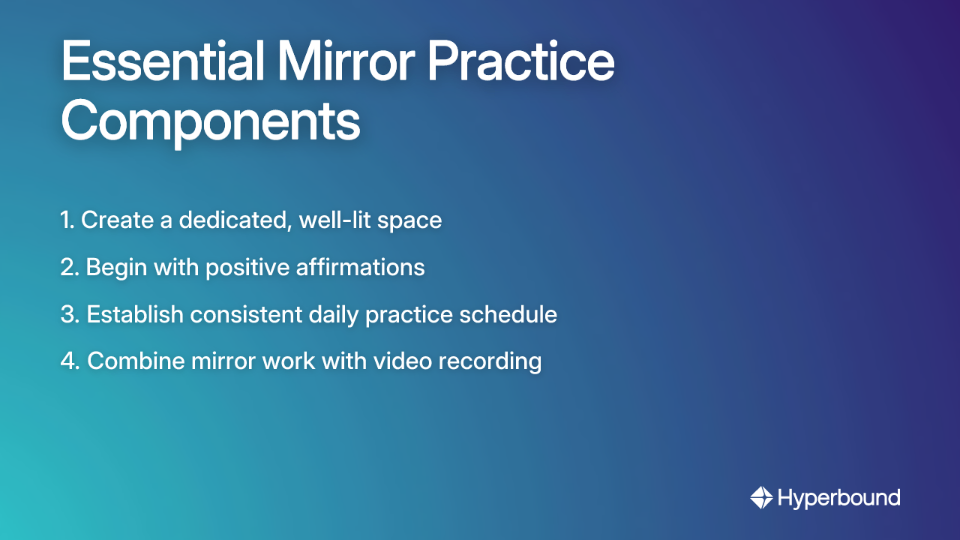
Find a quiet, well-lit area where you won't be disturbed. Toastmasters experts recommend a setting that allows you to see your full upper body, not just your face.
Before self-critique, begin with positive self-talk. A simple "I am a clear and confident communicator" sets the right mindset.
Consistency is key. Start with this schedule:
As noted in Peaceful Soul Quest's research on the Mirror Technique, "creating a serene space for mirror work promotes mindfulness and reflection," making this foundational step crucial to your success.
While the mirror provides immediate feedback, combining it with video recording offers more objective perspective. As body language experts advise, "Record yourself to assess body language depth and breadth." This helps overcome personal bias—a key step toward improvement.
Use this structured self-evaluation checklist during your mirror sessions:
Toastmasters research shows that a strong, open stance is rated as more trustworthy and authoritative by audiences.
Many people report, "I can't even maintain eye contact without my mind going blank." The mirror allows you to practice this crucial skill without social pressure.
Now that you know what to observe, let's develop your skills systematically:
Exercise 1: Deliberate Gesture Integration Make a deliberate effort to include gestures in your speech notes. The Toastmasters Magazine recommends: "Assign a unique gesture for each key point in your speech." This not only enhances your delivery but also improves memorization.
Exercise 2: Emphatic Gestures Practice using symmetrical gestures to emphasize crucial points. Keep hands at your sides when not gesturing and avoid repetitive movements.
Exercise 3: Gesture-Word Alignment Ensure your gestures arrive slightly before or with your words—never after. This creates congruence that audiences perceive as authentic.
Exercise 1: Chronological Movement Recite a story while using your body to reflect the timeline. Step forward when discussing future events, stay centered for present, and step back for past.
Exercise 2: Spatial Pattern Recitation Practice a presentation about a physical space (like a home tour) using gestures to point to different areas. This develops spatial awareness—a key component of engaging presentations.
Exercise 3: Topical Territory Assign a specific spot on your "stage" for each subtopic, and physically move to that spot when discussing it. This technique, used by TED speakers, creates visual structure for your audience.
Exercise 1: Coordination Drills Incorporate playful exercises like balloon tossing or juggling to improve hand-eye coordination. These warm-ups enhance the neural pathways responsible for smooth gesture coordination.
Exercise 2: Incline and Running Recitation As one public speaking enthusiast recommends, "Go up an incline or go on a run while specifically focusing on expanding your breaths during speech recitations." This builds powerful breath support for a strong Vocal Image.
Exercise 3: Out-Shout the Highway "By the highway, try to recite a speech and be louder than it without breaking your voice, focusing on volume and fullness of voice." This exercise, while unconventional, dramatically improves projection and vocal control.
Exercise 4: Pebbles in Mouth This classic elocution technique involves reciting speeches with small pebbles in your mouth (similar to Demosthenes' ancient practice). It forces crisp articulation and eliminates mumbling—a common issue for nervous speakers.
Once you've developed foundational skills in the privacy of your practice space, it's time to integrate them into real-world settings:
Watch public speaking champions to observe how they use body language. The World Championship of Public Speaking® showcases masters of nonverbal communication in action.
In real audiences, focus on one audience member per thought and shift your gaze during natural pauses. This creates a feeling of connection and rapport building with your entire audience.
The mirror can't tell you everything. As one expert notes, "A good teacher can do two things that general-audience video courses cannot: help you become objective about your own performance, and keep you from wasting time on exercises that aren't YOUR next steps."
Consider joining Live Practice Workshops or using AI-powered platforms like Hyperbound that provide personalized, data-driven feedback on your delivery, word choice, and other key factors.
Rehearse your speech including gestures to memorize both words and movements. This helps lock in muscle memory so your body language flows naturally during actual presentations.

The journey of mastering body language follows four stages:
The Mirror Method accelerates this progression, transforming what feels like "frustrating" conscious control into natural, authentic expression.
Remember, the goal isn't perfection or adhering to arbitrary rules that feel "stupid and arbitrary." Rather, it's developing a natural congruence between your message and movement—an authenticity that audiences instantly recognize and trust.
With consistent practice using the Mirror Method, you'll find yourself no longer thinking about your body language during presentations. Instead, you'll be fully present with your audience, your message flowing through both your words and your perfectly aligned nonverbal communication.
The mirror, your most honest critic and most supportive coach, remains your lifelong tool for continued growth and self-discovery in the art of communication.
The Mirror Recitation Method is a self-practice technique where you use a mirror to observe and improve your body language, facial expressions, and gestures in a private, low-pressure environment. It transforms abstract advice about nonverbal communication into a tangible practice, helping you align your physical expressions with your spoken message for more authentic and impactful communication.
Practicing in front of a mirror improves public speaking by providing immediate, real-time visual feedback on your nonverbal cues. This helps build confidence and turns conscious effort into natural competence. The method allows you to practice maintaining eye contact, using purposeful gestures, and adopting a confident stance without the pressure of a live audience, allowing you to better focus on your message and connect with your listeners.
For best results, consistency is more important than session length. A structured daily practice of 15-20 minutes is highly effective. A good routine includes a brief morning session to set intentions, a midday check-in on posture, and a longer evening reflection. This consistent practice builds muscle memory and integrates improved body language into your daily habits.
During mirror practice, you should observe four key areas: your body position and stance, your facial expressions, your eye contact, and any unconscious nervous movements. Pay attention to whether your stance is open and confident, if your facial expressions match your words, and if you can maintain a steady gaze. Also, identify and work on eliminating "filler movements" like fidgeting or swaying.
Combining mirror work with video recording provides a more objective perspective on your performance that you might miss in real-time. While a mirror offers immediate feedback, a recording allows you to review your body language as an audience member would. You can more effectively assess the overall flow, timing of gestures, and breadth of movement, helping to overcome personal bias.
To make gestures feel natural, focus on aligning them with your key points and ensuring they slightly precede or coincide with your words, never coming after. Start by assigning specific, meaningful gestures to the main ideas in your speech and practice using open, symmetrical gestures for emphasis. The goal is to develop a vocabulary of gestures that support your message, rather than choreographing every single movement.
For more structured approaches to public speaking improvement, consider exploring resources from Toastmasters or consulting with Speech-Language-Pathologists who specialize in professional communication enhancement.










Use Cases
Legal