
You've been there before. The dreaded lull in conversation when your "How was your weekend?" is met with a simple "Good." Suddenly, you're staring into the abyss of an awkward silence, desperately fishing for something—anything—to say next.
But what if there was a simple technique that could transform these dead-end exchanges into meaningful connections? A way to show the other person that you're not just making small talk, but genuinely engaging with them?
There is, and it has a name: The Callback.
When you reference something specific that someone mentioned in a previous conversation—"How did that presentation go last week?" or "Did you end up trying that new restaurant you mentioned?"—you're doing more than filling silence. You're providing concrete proof that you were listening, that you remember, and most importantly, that you care.
Conversations are meant to be a two-way street, yet many of us struggle to keep them flowing naturally. Research published in the Journal of Personality and Social Psychology found that people who ask more follow-up questions are consistently perceived as more likable than those who don't.
Why? Because follow-up questions demonstrate three crucial qualities:
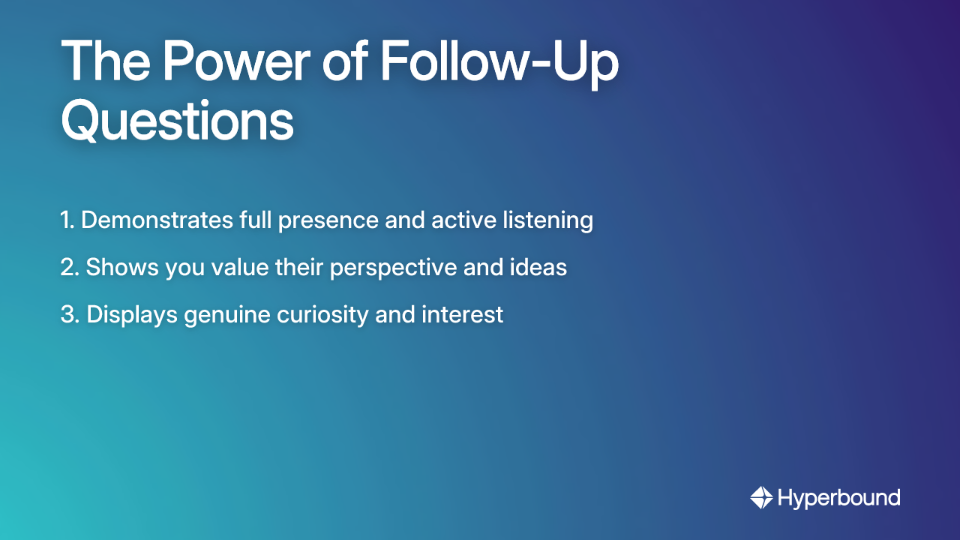
When you master the art of the follow-up question, you transform superficial exchanges into opportunities for connection. You turn what might have been forgettable small talk into the foundation for a meaningful relationship.
Before you can ask brilliant follow-up questions, you must first become an exceptional listener. Active listening isn't just hearing words—it's absorbing their meaning, context, and the emotions behind them.
Here's how to build your active listening foundation:
Put your phone away. Make eye contact. Physically and mentally remove distractions. As the experts at Verywell Mind note, being fully present involves "tuning into the other person's inner world while stepping away from your own."
Research suggests that up to 65% of communication is non-verbal. Are they leaning in with excitement? Crossing their arms defensively? Their body language often reveals more than their words.
Aim for 50-70% eye contact to show engagement without becoming uncomfortable. This balance communicates attention without intensity.
Use phrases like "It sounds like you're saying..." or "So what you mean is..." to confirm understanding. This technique, sometimes called "looping for understanding," ensures you're interpreting correctly while showing the other person you're engaged.
Even your initial questions should invite elaboration. Instead of "Did you enjoy the conference?" (which could be answered with a simple "yes" or "no"), try "What was your favorite part of the conference?"
Not every pause requires filling. Sometimes, people need a moment to gather their thoughts. What feels like an awkward silence to you might be their valuable thinking time.
Create a safe space where people can share openly without fear of criticism. This doesn't mean you must agree with everything, but suspending immediate judgment encourages deeper sharing.
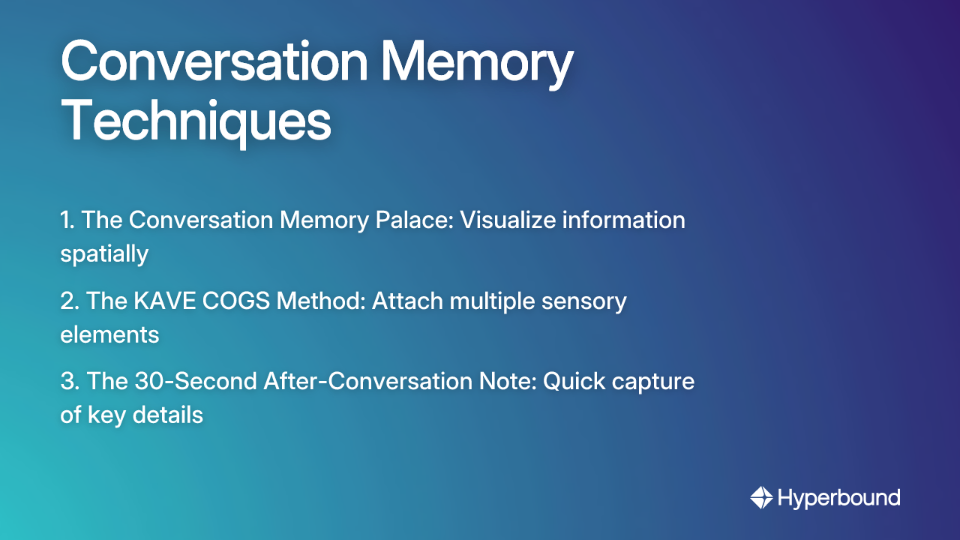
Even with excellent listening skills, you need a system to recall important details days or weeks later. Here are three practical memory techniques specifically designed for conversations:
This powerful mnemonic device uses spatial visualization to store information:
Example: Your colleague mentions they're training for a marathon. Imagine oversized, glowing running shoes sitting on your living room coffee table. Next time you mentally "walk through" your living room before meeting them, you'll see those shoes and remember to ask, "How's your marathon training going?"
Make memories stick by attaching multiple sensory elements to them:
Example: When your friend mentions their new coffee hobby, don't just remember the word "coffee." Visualize the dark beans (Visual), imagine the aroma of fresh grounds (Olfactory), feel the warmth of the cup (Kinesthetic), and recall the excitement in their voice (Emotional).
For a simpler approach, build a habit of taking quick notes after meaningful conversations:
Example Note: Michael (IT dept) - daughter starting college next month (UCLA), nervous about empty nest, planning kitchen renovation to stay busy
With these three topics noted, you're equipped with perfect follow-up questions for your next encounter.
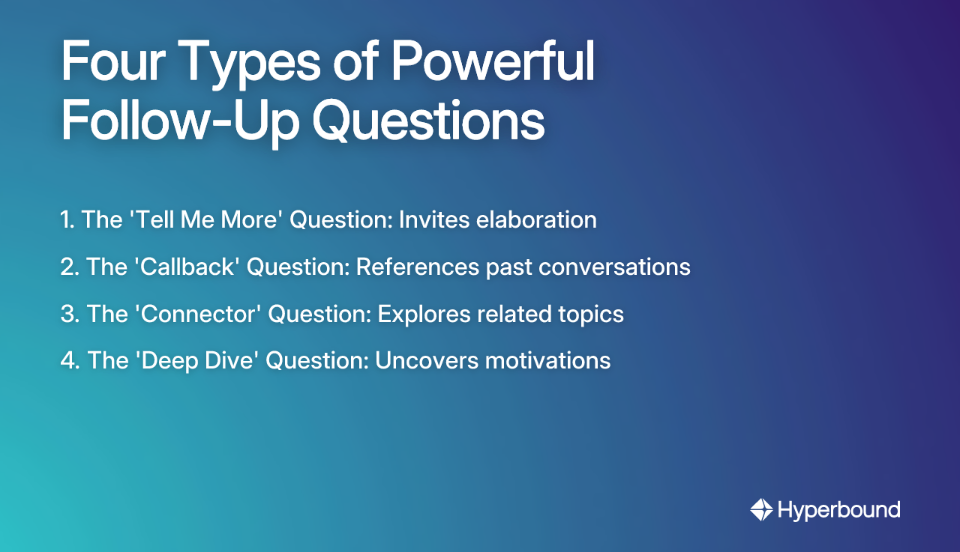
Now comes the fun part—putting your active listening and memory skills to work. Here are four types of follow-up questions guaranteed to show you're paying attention:
These questions invite the person to expand on what they've just shared. They work particularly well when someone mentions something with emotional weight or hesitates while speaking.
Templates:
Example: Them: "Yeah, work has been really challenging lately." You: "You mentioned work has been challenging. What specifically has been difficult?"
These are the gold standard of follow-up questions. By referencing something from a previous conversation, you demonstrate both memory and genuine interest in their life.
Templates:
Example: "When we talked last month, you mentioned you were considering a career change. Have you made any decisions about that?"
These questions help uncover values, motivations, and deeper thoughts. They're best used when you've established some rapport.
Templates:
Example: Them: "I volunteer at the animal shelter on weekends." You: "What aspects of that volunteer work do you find most fulfilling?"
Let's see how these techniques transform typical conversational dead ends:
Scenario 1: The Weekend Question
Before: You: "How was your weekend?" Them: "Good." Result: Awkward silence
After: You: "How was your weekend?" Them: "Good." You: "Did you get to do anything specific you enjoyed?" (Tell Me More) Them: "Actually, I finally tried that new hiking trail." You: "That sounds great! I remember you mentioned you were getting into hiking. Is this part of your goal to explore more outdoor activities?" (Callback + Connector)
Scenario 2: The Pet Question
Before: You: "Do you have any pets?" Them: "No." Result: Conversation hits a dead end
After (Better framing): You: "If you could have any animal as a pet, what would you choose?" Them: "Probably a dog, but my apartment doesn't allow them." You: "What kind of dog would you get if you could?" (Tell Me More)Them: "A golden retriever. I had one growing up." You: "That's a great compatibility check—I'm a dog person too. What was your childhood dog like?" (Connector + Tell Me More)

The ability to ask thoughtful follow-up questions is perhaps the most underrated social skill. It transforms forgettable small talk into meaningful exchanges and sends a powerful message: "I hear you, I remember you, and what you say matters to me."
The formula is simple:
In a professional context, especially in sales, mastering this skill can be the difference between a closed deal and a missed opportunity. For teams looking to scale this ability, consistent practice and data-driven feedback on these conversational nuances are invaluable. This is where modern coaching tools can make a significant impact.
As you practice these techniques, you'll find yourself soliciting advice less often and building genuine connections more frequently. Conversations will flow naturally, awkward silences will diminish, and your relationships—both personal and professional—will deepen.
Your challenge: In your very next conversation, use just one "Callback" question that references something from a previous exchange. Notice how the other person responds. That moment of recognition in their eyes when they realize you were truly listening? That's the beginning of a real connection.
The "Callback" is a conversational technique where you reference a specific detail from a previous conversation to show you were listening and care. For example, instead of a generic "How are you?", you might ask, "Last time we talked, you were preparing for a big presentation. How did it go?" This demonstrates active listening and memory, turning simple small talk into a more meaningful connection.
Follow-up questions are crucial because they demonstrate genuine interest, curiosity, and that you value the other person's perspective. Research shows that people who ask more follow-up questions are perceived as more likable. They prove you're not just waiting for your turn to speak but are actively engaged in understanding the other person, which is the foundation of any strong relationship, both personal and professional.
You can improve your conversational memory by using specific techniques like the "Conversation Memory Palace" (visualizing details in a familiar mental space), the "KAVE COGS" method (linking information to multiple senses), or the simple habit of taking a 30-second note after a conversation. These methods help you deliberately store key information, making it easier to recall and use in future interactions.
There are several types of effective follow-up questions. "Tell Me More" questions invite elaboration (e.g., "What was that like for you?"). "Callback" questions reference past conversations (e.g., "How did that project turn out?"). "Connector" questions explore related topics, and "Deep Dive" questions uncover motivations (e.g., "What about that is most rewarding for you?").
To avoid sounding like an interrogator, focus on conversational flow and genuine curiosity rather than firing off a list of questions. Maintain a natural rhythm by sharing your own related experiences, using a warm and curious tone, and paying attention to non-verbal cues. If they seem hesitant, it's okay to let a topic go. The goal is a balanced, two-way exchange, not an interview.
The best way to practice is to start small and be intentional. In your very next conversation, set a simple goal to use one "Callback" question. Pay close attention to the other person's positive reaction. For professionals, especially in sales, using AI-powered tools for sales roleplays can provide a risk-free environment to practice and receive feedback on conversational techniques.
If a follow-up question gets a short answer, don't panic. The person may not want to elaborate on that specific topic. You can try one more open-ended question on a related subject or pivot by sharing a brief, relevant story of your own. For example, if you ask about their weekend hike and they just say "It was fine," you could say, "That reminds me of a trail I tried last month..." This can restart the conversational flow naturally.











Use Cases
Legal