You've set up the perfect demo for your B2B software solution. Your technical features are polished, your UI is sleek, and you're ready to wow the IT team with your cutting-edge capabilities. But then comes the dreaded email: "Our CFO would like to join the next call to discuss ROI metrics and strategic alignment."
Suddenly, you're scrambling to translate your technical pitch into financial language, wondering how your carefully crafted presentation about system architecture and integration capabilities will resonate with someone whose primary concern is the bottom line.
Welcome to the new reality of B2B software sales, where the CFO has emerged as your most critical buyer.
The truth is stark and unavoidable: selling to pain is OVER. According to G2's Software Buyer Behavior Report, only 33% of buyers now consider IT as the final decision-maker—a significant 10% decline from just two years ago. Meanwhile, 26% now identify C-suite executives, particularly CFOs, as the ultimate authority on software purchases—a 7% increase in the same period.
This isn't a temporary trend or a market blip. It's a fundamental restructuring of how organizations make technology decisions. The economic buyer, personified by the CFO, is now your primary audience, and this shift is reshaping every aspect of the B2B software sales process.
Several powerful forces have converged to place financial leaders at the center of software purchasing decisions:
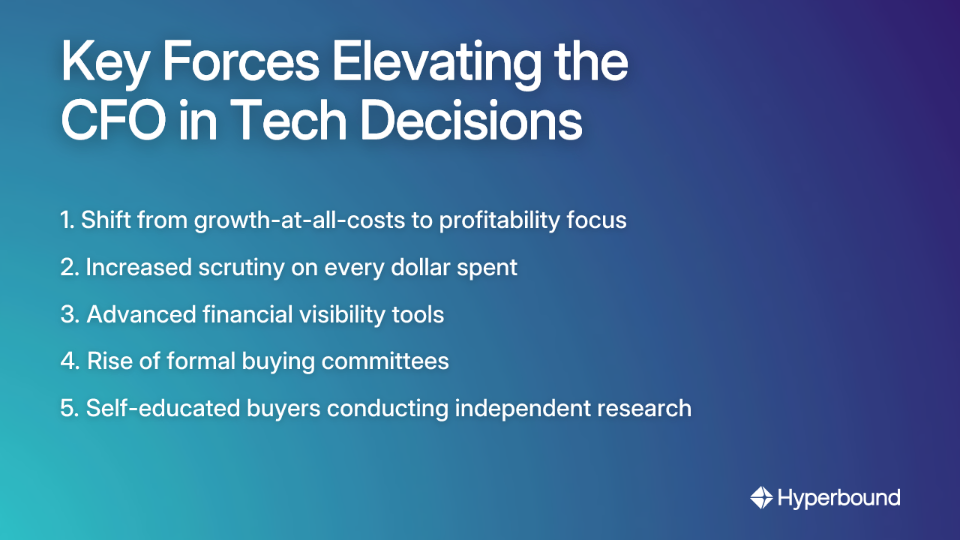
The era of prioritizing growth above all else has ended. Economic pressures have forced a pivot toward efficiency and profitability. According to research from Bessemer Venture Partners, there's now a 2:1 ratio of importance between profitability and growth for software companies. This fundamental shift in priorities has naturally elevated the role of financial stewards.
In today's economic climate, every dollar is under the microscope. While 55.6% of buyers expect software spending to increase, these purchases are subject to unprecedented levels of justification. CFOs now wield significant power to control expenditures and are scrutinizing all purchases, especially in categories like ERP systems, CRM platforms, and Cloud Infrastructure where spending has traditionally been substantial.
Modern spend management platforms have given CFOs unprecedented visibility into departmental spending. Financial Software and AI-powered Analytics now allow finance teams to track every dollar spent on technology, enforce compliance, and prevent software sprawl across the organization.
Today's B2B software buying process is no longer a simple conversation with a single decision-maker. It has evolved into a complex dance involving multiple stakeholders with diverse priorities:
A staggering 80% of companies now use formal buying committees to influence technology decisions, involving as many as 22 distinct roles from different departments. As one sales professional noted on Reddit, "Deals don't move forward just because one person is convinced. The entire group needs to be nudged toward a decision."
This committee-based approach creates several challenges:
Perhaps most concerning for sales teams, 68% of B2B buyers only involve a vendor's sales team at the final stage of their decision process. Today's buyers conduct extensive research independently, meaning your online presence, educational content, and reputation are critical for building internal champions before you even get a call.
To succeed in this new landscape, sales professionals must fundamentally shift how they communicate value. When speaking with financial decision-makers about solutions like Cybersecurity, Compliance Software, or Identity Protection Software, remember that most "high-level execs tend to be direct to the point of rudeness—they don't have time for BS, so cut to the chase immediately."
Before approving any purchase of Warehouse Management Software (WMS), Data Center Infrastructure, or Telephony and Communication Software, CFOs will interrogate every proposal with these questions:
The old sales motion focused on technical features and benefits. The new approach must emphasize business outcomes and financial metrics:
Old Pitch (to IT): "Our Point of Sale (POS) System integrates with your existing stack and automates checkout with our patented one-click technology."
New Pitch (for the CFO): "By implementing our POS System, you can reduce transaction processing time by 35%, allowing you to serve 15% more customers during peak hours. Our clients typically see a 250% ROI within 9 months, with a 12% increase in average transaction value through our upsell features."
The business case has become the cornerstone of successful B2B software sales. As one project manager noted on Reddit, "The primary point of a business case is to get sponsor buy-in to fund the product." Without a proper business case, securing funding is nearly impossible—especially for significant investments in ERP, CRM, or sales enablement platforms. Equipping your team to build and present these cases effectively is crucial, which is where AI sales coaching platforms like Hyperbound come in, allowing reps to practice and perfect their financial-focused pitch.

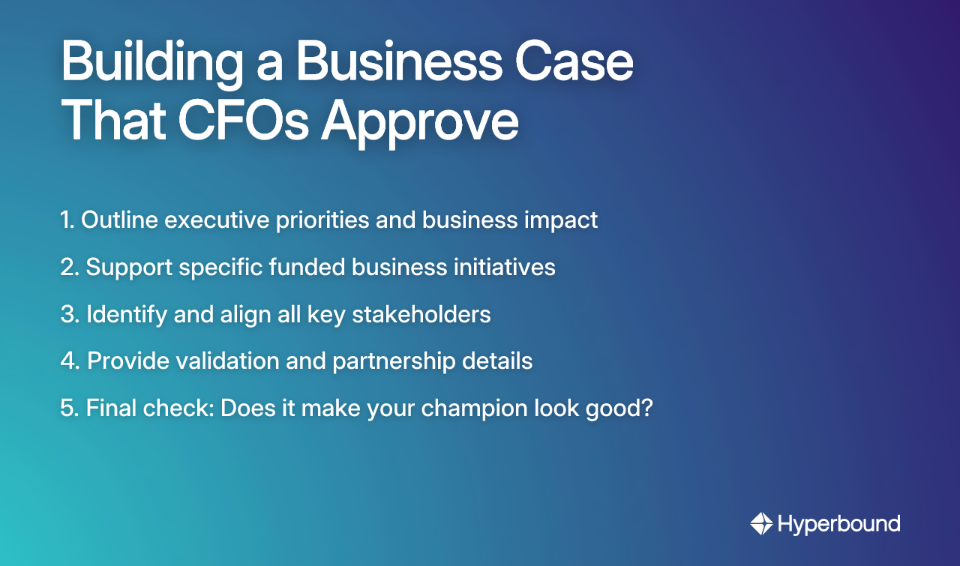
Based on best practices from InAccord, here's how to create a business case that will resonate with financial decision-makers:
When engaging financial stakeholders about Data Center Infrastructure, Automation Tools, or Cloud Infrastructure solutions, your approach must be fundamentally different than when selling to technical users:
Your primary job is to help your internal champion build credibility and present a well-researched case. Trust is key; CFOs are more likely to approve purchases if they trust the internal buyer's due diligence.
Frame discussions around solving overarching business challenges, not just departmental pain points. When presenting Cybersecurity or Compliance Software, connect it directly to business risk mitigation and regulatory requirements, not just technical vulnerabilities.
Upon renewal, the CFO will assess actual benefits versus anticipated outcomes and scrutinize utilization rates for sales enablement and project management tools. Ensuring your customer success and account management teams can effectively communicate this value is critical for securing renewals. Platforms like Hyperbound's AI Post-Sales Roleplays help these teams practice navigating tough renewal conversations and proactively demonstrating ROI.
The CFO's role as a key decision-maker in tech acquisition is here to stay. This shift demands that sales professionals develop new skills:
The B2B software landscape has fundamentally changed. Those who master the art of selling to the CFO will not only survive but thrive, building stronger, more strategic partnerships with their customers. In this new reality, your ability to translate technical capabilities into business value isn't just a nice-to-have skill—it's the difference between closed deals and lost opportunities.
The days of selling to IT alone are over. The CFO is your new buyer. Adapt accordingly.
The CFO has become a critical buyer due to a major business shift from a "growth-at-all-costs" mindset to a focus on profitability and efficiency. This change, driven by economic pressures, means every dollar spent is under intense scrutiny. CFOs now use advanced financial visibility tools to control spending and ensure every software purchase delivers a clear, quantifiable return on investment.
You can translate technical features into financial benefits by focusing on business outcomes instead of product capabilities. Instead of describing what your software does, explain what results it produces. For example, rather than saying a feature "automates checkout," say it "reduces transaction time by 35%, increasing peak hour customer capacity by 15% and delivering a 250% ROI within nine months."
A CFO will typically interrogate a software proposal with four core questions:
A strong, CFO-ready business case justifies the purchase in clear financial terms and should include five key elements:
The B2B buying process has become longer and more complex. Instead of selling to a single IT decision-maker, sales now involve formal buying committees of up to 22 people. This requires a multi-threaded sales approach to build consensus among diverse stakeholders. Furthermore, buyers are now highly self-educated, conducting most of their research independently before even contacting a sales representative.
To sell effectively in this new landscape, sales teams need to develop three core skills:










Use Cases
Legal