
You've just been handed a vast sales territory spanning multiple states. Excitement quickly turns to anxiety as you realize the enormity of the task ahead: hundreds of potential accounts, limited time, and aggressive quarterly targets. How do you possibly cover all this ground effectively?
"Managing a large book of business requires a methodological approach to hit all areas of the territory," notes an experienced B2B sales professional. Without a system, you'll likely find yourself with "lots of opportunities in the pipeline but losing a lot of deals" due to inconsistent follow-up and scattered focus.
The solution? A structured 14-week rotation system that balances deep engagement with your highest-value prospects while ensuring consistent territory coverage. This methodical approach transforms overwhelming geographies into manageable segments, allowing you to work smarter, not harder.
Before diving into outreach tactics, you need clarity on who you're targeting. This starts with developing your ideal prospect profile – your customer avatar that precisely defines who benefits most from your solution.
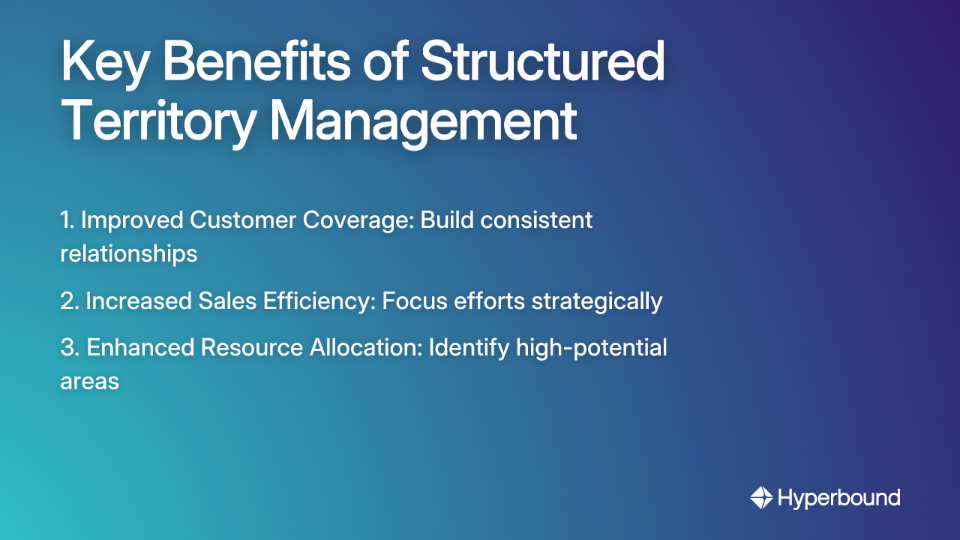
Effective territory management delivers three critical benefits:
Before you can prioritize accounts, you must know exactly who you're looking for. Over 67% of brands now leverage account-based marketing (ABM), and a well-defined ideal prospect profile is the cornerstone of any successful ABM strategy.
To create your customer avatar:
Remember that your goal is to "realize their big three: concerns, challenges, and frustrations" so you can demonstrate exactly how your company solves these problems. This level of understanding is essential for consultative selling that builds trust.
With a clear understanding of your ideal prospect, it's time to prioritize your accounts strategically. In times of economic uncertainty, focusing on high-value accounts is essential for maximizing revenue and strengthening relationships.
Begin by compiling a comprehensive list of all potential accounts in your territory. Then segment them into three tiers:
Tier 1: High-Priority Accounts (10-15% of your territory)
Tier 2: Medium-Priority Accounts (25-30% of your territory)
Tier 3: Low-Priority/Prospecting Accounts (remaining 55-65%)

Move beyond traditional lead scoring. With 83% of the B2B buyer's journey involving non-direct engagement, you need deeper insights into account potential. Develop a scoring system based on these key factors:
CRM platforms like Salesforce or HubSpot can automate this scoring process, allowing you to quickly identify your highest-value targets and adjust your approach accordingly.
Now for the core of your territory management strategy: a structured 14-week rotation that ensures you balance deep engagement with focus accounts while maintaining consistent coverage across your entire territory.
Before implementing your rotation, visualize your accounts geographically. Sales territory mapping software transforms raw data into an actionable geographic strategy.
Key features to look for in mapping tools:
Popular options include Maptive, Geopointe, and eSpatial, which integrate with your CRM to provide real-time territory insights.
Weeks 1-4: Deep Dive on Tier 1 (High-Priority Accounts)
Goal: Secure meetings, build deep relationships, and advance deals in your pipeline.
Outreach Strategy:
This focused approach helps solve the problem of having too few meetings to work with, as one SDR noted: "8 meetings is not a lot to work with in terms of pipeline."
Weeks 5-10: Nurture Tier 2 (Secondary & High-Potential Prospects)
Goal: Nurture relationships, qualify interest, and create a steady flow of accounts to move into Tier 1.
Outreach Strategy:
Weeks 11-14: Coverage & Prospecting in Tier 3 (Low-Priority/New Prospects)
Goal: Maintain market presence, generate new leads, and identify emerging opportunities.
Outreach Strategy:

Managing a large territory requires the right technology. As one sales professional aptly put it: "If you're working at a company that's making you manually dial, it's time to get out." Here are the essential tools:

A clean, accurate database is the foundation of effective territory management. Consider these options:
These platforms can provide up to 30% improvement in data quality, ensuring your outreach efforts aren't wasted on outdated information.
To execute your 14-week rotation efficiently:
To ensure your team can execute these varied strategies effectively, a coaching platform is essential. Consistent practice helps reps master messaging for each account tier.
Ensure both teams collaborate towards common goals with shared criteria and joint planning sessions for unified B2B outreach. This alignment is crucial for effective ABM strategies and consistent messaging across all customer touchpoints.
Hold quarterly reviews to:
Your territory plan should be a living document that evolves with your business and market.
Create what some sales veterans call a "bird dog program" - a structured referral system. As one experienced rep noted, "create a 'bird dog' program aka referral program because everyone talks and warm leads are a lifesaver."
Warm referrals build immediate trust, which is crucial when competing against incumbent vendors. Structure your program to reward both customers and partners for successful introductions.
Sales can be stressful, especially when managing large territories. But a structured system allows you to break down quarterly quotas into monthly, weekly, and daily goals. When you hit those smaller goals, you build momentum and confidence.
Track these key metrics to measure your system's effectiveness:
Platforms like Hyperbound can also provide deeper insights by analyzing rep performance on actual calls against your methodology, identifying skill gaps that might be impacting territory performance.
A systematic approach to territory management isn't just about organization; it's about maximizing your efforts to build a stronger pipeline, foster better customer relationships, and achieve sustainable growth. Companies that effectively optimize their sales territories see up to 30% higher sales performance.
By implementing this 14-week rotation system, you'll ensure maximum territory coverage while focusing your deepest efforts on the accounts most likely to convert. Remember that consistency is key - trust the process, remain disciplined in your approach, and continually refine your strategy based on results.
Start today by defining your ideal prospect profile, segmenting your accounts into tiers, and mapping out your first 14-week rotation. Your future self – with a healthier pipeline and more predictable revenue – will thank you.
The 14-week rotation system is a structured sales strategy designed to ensure comprehensive territory coverage while prioritizing high-value accounts. It divides your outreach efforts into three distinct phases: a 4-week deep dive on your Tier 1 accounts, a 6-week nurturing phase for Tier 2 accounts, and a 4-week prospecting and coverage phase for Tier 3 accounts, ensuring a balanced and methodical approach.
Segmenting your sales territory into tiers helps you focus your time and resources on the most valuable accounts, leading to increased sales efficiency and higher conversion rates. By categorizing accounts as Tier 1 (high-priority), Tier 2 (medium-priority), and Tier 3 (low-priority/prospecting), you can tailor your outreach strategy and engagement level to match the potential of each account.
To create an Ideal Prospect Profile, you should analyze your best current customers to identify their common characteristics. This process involves identifying shared attributes like industry, company size, and technology stack, as well as documenting their typical challenges and pain points. A clear IPP ensures you are targeting companies that will benefit most from your solution.
The 14-week rotation is a flexible framework, not a rigid rule, and can be adjusted to fit your specific sales cycle. If you have a shorter sales cycle, you could compress the rotation into a shorter timeframe, such as 8 or 10 weeks. For longer, more complex sales cycles, you might extend the phases, particularly the deep dive on Tier 1 accounts, to better align with your process.
Essential tools for managing a large sales territory include a CRM system (like Salesforce or HubSpot) to track interactions, sales intelligence tools (like ZoomInfo) for accurate data, sales engagement platforms (like Outreach or SalesLoft) to automate campaigns, and sales readiness platforms (like Hyperbound) to ensure your team can execute the strategy effectively.
You can measure the success of your territory management plan by tracking key metrics such as meetings scheduled per tier, conversion rates at each pipeline stage, and overall territory coverage percentage. Analyzing these metrics helps you understand what’s working, identify areas for improvement, and ensure your efforts are generating a positive return on investment.











Use Cases
Legal