
You've decided it's time to invest in tech sales training for your team. But with companies spending over $30 billion annually on sales training and only 11% of that effort going into proper evaluation, how do you ensure you're not throwing money into a black hole?
Understanding infrastructure and theory alone isn't sufficient for success in tech sales. This is the billion-dollar problem: without a system for continuous practice and reinforcement, your reps will forget up to 87% of what they learned within a month.
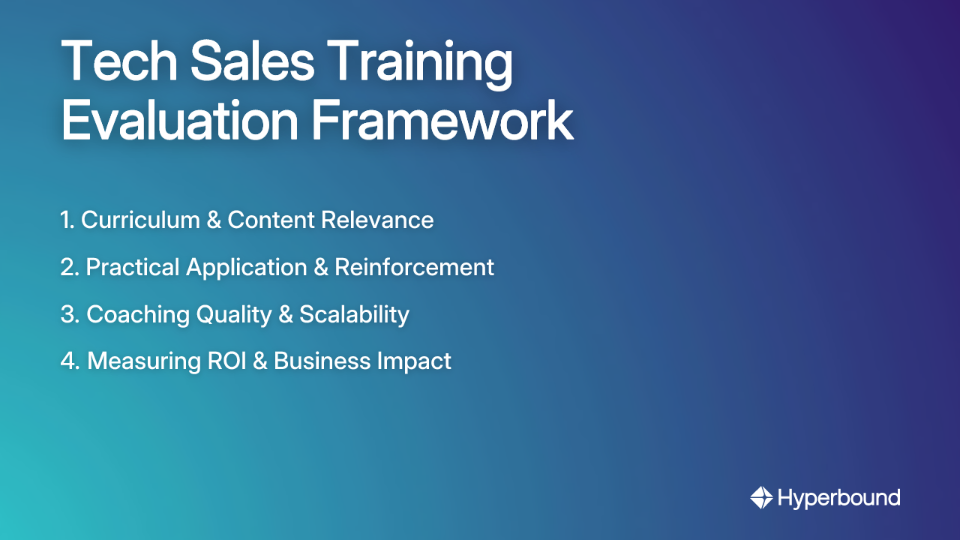
The most effective tech sales training isn't just a course—it's a complete system for behavioral change. This article provides a comprehensive framework to help you evaluate programs across four crucial pillars: Content Relevance, Practical Application, Coaching Quality, and ROI Measurement.
Before diving into our evaluation framework, let's understand why so many tech sales training programs fall short:
Tech sales is fundamentally a performance skill, like a sport. You can't learn to hit a baseball by reading a book; you need at-bats. Traditional training often fails because it focuses on knowledge transfer, not skill application.
As one sales professional noted in a recent Reddit discussion, "Understanding theory and tools is not enough without real-world application in tech sales." This sentiment echoes throughout the industry—training that doesn't bridge this gap rarely sticks.
The Ebbinghaus Forgetting Curve isn't just theoretical—it's the enemy of every sales enablement leader. Without a system for continuous practice and reinforcement, new skills never become ingrained habits.
Many sales professionals report "struggling to balance sales training with the essential prospecting and selling activities." Effective training programs must integrate learning into the workflow, not compete with it.
Most programs rely on managers for coaching and reinforcement. However, managers are stretched thin, and coaching quality can be inconsistent. Research shows that ineffective coaching can hurt performance nearly twice as much as good coaching helps.
.png)
Now, let's explore our comprehensive evaluation framework for tech sales training programs:
Key Questions to Ask:
What to Look For:
Red Flags:
Key Questions to Ask:
What to Look For:
Red Flags:
Best-in-Class Solution: Hyperbound's AI Sales Roleplays transform any training curriculum into a dynamic practice field. Your SDRs and AEs can practice everything from cold calling and discovery to objection handling against realistic AI personas, receiving instant feedback through AI-Powered Scorecards. This provides unlimited, risk-free practice that scales far beyond manager availability.

Key Questions to Ask:
What to Look For:
Red Flags:
Key Questions to Ask:
What to Look For:
Red Flags:
To help you apply this framework, we've created a downloadable Tech Sales Training Evaluation Scorecard. This tool allows you to objectively compare different programs side-by-side.
Here's a preview of what's included:
Program Being Evaluated: _________
Pillar 1: Content & Curriculum (Score: __/20)
Pillar 2: Practical Application (Score: __/20)
Pillar 3: Coaching & Feedback (Score: __/20)
Pillar 4: Measurement & ROI (Score: __/20)
Overall Score: __/80
Download the Full Tech Sales Training Evaluation Scorecard
Even the best training program is just the beginning. To create lasting change, you need to transform one-time events into a continuous learning loop. This is where technology can help bridge the gap.
Modern AI solutions can take any training program—whether it's an off-the-shelf course or your custom curriculum—and supercharge its effectiveness through continuous practice and feedback.
For example, Hyperbound's AI Coaching and AI Real Call Scoring analyze both practice roleplays and real customer conversations from your CRM or call recorder. The platform automatically scores these against your custom methodology and provides instant, personalized coaching tips.
This creates the crucial feedback loop that most programs lack. Your reps can practice new skills in a safe environment, receive objective feedback, and continuously improve without relying solely on manager bandwidth.
The most effective tech sales training isn't a single event; it's a system for continuous improvement. By evaluating programs across our four pillars—Content Relevance, Practical Application, Coaching Quality, and ROI Measurement—you can make smarter investments in your team's development.
Remember that without reinforcement, your reps will forget up to 87% of what they learned within a month. The right training program, combined with the right technology for practice and feedback, creates a continuous growth engine that drives real behavior change and measurable business results.
Use our scorecard to evaluate your options, and consider how technology like AI coaching can help bridge the gaps in any program you choose. Your sales team—and your bottom line—will thank you.
Most tech sales training fails because it focuses on knowledge transfer instead of skill application, lacks continuous reinforcement, and over-relies on busy managers for coaching. This creates a "knowing-doing gap" where reps understand concepts but can't execute them effectively. Without a system for practice, reps forget up to 87% of what they learned within a month.
You can measure the ROI of sales training by using a structured evaluation framework like the Kirkpatrick Model, which tracks results beyond simple satisfaction surveys. The key is to measure Level 3 (Behavior change) and Level 4 (Business Results). This means tracking whether reps are applying new skills on calls and if that application is impacting key business metrics like conversion rates, deal size, and sales cycle length.
The most important element is a strong component for practical application and reinforcement. While relevant content is crucial, training is ineffective if skills aren't practiced and retained. Look for programs that provide safe, repeatable opportunities for practice, such as AI-powered role-plays, to bridge the gap between knowing and doing.
Without ongoing reinforcement, sales reps forget up to 87% of what they learned in a training session within just one month. This concept, known as the Ebbinghaus Forgetting Curve, highlights why one-and-done training events are ineffective. Continuous practice and integrated coaching are essential to combat this and ensure long-term skill adoption.
A relevant tech sales training curriculum is one that is specifically tailored to the challenges of the technology industry, not generic sales principles. It should cover modern methodologies like value selling, be customizable to your specific products and ideal customer profile (ICP), and be delivered in bite-sized, easily digestible formats (micro-learning) to maximize retention.
To provide scalable and consistent coaching, you should leverage technology that offers objective, data-driven feedback instead of relying solely on managers. AI coaching tools can analyze both practice sessions and real calls against a set methodology, providing instant, unbiased feedback to every rep. This empowers managers to be more strategic coaches and ensures every team member receives consistent guidance.

Ready to transform how your team learns and performs? Learn more about Hyperbound's AI Sales Coaching platform and see how it can amplify the effectiveness of any tech sales training program.









Use Cases
Legal