
You've been hearing the whispers. Maybe you've even felt it yourself: tech sales isn't what it used to be. The market is saturated with talent, remote positions are disappearing, salaries are dropping, and that promised land of six-figure incomes and work-from-anywhere freedom feels increasingly like a mirage.
"The market is absolutely saturated with talent and full of jobs that were remote and are either now hybrid or full time in person and the salary averages are dropping," laments one sales professional on Reddit. Another describes their current situation as "a brutal experience for myself and the team I'm on."
So is tech sales truly dead? Has the gold rush ended? And if so, where should ambitious sales professionals look for their next opportunity?
This article cuts through the noise to examine the current state of tech sales and—more importantly—identify alternative industries where your hard-earned sales skills can thrive, even in uncertain economic times.

Tech sales—selling software (SaaS), hardware, cloud solutions, or IT services—has been the darling of the sales world for over a decade. The allure was undeniable: high base salaries, lucrative commission structures, innovative products, and often, the flexibility of remote work.
But several significant challenges have intensified:
The flood of talent into tech sales has created fierce competition for positions. Companies can afford to be extremely selective or offer lower compensation packages knowing someone will accept.
As one sales professional aptly put it: "When interest rates are low, money flows like wine. But when rates rise, the economy slows down and consumer spending dries up." The end of ZIRP (Zero Interest Rate Policy) has directly impacted tech companies, leading to budget cuts, hiring freezes, and layoffs.
"Companies can be slow to change, and as the market moves, they are no longer positioned strongly," notes one seasoned rep. Without strong PMF (Product Market Fit), even the best salespeople struggle to close deals.
Territory assignments, quotas, and pipeline management have become increasingly contentious as companies fight for market share in a more competitive landscape.
The result? A perfect storm that has left many tech sales professionals questioning their career choices and looking for alternatives.
While the golden era of easy tech sales may be fading, certain niches remain not just viable but thriving. The key is distinguishing between "vitamin" products (nice-to-haves) and "painkiller" solutions (must-haves).
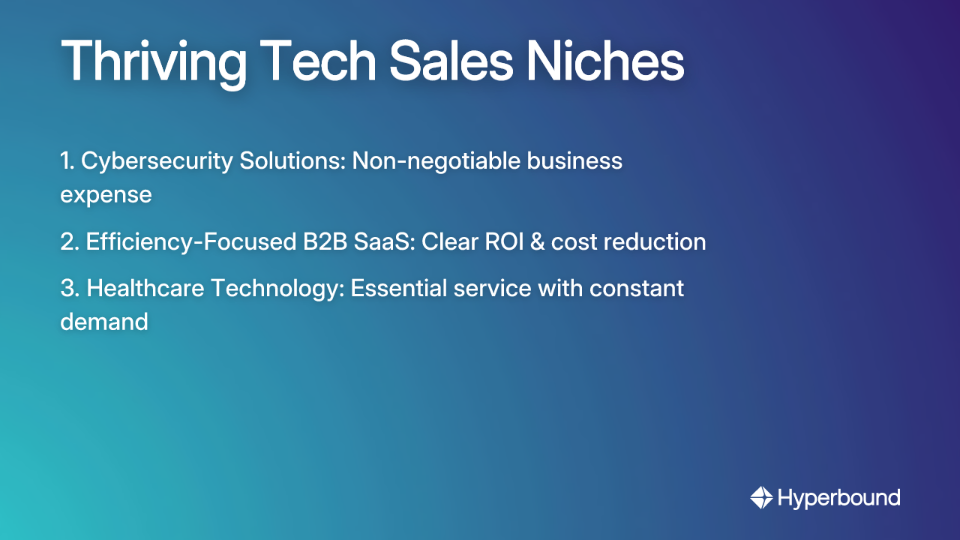
During economic downturns, companies ruthlessly cut vitamin products while doubling down on painkillers that solve critical business problems. Here are three tech sales areas that continue to show resilience:
Cybersecurity isn't optional in today's business environment. In fact, cyber attacks typically increase during economic downturns, making security a non-negotiable expense.
According to Gartner research, cybersecurity spending grows by approximately 11.3% even during recessions, with cloud security growing by an impressive 26.8%. When presenting cybersecurity solutions, focus on:
Software that demonstrably saves money or increases revenue remains essential, even in tight times. The key is having a crystal-clear value proposition that shows tangible ROI.
Successful SaaS salespeople in this environment focus on solutions that:
The sales cycle may lengthen as buyers require more approvals, but solutions with proven ROI still close.
Healthcare remains relatively recession-proof because it's an essential service with constant demand. Hospitals and clinics continue to invest in technology that improves efficiency and patient outcomes, even during downturns.
Healthcare tech sales requires navigating complex buying committees and lengthy sales cycles, but for those willing to invest in learning the industry, it offers stability that consumer-focused tech often lacks.
While finding the right tech niche is one approach, another increasingly attractive option is pivoting to more traditional, "blue-collar" industries. As one experienced sales professional advised: "Pick an old-school sales industry. You will probably make more, possibly have your own book, better WLB, better life, more respect, and a path towards retirement."
These industries might lack the glamour of tech, but they offer something increasingly valuable: stability and sustainability.
The construction industry represents a massive opportunity that many tech-focused salespeople overlook. Consider these statistics:
Construction sales isn't without challenges. The industry has heavy competition, relatively low profit margins, and lengthy decision timeframes. But here's where tech sales skills become invaluable:
Other stable "old-school" industries worth exploring include:

.png)
Ready to explore new opportunities? Here's how to position yourself for success:
Translate your tech experience into universal sales language:
Before you pivot, ensure your core skills are razor-sharp. The ability to handle objections, articulate value, and navigate complex conversations is universal. In a competitive market, these skills are your biggest differentiator. This is where dedicated practice comes in.
Using an AI Sales Coaching platform like Hyperbound allows you to practice realistic sales scenarios, from cold calls to closing, ensuring you can adapt your proven tech sales techniques to any industry. It's a low-risk way to build confidence and master the talk tracks for a new product or market.
Traditional industries often have different cultures than tech startups. Don't fight it—embrace it:
Tech sales isn't dead, but the gold rush is over. The path forward requires either specialization in recession-proof tech niches or pivoting to stable, traditional industries where your sales skills are in high demand.
The skills you've developed in the high-pressure world of tech sales—understanding customer pain points, demonstrating clear value, navigating complex buying processes—are incredibly transferable. Your next big break might not be with a flashy startup, but with a foundational industry that offers greater stability, respect, and long-term success.
Remember what one sales veteran advised: "You will probably make more, possibly have your own book, better WLB, better life, more respect, and a path towards retirement." In today's uncertain economic climate, that combination is increasingly attractive—and achievable for those willing to look beyond tech's fading promise.
The question isn't whether tech sales is dead. The question is: are you ready to apply your valuable skills where they'll be most appreciated and rewarded? Your next big break is waiting, perhaps in an industry you've never considered before.
Yes, tech sales can still be a good career, but the "gold rush" era of easy, high-paying remote jobs is over. The industry has become more competitive and requires specialization in recession-proof niches to ensure stability and high earning potential. Success now depends on finding roles in essential sectors like cybersecurity, healthcare tech, or efficiency-focused B2B SaaS that companies can't afford to cut.
Getting a job in tech sales is currently difficult due to a combination of market saturation, economic volatility, and internal company challenges. A flood of talent has increased competition, while rising interest rates have led to budget cuts and hiring freezes. Furthermore, many companies struggle with poor product-market fit, and internal politics over territories and quotas have intensified, creating a challenging environment for both new and experienced sales professionals.
The most stable tech sales jobs during a downturn are those that sell "painkiller" solutions—products that are essential for a business's operation. These include cybersecurity solutions (a non-negotiable expense), efficiency-focused B2B SaaS that provides clear cost savings or ROI, and healthcare technology, which serves a consistently high-demand, recession-proof industry.
Your tech sales experience is highly transferable to more traditional, "old-school" industries that offer greater stability. Top industries to consider include construction, business insurance and risk management, industrial equipment, and HVAC and building systems. These sectors value the consultative selling and CRM management skills honed in tech and often provide better work-life balance and long-term career paths.
To transfer your tech sales skills, reframe your resume to use universal sales language, focusing on achievements like managing complex sales cycles and demonstrating ROI rather than tech-specific jargon. Sharpen your core skills like objection handling and value articulation, which are valuable everywhere. Finally, strategically network with leaders in your target industry and be prepared to adapt to a different company culture.
Construction is a great industry for tech salespeople because it's a massive, stable market that often lacks the modern sales processes you're an expert in. Your skills in CRM mastery, consultative selling, and creating ROI-focused proposals are immediately valuable and can help you stand out. You can bring a new level of professionalism and efficiency to an industry where relationships and trust are paramount.











Use Cases
Legal