You've been tasked with growing revenue at your B2B company. The pressure's on to hit increasingly ambitious quotas, but traditional "spray and pray" approaches aren't delivering results. Prospects are numb to generic cold emails, and every day feels like you're on an endless fishing expedition with no clear strategy. Sound familiar?
B2B SaaS is getting harder by the day. The reality is that not all accounts are created equal, and wasting resources on poor-fit prospects is a luxury no sales team can afford.
Enter Target Account Selling (TAS) - a strategic B2B sales methodology that focuses your team's efforts on building and nurturing relationships with a select group of strategically chosen, high-value accounts that perfectly fit your Ideal Customer Profile (ICP). Unlike traditional broad-based approaches, TAS emphasizes deep research, personalization, and cross-functional collaboration to win the accounts that truly move the revenue needle.
In this comprehensive guide, you'll discover:
Let's transform your sales approach from aimless prospecting to strategic account conquest.
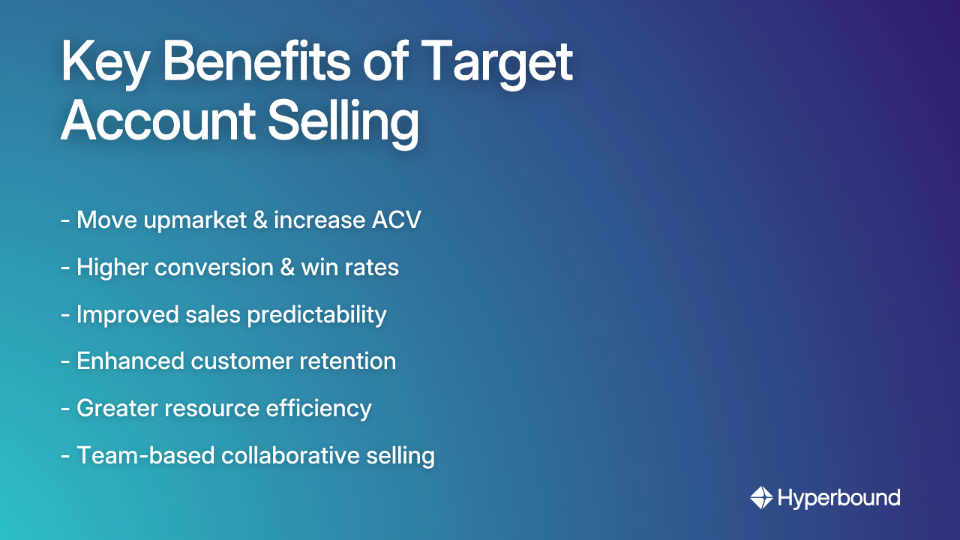
Before diving into the how-to, let's understand why TAS has become essential for sustainable B2B growth.
One of the most compelling benefits of TAS is its ability to help you land bigger fish. According to research from Gong.io, while TAS may generate fewer total deals than volume-based approaches, the deals it does produce have significantly higher ACVs. This is because TAS allows you to focus on accounts with the greatest revenue potential rather than chasing numerous smaller opportunities.
When you tailor your approach to specific targeted accounts, your conversion rates naturally improve. By developing deep account intelligence and crafting personalized value propositions, you directly address the prospect's unique pain points and business objectives. This precision leads to demonstrably higher success rates compared to generic approaches, as reported by Storylane.
A well-executed TAS strategy improves forecast accuracy and creates a more predictable revenue engine. By focusing on a defined list of accounts with clear qualification criteria, sales leaders can better predict which deals will close and when, making resource allocation and planning significantly more effective.
TAS isn't just about closing deals; it's about building long-term partnerships. The deep understanding you develop of your target accounts' business challenges positions you as a trusted advisor rather than just a vendor. This foundation of trust leads to stronger customer relationships, higher retention rates, and expanded opportunities for cross-selling and upselling.
Perhaps most importantly in today's competitive landscape, TAS ensures your team stops wasting precious time on poor-quality, low-potential accounts. Every hour spent on an unqualified prospect is an hour not invested in a high-value opportunity.
Modern B2B sales are complex, involving buying centers or groups of decision-makers rather than individuals. As highlighted by Upland Software, the days of the "lone wolf" seller are over. Today's complex B2B deals require a collaborative, team-based approach that includes:
This collaborative selling approach is essential because buyers now conduct significant independent research before engaging with sales. The limited time you have with them must be maximized, which requires seamless coordination across your revenue team.
Now that you understand the why, let's explore exactly how to implement TAS in your organization. This systematic approach will help you transition from random prospecting to strategic account conquest.
The foundation of effective TAS is a clearly defined ICP. As one experienced Account Executive on Reddit notes, the "first thing to do is always look at your best current clients and form a customer profile around them and look for similar companies."
Your ICP should include:
Firmographic characteristics:
Behavioral characteristics:
This isn't a one-and-done exercise. Your ICP should be regularly reviewed and refined based on new data from successful (and unsuccessful) deals. Gong's comprehensive guide offers deeper insights into creating a powerful ICP that drives results.
With your ICP established, it's time to identify and prioritize the specific accounts you'll pursue. This step transforms abstract criteria into an actionable list of target accounts.
Actionable Research Tactics:
If your company has a strict no-AI policy for list generation (as mentioned by one sales professional on Reddit), these manual methods of customer analysis and competitor research become even more valuable.
Surface-level research won't cut it in TAS. You need to understand your target accounts' world as thoroughly as they do.
Account Intelligence:
Market & Competitive Intelligence:
Primary Research:
As one sales professional noted on Reddit, "prospects are numb to generic outreach." Personalization is non-negotiable in TAS.
Craft Tailored Messages: Your outreach must address the specific pain points and goals you uncovered during research. Generic templates won't work for high-value targeted accounts.
Perfect the Cold Call: Many reps fear cold calling, but it remains highly effective when done right. According to Gong's research, aim for a talk-to-listen ratio of 55:45 - let the prospect talk more. Remember that "relatively few reps have the guts to call cellphones over and over until connecting," but persistence often makes the difference.
Show Up in Person: For high-value accounts, face-to-face interactions are invaluable. As one sales veteran on Reddit observed, "if someone is dropping a lot of money on something, especially if that something is new to them, they want to see a face in person." In-person meetings convey sincerity and build trust in ways virtual meetings cannot.
You're rarely selling to a single Decision Maker (DM). According to Gong's analysis, winning deals typically involve at least three stakeholders. Your job is to map and engage the entire buying center.
Identify key roles:
Customize your approach for each stakeholder:
For each high-priority target account, develop a specific opportunity plan that outlines:
This framework ensures your team executes with precision rather than relying on generic sales playbooks that don't account for the unique aspects of each target account.
Once you've mastered the basics, these advanced strategies will help you elevate your TAS approach and gain a competitive edge.
Not all target accounts deserve equal attention. Categorize your accounts into tiers based on revenue potential, strategic fit, and likelihood to close:
Tier 1: Your highest-value targets that receive the full-court press of resources, including executive involvement, custom content, and in-person meetings.
Tier 2: High-potential accounts that receive significant personalization but slightly less resource intensity than Tier 1.
Tier 3: Accounts that fit your ICP but may have longer sales cycles or less immediate revenue potential. These receive more scalable personalization approaches.
This tiering ensures you deploy your most valuable resources (especially expensive ones like in-person visits and executive involvement) where they'll generate the highest return.
Static, one-size-fits-all demos are increasingly ineffective for sophisticated B2B buyers. Create engaging, personalized interactive demos that showcase your solution addressing the specific use cases of the target account.
For example, Storylane reports that companies like Groundswell use tailored product demos for different buyer personas, resulting in a vastly improved sales experience. This level of personalization can dramatically shorten the sales cycle by making it immediately clear how your solution addresses the prospect's unique challenges.
Effective TAS requires seamless collaboration across your revenue team. Implement tools that facilitate this collaboration while automating repetitive tasks:
A well-maintained CRM with robust data enrichment ensures your insights are always accurate and accessible to everyone involved in the account.
For complex, high-value deals, executive involvement can be the difference between winning and losing. Train your executives to engage effectively with their counterparts at target accounts. This approach:
While TAS offers tremendous benefits, it's not without challenges. Here's how to avoid the most common pitfalls:
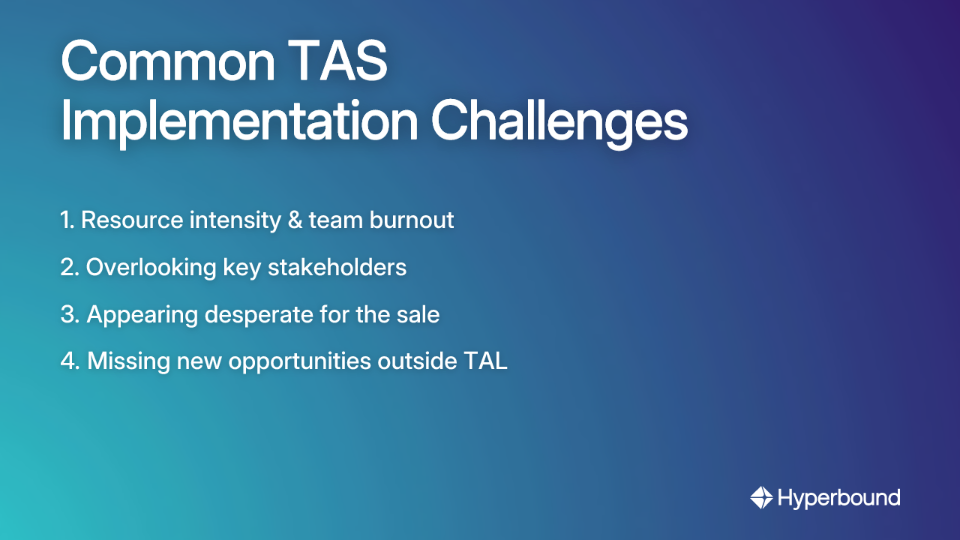
Problem: TAS requires significant time and resources for research and personalization, which can lead to team burnout if not managed properly.
Solution: Use technology and data analytics to streamline research. Prioritize ruthlessly with account tiering so you don't burn out your team on lower-value accounts. Automate where possible, but never at the expense of personalization for your highest-tier accounts.
Problem: Failing to map and engage the entire buying center can cause promising deals to stall or die suddenly when an unknown stakeholder raises objections.
Solution: Invest time in comprehensive stakeholder mapping early in the process. Always ask prospects, "Who else will be involved in this decision?" Provide your team with training on stakeholder management and navigating complex sales cycles.
Problem: As one Reddit user colorfully put it, "prospects are like women, they sense if you are desperate and run a mile." Pressuring a client can damage trust and undermine the relationship-building that's central to TAS.
Solution: Prioritize genuine relationship building over hitting a quota. Focus on understanding and solving their actual needs, not just pushing your product. Remember that asking for the sale is important, but it should come from a position of confidence in your solution's value, not desperation to close a deal.
Problem: A tight focus on your TAL might cause you to overlook emerging markets or new types of prospects that don't fit your current ICP.
Solution: Periodically reassess your ICP and target accounts. Schedule time for your team to explore new verticals or company types that might benefit from your solution. Consider allocating a small percentage of resources to "experimental" accounts that fall outside your typical ICP but show interesting potential.
These examples demonstrate how leading companies have implemented TAS principles to drive remarkable results:
AWS employs dedicated account managers who become deeply embedded in their enterprise clients' businesses. These teams conduct extensive research to understand each client's unique technical challenges and business objectives. They then tailor solutions and organize exclusive events to strengthen relationships, resulting in AWS dominating the cloud infrastructure market.
Salesforce uses its own powerful CRM software to track every interaction with its largest clients. This allows them to provide highly personalized support and strategic guidance. Their account teams focus on becoming trusted advisors rather than transactional sellers, helping customers maximize the value of their Salesforce investment while identifying opportunities for expansion.
Adobe leverages a combination of personalized marketing campaigns (Account-Based Marketing) and dedicated account management. Using sophisticated data analytics to understand customer behavior, Adobe proactively offers tailored solutions before customers even recognize the need. This approach has helped Adobe successfully transition from a traditional software company to a cloud-based subscription business.
Target Account Selling represents a fundamental shift in B2B sales strategy - moving away from high-volume, low-personalization approaches toward focused, research-intensive engagement with your most valuable potential customers. As we've explored throughout this guide, TAS isn't just another sales methodology; it's a comprehensive approach that aligns your entire revenue team around winning the accounts that truly matter.
Let's recap the key principles that make TAS so effective:
In today's increasingly competitive B2B SaaS landscape, TAS offers the most reliable path to increasing your Annual Contract Value, improving win rates, and building a predictable revenue engine. While it requires more upfront investment than volume-based approaches, the returns in terms of larger deals, shorter sales cycles, and stronger customer relationships make it well worth the effort.
For Account Executives looking to break into tech sales or experienced AEs seeking a better process, TAS provides the clear, repeatable strategy needed to stop the "fishing expedition" and start landing the trophy accounts that define a successful career. As one sales veteran on Reddit wisely noted, "asking for the sale is something some reps are scared of." With TAS, you've earned the right to confidently ask for the business because you've done the work to truly understand and address your prospect's needs.
Ready to implement Target Account Selling in your organization? Start by:
Remember that TAS is not a quick fix but a strategic approach that delivers sustainable results over time. The companies that excel with this methodology make it a core part of their sales culture, continuously refining their approach based on what works and what doesn't.
By focusing your team's efforts on the accounts that truly match your ICP, developing deep account intelligence, and engaging the entire buying center with personalized messaging, you'll transform your sales approach from aimless prospecting to strategic account conquest - and your results will reflect that transformation.
In the words of one successful B2B sales leader: "Stop being afraid to ask for the sale; with TAS, you've earned the right to." Now go land those high-value B2B accounts your competitors only dream about.
Target Account Selling (TAS) is a strategic B2B sales methodology where sales and marketing teams focus their efforts on a select list of high-value accounts that fit an Ideal Customer Profile (ICP). Instead of casting a wide net, TAS prioritizes deep research, personalization, and relationship-building to win large, strategic deals that significantly impact revenue.
Target Account Selling (TAS) and Account-Based Marketing (ABM) are closely related but distinct; TAS is a sales-led methodology focused on the entire sales process for a target account, while ABM is a marketing-led strategy focused on creating personalized marketing campaigns for those same accounts. The two strategies are most effective when they work together, with ABM generating awareness and engagement and TAS managing the sales cycle and closing the deal.
The first and most critical step to implementing Target Account Selling is creating a detailed Ideal Customer Profile (ICP). An ICP defines the firmographic and behavioral characteristics of your best customers, providing the foundation for identifying which high-value accounts your team should target.
The number of accounts on a Target Account List (TAL) depends on your team's size and resources, but a good rule of thumb is to focus on quality over quantity. An Account Executive can typically manage a small number of high-priority Tier 1 accounts (e.g., 5-10) with deep personalization, and a larger number of Tier 2 and Tier 3 accounts with more scalable outreach. The key is to ensure each account can receive the attention it deserves.
The success of a TAS program is measured by metrics that reflect deep engagement and high value, not just volume. Key performance indicators (KPIs) include higher Annual Contract Value (ACV), increased win rates for target accounts, shorter sales cycles, higher customer lifetime value (LTV), and improved forecast accuracy.
Cross-functional collaboration is vital in TAS because modern B2B purchasing decisions are made by buying committees, not single individuals. A successful strategy requires a coordinated effort from sales, marketing, product specialists, and executive leadership to engage different stakeholders with relevant messaging and build consensus across the prospect's organization.
Yes, small businesses and startups can benefit immensely from Target Account Selling, as it allows them to use their limited resources with maximum efficiency. By focusing on a small list of high-potential accounts that perfectly fit their solution, startups can compete with larger companies, land foundational customers, and build a strong reputation within a specific niche.
.png)










Use Cases
Legal