
Sales reps still ask questions that the battlecard already answers. The pattern reflects a structural failure, not a training failure. The battlecard exists as a PDF or a linked document, disconnected from the context where it would be useful. No agent, human or AI, can reliably surface it at the right moment when the knowledge is stored as a flat file in a folder.
This is the core problem for any team using AI in its GTM motion. The bottleneck is the structure of the knowledge the agent works with, rather than the intelligence of the agent.
Most sales enablement libraries are collections of files: battlecards, persona guides, qualification frameworks, call scripts, and competitive summaries. Each item is useful in isolation, but together they form an unstructured collection. A traditional CMS stores content as title/body/date rows and does not encode the relationships that make content meaningful: those relationships live implicitly in the author's intent, not the data structure.
When an AI agent queries that library, it runs a vector search: it finds the text chunk most similar to the query and returns it. Vector search is a sophisticated method of finding a snippet, not a form of reasoning. The agent retrieves the nearest document; it does not know that the CFO persona connects to a specific set of objections, or that those objections connect to specific battlecard responses, or that the qualification rules relevant to a first discovery call are different from those relevant to a renewal conversation.
The result is that agents built on flat content stores produce inconsistent outputs. A benchmark study of retrieval architectures found that prompting agents against unstructured document collections produces independently generated artifacts that drift from each other. The practice bot, the scorecard, and the manager coaching prompt each retrieve different chunks and produce different answers from nominally the same playbook, resulting in four versions of the truth.
The same research found that knowledge-graph-based retrieval (GraphRAG) improved factual correctness by 8% and context relevance by 7% over standard vector RAG on complex reasoning tasks. The difference is substantial and reflects a fundamental architectural distinction.
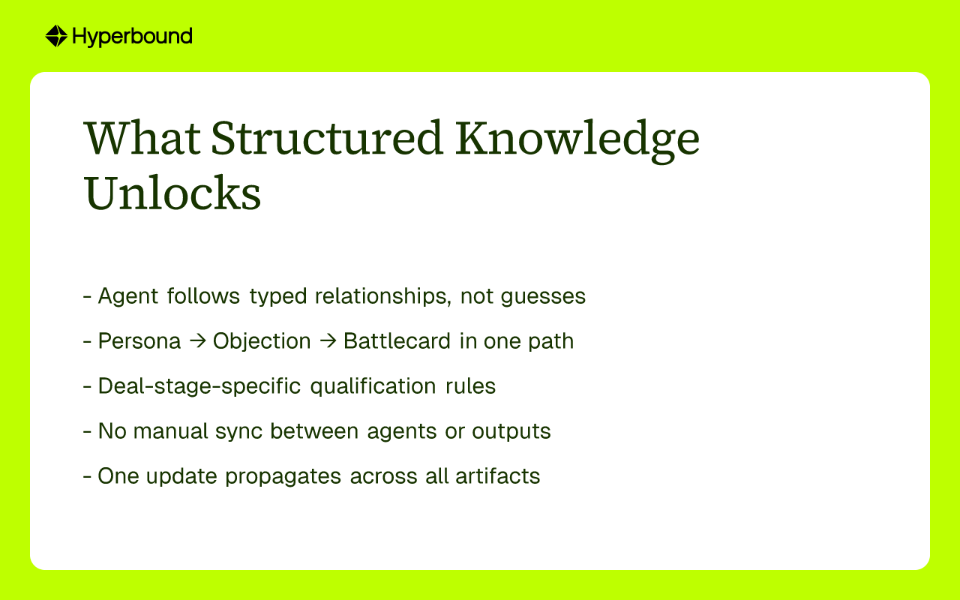
Graph traversal works differently from vector search. Instead of finding the nearest chunk, the agent follows explicit, typed relationships between entities: from a deal stage to the applicable qualification rules, from a persona to its linked objections, from an objection to the battlecard designed to address it. Each hop is a defined relationship, not an inference. The agent computes a path rather than guessing at relevance.
This is what agentic content management requires at its foundation. The foundation is not improved prompts or additional documents. It requires a data model that encodes relationships as first-class objects, so the agent can traverse them rather than search around them.
The primitives that make this possible are typed entities, bidirectional links, and block-level addressability. These converged in personal knowledge tools like Roam and Obsidian and are now the structural requirements for systems that need agents to reason rather than retrieve. In a revenue context, the entities are personas, objections, qualification criteria, deal stages, battlecards, and talk tracks. The relationships between them are where the reasoning capability resides.
Two concrete examples illustrate this.
Persona connects to objections; objection connects to battlecard. An agent on a live call identifies the prospect's persona as a CFO. It traverses the relationship graph from that persona to the linked common objections: budget approval cycles, ROI justification, risk tolerance. When the prospect raises one of those objections, the agent traverses from that specific objection to the battlecard that addresses it. It surfaces the exact talking points, customer evidence, and data relevant to that moment. It follows a path defined when the knowledge was structured, rather than searching for the term "battlecard".
A qualification rule applies to first calls but not renewals. MEDDICC is a full-lifecycle discipline. The rules for identifying an Economic Buyer and establishing decision criteria on a first discovery call are different from the rules for confirming champion status and quantifying impact on a renewal or upsell. The framework spans forecast accuracy, ramp time, ACV growth, and net revenue retention; each stage carries different priorities. A structured model encodes that distinction explicitly. The agent reads the deal stage from the CRM, traverses to the applicable rule set, and applies only the criteria relevant to that specific conversation. A flat document cannot express that conditionality. A relationship graph does it by design.
The operational consequence of structured sales content is consistency, and consistency compounds.
When an AI practice bot, a call scorecard, and a manager feedback prompt all traverse the same relationship graph, they produce outputs that agree with each other. The same persona-objection-battlecard chain that informs the roleplay scenario informs the scoring criteria and the coaching note. They share one source of structured truth, without requiring manual synchronization.
This is the outcome that flat document libraries cannot reliably deliver. Enablement teams spend significant time maintaining alignment between training materials, scorecards, and playbooks. When content is updated in one place, the downstream artifacts need to be manually refreshed everywhere else. That maintenance overhead is proportional to the number of agents and outputs the team runs. As AI use expands across the GTM motion, the drift problem scales with it.
Structured revenue knowledge solves this at the model level. Update the relationship between a persona and its objections, and every artifact generated from that graph reflects the update automatically.
The direction follows the same principle that already drives Hyperbound's consistent practice loop: Score Real Calls, Identify Gaps, Practice, Repeat. When a team's practice bots, scorecards, and coaching notes all draw from one structured source, they agree with each other, and that agreement is what turns training into behavior change. Kota CMS extends that discipline to the knowledge model itself.
Applying that same discipline to the underlying knowledge model, not just the practice cadence, is the direction the category is moving.
Gartner frames agentic CMS as an emerging category. What is currently shipping in most systems is capability agents bolted onto a flat content store. Retrieval is improved. The underlying model remains the same: rows of documents without encoded relationships.
The relational, model-first approach described in this article is the core direction Kota CMS is designed around. It is the foundational design question: what structure does revenue knowledge need so that agents can reason over it rather than search through it?
This means moving structured sales content from a collection of files into a living graph of typed entities and explicit relationships. Personas, objections, battlecards, qualification rules, deal stages, and talk tracks become nodes. The connections between them become the intelligence layer. Every agent that touches that graph, whether it is generating a practice scenario, scoring a call, or producing a coaching summary, operates from the same source of truth.
Kota CMS is being expanded to make this possible for revenue teams without requiring them to become knowledge engineers. The model should serve the playbook. The mechanism lives next door to the structured model: how to give an AI your methodology without retyping it, and who changed what when the model is governed and versioned.
Kota CMS is available as a paid add-on in private preview. To learn more and request access, contact your Hyperbound account manager or visit the Kota CMS introduction.
Private preview capabilities, scope, and availability are subject to change as we continue development and incorporate customer feedback.

AI sales agents give inconsistent answers because the source content is stored as flat documents rather than as a graph of typed relationships. Without encoded relationships, each agent retrieves a different chunk and produces a different version of the truth.
Vector RAG finds the nearest text chunk to a query; GraphRAG follows explicit, typed relationships between entities such as deal stages, personas, objections, and battlecards. A benchmark study found GraphRAG improved factual correctness by 8% and context relevance by 7% over standard vector RAG on complex reasoning tasks.
An agentic knowledge graph in sales is a structured model of entities like personas, objections, battlecards, qualification rules, deal stages, and talk tracks, connected by explicit relationships that AI agents can traverse instead of search through.
A flat document library is not enough because it does not encode the relationships that make sales content meaningful. Agents retrieve the nearest snippet but cannot follow a chain like persona -> objection -> battlecard or deal stage -> qualification rule.
Revenue teams should start with personas, objections, battlecards, qualification rules, deal stages, and talk tracks, then map the explicit relationships between them. These entities and relationships create the reasoning paths AI agents need for consistent outputs.
Yes, qualification frameworks like MEDDICC can be modeled as deal-stage-specific rule sets in a knowledge graph. That structure lets an agent apply first-call discovery criteria differently from renewal or upsell criteria.
Hyperbound's structured practice loop (Score Real Calls, Identify Gaps, Practice, Repeat) is designed to drive consistent behavior change. Kota CMS extends that same discipline to the knowledge model itself; it is in private preview and Hyperbound has not yet published outcome figures for it.
Kota CMS is designed around a relational, model-first approach that turns sales content into a living graph of typed entities and explicit relationships. Revenue teams can use it without becoming knowledge engineers because the model is built to serve the playbook without requiring manual knowledge engineering.
<a name="request-access"></a>










Use Cases
Legal