
Your prospect seemed enthusiastic throughout the entire sales process. They nodded along during your demo, asked engaging questions, and even hinted at implementation timelines. Then suddenly, the dreaded email arrives: "We've decided to go with another vendor. Their solution fits our budget better."
Sound familiar? You're not alone. Many sales professionals selling premium solutions consistently lose deals to lower-priced competitors, leaving them frustrated and questioning their approach.
But here's the truth: you're not losing on price, you're losing because you're not establishing your value.
While 84% of sales professionals believe price is the biggest reason for objections, only 26% of customers actually cite price as their primary obstacle. This guide isn't about teaching you to discount your offerings—it's about mastering the art of value communication to make your premium price the obvious choice.
When prospects say "your price is too high," they rarely mean it literally. Price objections are typically smokescreens for deeper concerns:
Understanding this psychology is crucial because most buying decisions are made emotionally, not logically. Your prospects operate with mental benchmarks for pricing shaped by market standards and past experiences. Your job is to shatter those benchmarks by establishing a new standard of value.
The cornerstone of winning against cheaper competitors is value-based selling—a consultative approach focused on providing value and solving problems rather than just promoting features.
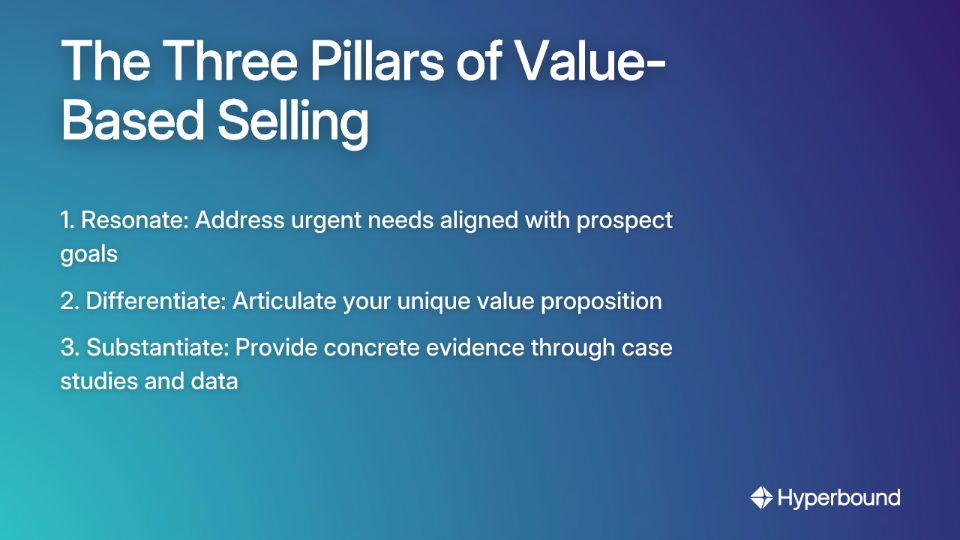

Listen First, Pitch Later: Before presenting your solution, understand the prospect's world completely. Ask probing questions like: "Is there anything you wish your current vendor did differently or that they don't do but you wish they did?"
Sell Outcomes, Not Features: Frame every feature as a direct solution to a pain point or path to a desired outcome. Instead of "Our software integrates with X," say "By integrating with X, you eliminate 5 hours of manual data entry per week. What could your team accomplish with that time back?"
The golden rule is simple: discuss price only after the product's value has been fully established and agreed upon. When you do bring up price, here's how to frame it effectively:
Present your fees next to expected returns to change the conversation from "cost" to "investment":
"The investment for our platform is $20,000 annually. Based on our discussion, we project this will save you $48,000 in operational costs in the first year alone, delivering a 140% ROI."
Educate clients that the cheapest option is rarely the least expensive in the long run. Break down the hidden costs of choosing a "cheaper" competitor:
Use specific, tangible ROI examples:
When faced with price objections, avoid getting defensive, making assumptions, or immediately dropping your price. Instead, treat objections as requests for more information.
"I completely understand where you're coming from. A lot of our customers felt the same way initially. Let's break down the value and see if it aligns with your needs."
Ask clarifying questions to diagnose the real issue: "I appreciate you sharing that. To make sure I understand, is the primary concern the overall budget, or is it more about the cash flow of a single payment?"
"That's a fair point. Lower price often doesn't mean lower total cost. When you evaluated their solution, did they provide a guarantee for 99.9% uptime like we do? How important is that reliability to your operations?"
"I could match their price, but to do so, we would need to remove [Feature A] and [Feature B]. Based on our conversation, you said those were critical for [achieving Goal X]. How would removing them impact your team?"
"You've said that [specific feature] is important to you. While there may be cheaper options, they don't provide this feature depth. Wouldn't you agree that the added benefit would be worth the investment?"
"If our solution saves your team six hours per week, what could they be working on instead?"
"Let's put the price aside for one moment. If this were free, would it be the right solution for you?" (This helps determine if it's a value or budget issue)
"Where will you be in a year if nothing changes?"
"We understand the budget issue. Many of our clients face similar price sensitivity. What if we split this investment across two quarters to make the cash flow more manageable?"
"What if we started with a smaller pilot project for three months? We can prove the value, and then talk about expanding when the new budget is approved."
Nonprofits present a unique challenge: extremely tight budgets, compliance requirements that make purchases mandatory, and often a lack of urgency because "they don't really believe that if they don't have it, they'll be in any trouble."
Don't sell the compliance checkbox; sell peace of mind and mission protection:
"I understand this feels like a mandatory expense. Our goal is to turn it into a strategic asset. Our solution not only guarantees you are 100% compliant but also provides the detailed reporting that high-value donors are now demanding. It protects your status and helps you raise more funds."
Show how premium features free up resources for their actual mission:
"The cheaper option requires 10 hours of manual data entry a month. Our automated solution eliminates that. That's 10 hours your team gets back to write grants, connect with donors, or run programs. What's the value of that time to your mission?"
Nonprofit budgeting is unique, so offer flexible terms:
"I know nonprofit budget cycles can be challenging. We can structure this as a phased implementation that aligns with your grant funding, or we can look at a multi-year agreement that locks in a lower annual rate."
Losing on price is merely a symptom of not effectively communicating value. By mastering value-based selling, reframing conversations around ROI and total cost of ownership, and handling objections as opportunities to reinforce your solution's value proposition, you can consistently win against cheaper competitors.
Remember: price is only an issue in the absence of value. When you truly differentiate your solution and connect it to emotional buying triggers as well as tangible business outcomes, prospects stop comparing you to cheaper alternatives altogether.
According to HubSpot, 90% of sales teams using value-based selling report year-over-year revenue growth, compared to only 72% of those who don't. By adopting these strategies, you're not just saving deals—you're joining the top tier of sales professionals who consistently win on value, not price.
The next time a prospect says they found a cheaper option, don't panic. See it as an opportunity to demonstrate why, when it comes to solving their specific problems, your solution isn't expensive—it's priceless.










Use Cases
Legal