You've just wrapped up a sales call and play back the recording. As you listen, you cringe—there they are again: "um," "like," "you know," and the dreaded "essentially" peppered throughout your pitch. Each filler word feels like a tiny credibility leak, draining authority from what should have been a confident presentation.
If this scenario feels painfully familiar, you're not alone. Many sales professionals struggle with verbal clutter that disrupts their communication flow and potentially costs them deals.
"My 'uhms' would make prospects stop talking," confessed one sales rep in a Reddit discussion. Another lamented, "I'm talking a lot on the calls sometimes even when the prospect wants to talk."
This comprehensive guide will help you understand the psychology behind filler words, quantify their impact on your sales performance, and provide actionable techniques to eliminate them from your sales lexicon.
Filler words aren't just bad habits—they're symptoms of a deeper cognitive process. Understanding why we use them is the first step toward eliminating them.
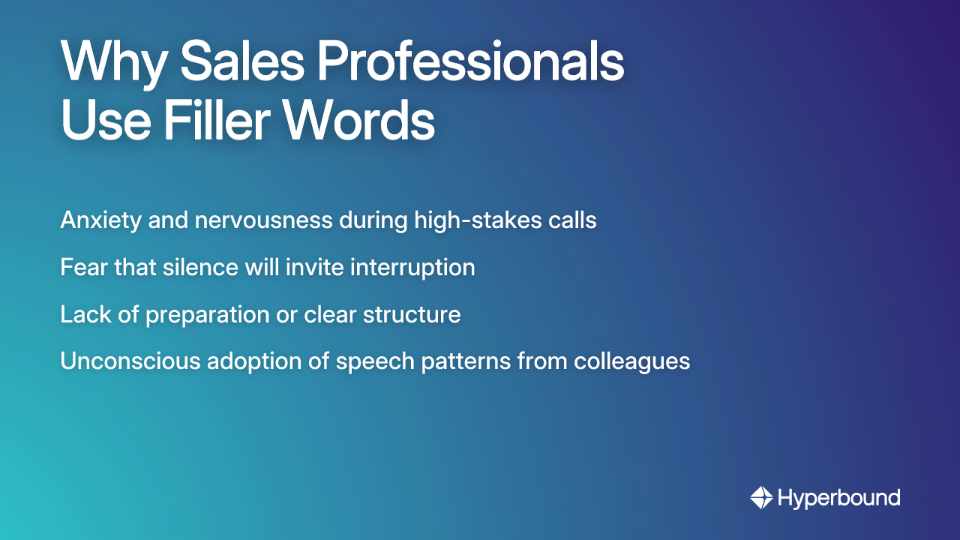
Filler words occur when our speech outpaces our thoughts. They serve as verbal placeholders while our brain searches for the right words. This mismatch typically happens for several reasons:
You might think a few "ums" here and there are harmless, but research tells a different story.
According to research by Dr. Frederick Conrad, the success rate of salespeople drops significantly as their use of filler words increases. When sales reps used filler words sparingly (around 2% of their speech), it had a small positive effect. However, usage above 5% was correlated with lower close rates.
As one frustrated buyer noted: "Can tech salespeople stop saying the word 'ESSENTIALLY'?" This sentiment reflects how filler words can become irritating distractions that overshadow your message.

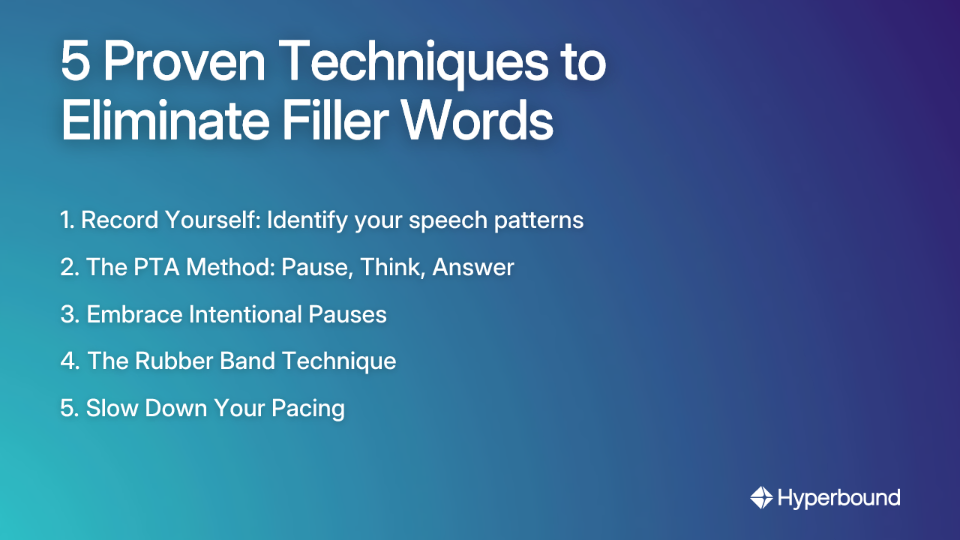
Now that you understand the why behind filler words, let's dive into how to eliminate them from your sales calls.
Self-awareness is the foundation of improvement. You can't fix what you don't recognize.
Why it Works: Recording provides objective data on your speech patterns and forces you to confront habits you might not notice in real-time.
How to Do It:
Pro Tip: While some transcription services scrub "ums" and "ahs," giving you a false sense of clean speech, Hyperbound's AI Real Call Scoring is designed to pinpoint these verbal tics, providing an accurate assessment of your communication habits.
This simple three-step method replaces the panicked rush to speak with a deliberate, thoughtful process.
The Steps:
As one sales professional shared on Reddit, "After they stop talking, pause for a solid 5-10 seconds. Just be silent, take a breath and take your time!"
The intentional pause is perhaps the most powerful tool in your communication arsenal.
Silence is Golden: Reframe silence. It isn't awkward; it's a tool. A well-placed pause can add emphasis, command attention, and give the prospect time to absorb what you've said.
Replace Fillers with Pauses: When you feel the urge to say "um," simply stop. Take a breath. Let the silence hang for a second. This creates a perception of confidence and thoughtfulness.
Research from Duarte suggests that audiences perceive speakers who use intentional pauses as more authoritative and prepared than those who fill every moment with sound.
This technique uses negative reinforcement to create a powerful physical and mental connection to the habit you're trying to break.
How to Do It:
As one successful salesperson shared: "I kept a rubber band on my wrist, and every time I said 'um' I would snap it, just hard enough to sting. Within a few weeks, I had reduced my filler words by about 80%."
Speaking too fast is a primary driver of filler words because your brain can't keep up with your mouth.
The Fix: Make a conscious effort to speak more slowly and deliberately. This reduces anxiety and gives you the mental space to choose your words carefully.
Expert Advice: Aim to reduce your speaking speed from an 8 out of 10 to a 6 out of 10. It will feel uncomfortably slow to you, but will sound calm and collected to your prospect.
Tech salespeople face unique challenges when explaining complex products, which can lead to overreliance on certain filler words. Here's how to address these specific challenges:
First, pinpoint exactly when words like "essentially" and "actually" appear in your speech:
"Create a question tree. You'll find yourself and the prospect having a crafted conversation," advised one successful sales professional on Reddit.
A question tree is a pre-planned conversation flow that helps you navigate discussions more smoothly. When you have a structure, you're less likely to rely on verbal crutches.
How to Build One:
Instead of saying "essentially" before explaining a feature, try these alternatives:
These phrases serve the same function but add value rather than noise to your explanation.
The fastest way to build new habits is through repetition. However, practicing on live prospects is risky. AI-powered roleplay provides a safe, scalable environment to master filler-free communication.
How it Works:
Create a friendly competition around reducing filler words:
Ask a peer or manager to listen to your calls and provide feedback:
Asking better questions helps shift the conversation focus from your explanations to the prospect's needs, reducing opportunities for filler words.
Sample Practice:
Eliminating filler words is not about achieving perfection—it's about making meaningful progress that improves your communication effectiveness and sales outcomes.
Remember these key takeaways:
With consistent practice, you'll not only reduce filler words but also become a more confident, persuasive communicator who can maintain better communication flow with prospects, handle sales objections effectively, and ultimately close more deals.

As one sales professional who conquered this challenge noted: "It's getting better but still work in progress." Improvement is a journey, not a destination. The fact that you're reading this guide means you've already taken the first step toward more powerful, filler-free communication.
Start small, track your improvement, and celebrate progress. Your prospects—and your commission check—will thank you.
Filler words are sounds or phrases like "um," "like," "you know," or "essentially" that people use to fill pauses in conversation while they are thinking of what to say next. In a sales context, they often signal nervousness, lack of preparation, or uncertainty, which can damage a salesperson's credibility and authority.
You likely use filler words due to a combination of factors, including anxiety during high-stakes calls, a fear of silence, lack of preparation, or simply as a learned social habit from colleagues. It's often a "brain-mouth mismatch," where your speech gets ahead of your thoughts, and your brain uses fillers as verbal placeholders while it catches up.
Excessive filler words can significantly hurt your sales performance by undermining your credibility, diluting your core message, and making you sound unprepared or uncertain. Research shows that as filler word usage increases, close rates tend to decrease because prospects can become distracted or annoyed, focusing on your verbal tics instead of your value proposition.
The most effective way to stop using filler words is to consciously replace them with intentional pauses. This simple technique gives you time to think and makes you sound more confident and thoughtful. You can master this by using the "Pause, Think, Answer" (PTA) method: when you feel the urge to use a filler, pause for a second, formulate your response, and then answer clearly.
You can practice reducing filler words safely by recording and analyzing your own calls, or more effectively, by using AI-powered roleplay platforms. AI sales roleplay tools like Hyperbound provide a risk-free environment to simulate real sales conversations. You can practice handling objections and explaining complex topics, receiving instant feedback on your filler word usage without jeopardizing a relationship with a real prospect.
Yes, while any filler word can be distracting, certain words like "essentially" or "actually" can be particularly damaging for salespeople, especially in tech. These words are often used as a crutch when explaining complex topics, but they can come across as condescending or may minimize the importance of the features you're describing. It is better to use precise, value-driven language like, "What this means for your business is..."
You can start seeing a reduction in filler words within a few weeks of consistent, conscious practice, but breaking a long-standing speech habit is a gradual process. The key is consistency. By regularly using techniques like self-recording, the PTA method, and other exercises mentioned in this guide, you will build new, better habits. The goal is steady progress, not overnight perfection.










Use Cases
Legal