
You've hired a sharp new BDR. They've sat through orientation, watched the product walkthrough, and nodded along to your objection-handling slides. Then they get a hiring manager on the phone — and freeze the moment they hear: "We already have vendors we're happy with."
This is the gap that kills pipeline in staffing agencies. Not effort. Not attitude. The gap between knowing what to say and being able to say it under pressure, live, with a skeptical prospect on the other end.
Generic staffing sales training rarely closes that gap. Here's why:
The markup conversation. Off-the-shelf sales programs teach feature-benefit selling. But staffing reps don't sell features — they defend a gross margin on every call. Justifying a 25% markup to a cost-conscious hiring manager is a value conversation, not a product demo. Generic curricula won't teach your reps how to hold the line.
The "we already have vendors" objection. This is the single most common blocker in staffing BD calls, and most standard objection-handling frameworks treat it like any other pushback. It isn't. It requires a nuanced counter-narrative that speaks directly to vendor fatigue, fill rates, and time-to-placement — none of which appear in a generic sales course.
Converting recruiters into hunters. Many staffing sales reps come from a recruiting background. They're wired for candidate relationships, not client acquisition. Shifting the mindset from reactive to hunter-mode is a fundamental behavioral change — one that most training programs completely ignore.
The practice deficit. Reps face high-stakes conversations without adequate preparation, leading to pipeline leakage and burnout. They're learning on live prospects — the most expensive classroom there is.
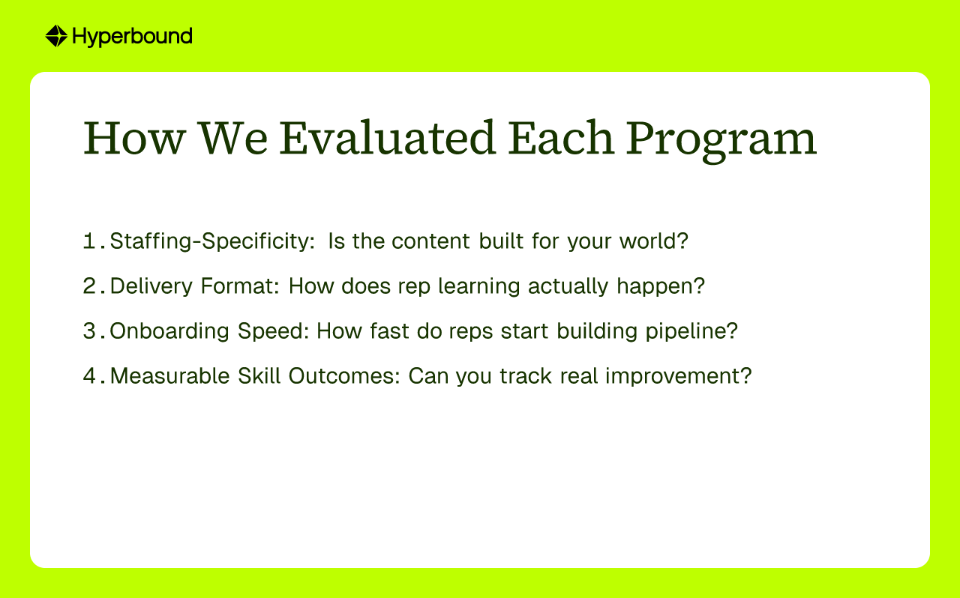
To cut through the noise, we evaluated 7 staffing sales training programs across four criteria that actually matter to sales leaders and enablement managers:
Best for: Staffing agencies that need reps to practice cold calls, markup objections, and hiring manager pushback before burning real prospects.
The biggest gap in traditional staffing sales training isn't content — it's repetition. Reps need hundreds of at-bats in challenging scenarios before the responses become instinctive. Hyperbound Practice is purpose-built to solve that.
Using AI buyer personas trained on 2M+ hours of real B2B sales conversations — not generic scripts — Hyperbound lets your reps practice the exact conversations that make or break pipeline in staffing:
The AI personas respond dynamically, push back unpredictably, and react the way real prospects do — because they're built from the patterns of real sales calls. This isn't a scripted chatbot. It's a realistic simulation that forces reps to think on their feet.
Onboarding speed: Hyperbound delivers a 50% faster ramp time. Vanta reduced their ramp from 210 days to 72 days — a 60% reduction — after rolling out Hyperbound at scale.
Measurable outcomes: After every simulation, reps receive instant AI Scorecard feedback: talk-listen ratio, methodology adherence, how they handled key objections. Sales leaders get dashboards to track team-wide skill progression — not just course completion, but actual conversational competency.
Delivery format: On-demand and embedded directly in CRM, LMS, and Slack. Tenured reps can use Bitesized Roleplays to drill specific scenarios in short bursts without sitting through a full training module. For complex multi-stakeholder calls (think hiring manager + HR director), Multiparty Roleplays let reps practice navigating a room before stepping into one.
Staffing-specificity: Fully customizable. Agencies can build AI personas that perfectly replicate their target ICP — down to the industry, company size, and objection style of the hiring manager you cold call every Tuesday morning.
The core insight here applies directly to the staffing context: knowledge from any classroom program means nothing if reps can't execute it under pressure. Hyperbound is where that knowledge becomes muscle memory.
👉 See Hyperbound Practice in action | Read G2 reviews
Best for: Teams that need structured, industry-validated foundational knowledge fast.
The Staffing Industry Analysts (SIA) partnered with Butler Street — one of the most recognized advisory names in staffing — to create a training program that actually speaks the language of this industry. This is not a recycled generic sales course with the word "staffing" dropped in the title.
Modules cover Sales Effectiveness, Recruiting Effectiveness, and Leadership Effectiveness, all grounded in the real dynamics of staffing firms: how to communicate value in a commoditized market, how to differentiate your agency when hiring managers have 10 other vendors in rotation, and how to build client relationships that go beyond filling a req.
Delivery format: Self-paced online modules with video, text, and interactive elements — accessible on the rep's schedule, not yours.
Onboarding speed: Gets new hires to a solid knowledge baseline quickly. The application of that knowledge, however, depends heavily on manager reinforcement and practice repetition after the modules end.
Measurable outcomes: Reps complete structured modules with practical tools and templates for immediate use. Skill measurement is largely manager-observed rather than system-tracked.
Cost: $499 for SIA members, $599 for non-members — a reasonable entry point for agencies looking to establish a knowledge foundation without a major budget commitment.
Best for: Firms that want an extensive, ready-to-deploy content library specifically for staffing teams.
Menemsha Group has built one of the most comprehensive staffing-specific training content libraries available. If your enablement team is stretched thin — managing 50+ reps with limited bandwidth — this is the kind of pre-built resource that can accelerate rollout without requiring you to build everything from scratch.
The platform includes:
They also include manager enablement content — coaching frameworks, scorecards, and data-driven coaching methodologies — which addresses the reality that frontline managers in staffing rarely have formal coaching training of their own.
Delivery format: SaaS platform. Content is modular and can be assigned to specific roles or inserted into an onboarding curriculum.
Onboarding speed: The volume of pre-built content means less time spent building and more time spent learning. New hires can move through structured material at a good pace.
Measurable outcomes: The roleplay certification exercises and coaching scorecards provide more structure than a passive video library. That said, the quality of skill measurement still depends on how managers use the tools provided.
Best for: Establishing a shared sales language and framework across the entire organization.
Programs like Sandler Training, Challenger, and MEDDIC are proven at scale. They give teams a coherent system of thinking — how to qualify, how to teach, how to advance a deal — that creates consistency across a distributed team.
The caveat for staffing: these are industry-agnostic frameworks, and they require deliberate translation work to make them useful in your context. "Identify pain" in Sandler looks different when the pain is a 90-day vacancy dragging on an engineering team. "Commercial teaching" in Challenger requires your reps to understand enough about a client's talent market to lead with an insight — that's a high bar without staffing-specific content to draw from.
Delivery format: Typically instructor-led, either virtual or in-person, with supplemental online materials.
Onboarding speed: These programs prioritize deep learning over quick-start. Expect a longer runway before reps are fully applying the methodology in live calls.
Measurable outcomes: Methodology certification is the primary output. Connecting that certification directly to pipeline metrics requires additional infrastructure.
Best for: Established agencies with a mature enablement function and the resources to build proprietary content.
A custom in-house program can be the most company-specific training possible — built around your exact ICP, your differentiators, your pricing model, and your top reps' winning behaviors. At its best, it's the most relevant content your reps will ever receive.
The challenge is execution. Sales enablement leaders are frequently outnumbered — one enablement professional managing 50 to 100+ reps — which means custom content is often outdated before it's finished. Reps then waste time digging through Drive folders and internal wikis to find materials that should be at their fingertips.
Onboarding speed: High initial investment. Slow to build, and even slower to iterate when messaging changes or new objections emerge.
Measurable outcomes: Entirely dependent on what systems you build. Most in-house programs lack objective, rep-level skill measurement — making it difficult to close the loop between training and pipeline results.
Best for: Targeted, expert intervention for specific strategic challenges.
Boutique consultants who specialize in staffing and recruiting BD bring deep vertical knowledge and can create immediate breakthroughs — especially for leaders trying to reposition their firm's value proposition, fix a broken outbound motion, or develop a high-potential account manager into a true hunter.
The model works for specific interventions. It's harder to scale for onboarding an entire class of new hires without significant cost and coordination overhead.
Delivery format: Live workshops, one-on-one coaching, and strategic consulting — highly personalized, by design.
Onboarding speed: Fast for targeted challenges. Slower and more expensive as a primary onboarding vehicle.
Measurable outcomes: Often anecdotal. Success tends to be tied to the specific engagement rather than a systematic, repeatable measurement of team-wide skill improvement.
Best for: Supplemental, self-directed learning on broad sales fundamentals.
Platforms like LinkedIn Learning offer accessible, cost-effective courses on sales topics — prospecting, communication, negotiation — at a price point that's hard to argue with. For reps who want to fill specific knowledge gaps on their own time, this is a reasonable resource.
What it won't do: prepare a BDR for the moment a hiring manager at a 500-person manufacturing firm says "your markup is way higher than our other agencies." That requires specificity, practice, and feedback — none of which a passive video library provides.
Measurable outcomes: Course completion certificates. There's a significant gap between completing a module on objection handling and actually handling an objection well under live fire.
Here's the uncomfortable truth about staffing sales training: knowledge is not the same as skill.
A rep can watch every module, read every playbook, and ace every certification quiz — and still fold the moment a skeptical hiring manager pushes back on their fee. That's not a knowledge problem. It's a practice problem.
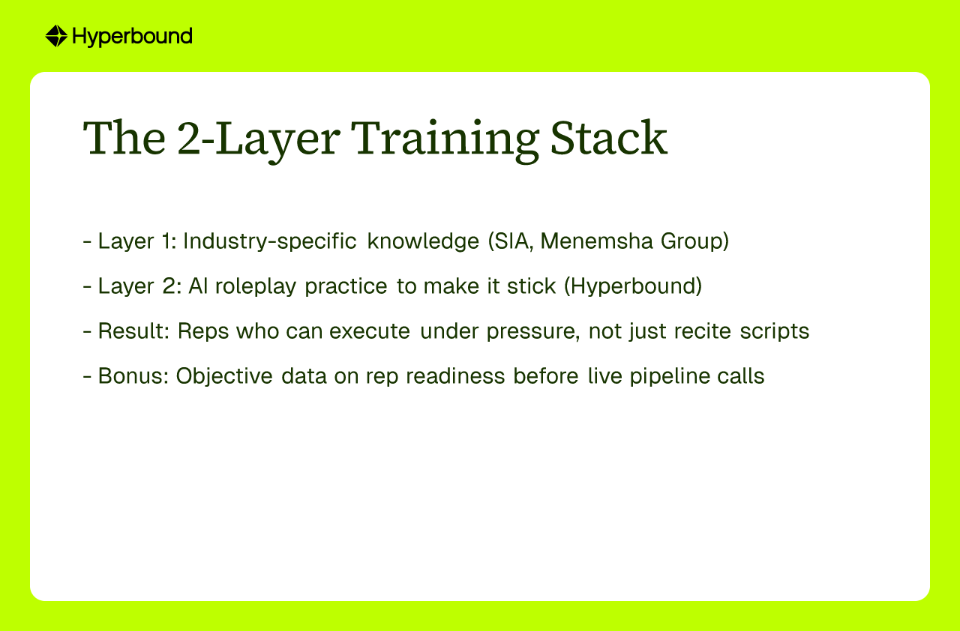
The agencies building the strongest pipelines aren't choosing between training formats. They're layering them deliberately:
Step 1 — Build the Foundation with Industry-Specific Knowledge Start with a program like SIA + Butler Street or Menemsha Group to give reps the vocabulary, frameworks, and staffing-specific context they need. This is the what to say layer. It gets them oriented to your market, your value proposition, and the most common buyer scenarios they'll encounter. Without this, AI roleplay practice has nothing substantive to reinforce.
Step 2 — Make It Stick with AI Roleplay Practice Immediately layer on an AI practice platform like Hyperbound Practice to turn that foundational knowledge into repeatable, measurable skill. This is the how to say it under pressure layer. Reps practice the objection responses, discovery frameworks, and markup conversations they just learned in realistic, scored simulations — not in front of real prospects.
This is what closes the execution gap. Reps get hundreds of reps before their first real pipeline call. Managers get objective data on who's ready and who needs more work. Enablement leaders can tie training completion to actual conversational competency — not just course completion rates.
The formula is straightforward: Use a classroom program for foundational knowledge. Use AI roleplay to make it stick and measure it.

Building pipeline in staffing sales comes down to confidence and competence in a handful of critical conversations — the cold call opener, the markup defense, the "we already have vendors" counter. Foundational training gives reps the script. Consistent, measured practice is what turns that script into a winning performance. The agencies that invest in both layers will ramp faster, retain more reps, and generate pipeline that compounds over time.
Sales training for staffing agencies is different because it must address unique challenges like defending markups, handling the "we already have vendors" objection, and converting recruiters into proactive salespeople. Unlike generic product sales, staffing sales is a value conversation about gross margin, not features. Reps face specific, high-frequency objections and often need a fundamental mindset shift from a reactive recruiting background to a proactive hunting role.
The most common mistake is focusing solely on knowledge transfer without providing sufficient practice, leading to what this article calls the "practice deficit." Reps may know what to say in theory but freeze under the pressure of a live call with a skeptical hiring manager. Without repetition in a safe environment, training knowledge doesn't translate into real-world skill, leading to burned prospects and lost pipeline.
The most effective way is through repeated practice in realistic scenarios that go beyond simple scripts. This common objection requires a nuanced counter-narrative about vendor fatigue, fill rates, and time-to-placement. AI roleplay platforms allow reps to practice this conversation against dynamic AI personas that push back unpredictably, building the muscle memory needed to navigate the objection confidently on live calls.
AI sales roleplay is a training technology that uses artificial intelligence to simulate realistic sales conversations, allowing reps to practice high-stakes scenarios in a safe, on-demand environment. For staffing teams, this means reps can practice cold calls, markup defenses, and discovery calls with AI-powered "hiring managers." This closes the practice gap, accelerates ramp time, and provides objective, data-driven feedback on conversational skills before reps engage with actual prospects.
The most effective structure is a two-layer approach that combines foundational, industry-specific knowledge with consistent, AI-powered practice. First, use a program from a provider like SIA or Menemsha Group to teach the core concepts and frameworks relevant to the staffing industry (the "what to say"). Then, use an AI roleplay platform like Hyperbound to let reps practice applying that knowledge in realistic simulations until it becomes an instinctual skill (the "how to say it under pressure").
You can measure effectiveness by tracking improvements in both leading skill indicators and lagging business outcomes. Modern training platforms provide objective skill measurement, such as AI scorecards that track methodology adherence and objection handling in simulations. These skill improvements should then be correlated with business metrics like faster ramp time for new hires, an increased number of meetings booked, higher pipeline generation, and improved win rates.
Ready to see how AI roleplay can turn your team's knowledge into a pipeline-building machine? Try an interactive AI roleplay demo of Hyperbound for free →







Use Cases
Legal