Single-Threaded Deals: How to Spot One and Multi-Thread Without Burning Your Champion
7
min read

7
min read
A single-threaded deal becomes visible when the champion presents internally, a decision-maker who was not part of the conversation surfaces, and the opportunity stalls on pricing or timeline.
A single-threaded deal has one contact, one point of failure, and no structural support when internal pressure arrives.
Salesmotion.io's data puts a number on the risk. Single-threaded deals close at roughly 5%. Deals with five or more stakeholders engaged close at 30%. Despite that gap, 70% of B2B opportunities still carry only a single contact in the CRM.
Sales teams understand that multi-threading matters. Most single-threaded deals, however, appear stable until they collapse.
There are three distinct failure modes, and each one is structural rather than situational.
Champion departure. On a six-to-nine-month enterprise cycle, buyer-side roles churn. Forrester analysis cited by Rework finds that champion loss contributes to more than 40% of late-stage B2B deal collapses. The person who started the evaluation is not always the person who signs.
Influence risk. A champion who lacks organisational standing cannot win the internal argument when the seller is not in the room. They are unable to secure budget or priority and, critically, may not inform the sales team of the loss. The deal stalls without an explicit objection.
Competitor access. A competitor reaches the CFO or procurement lead while the deal team is siloed with a single contact. That stakeholder then shapes the evaluation criteria before the current vendor knows the conversation happened.
The most common reason a single-threaded deal is misread as secure is that sales teams have confused a fan with a champion.
A fan is warm, takes calls, praises the product, and forwards slide decks. A fan has no authority and no personal stake in the outcome, and is agreeable because they will not be the individual who approves the budget.
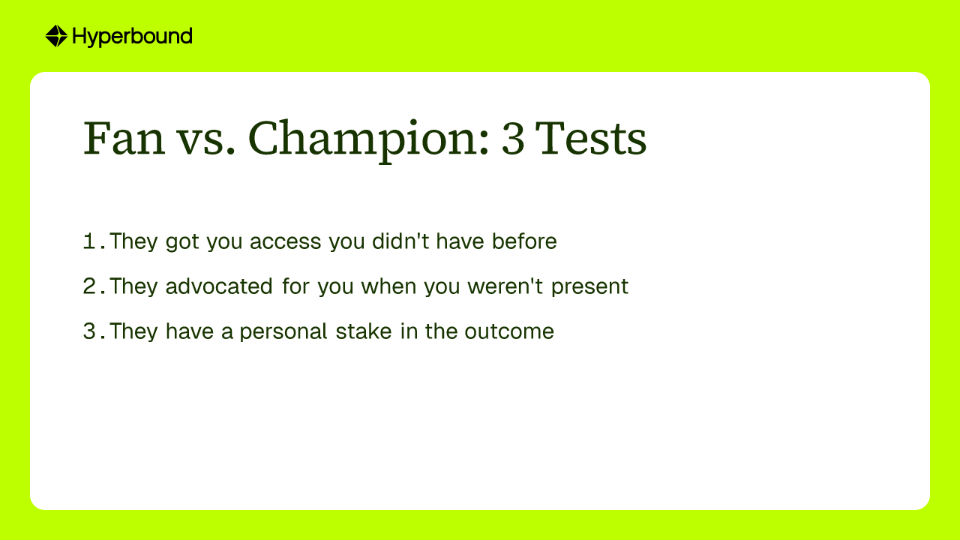
A true champion, according to Spotlight.ai's framework, meets three tests:
If a contact fails any one of these tests, the deal rests on goodwill rather than on structure. A champion who does not provide access to decision-makers is not a champion in any meaningful sense.
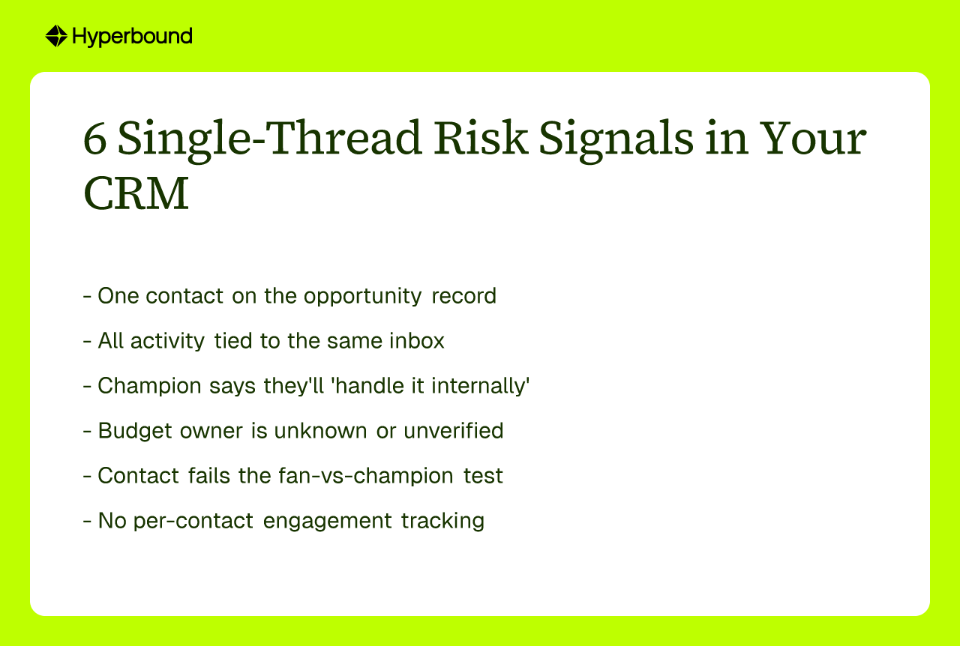
The diagnosis does not require a difficult conversation. It requires reading the data already in the CRM.
One contact on the record. The opportunity has a single associated contact. No other name appears anywhere on the record.
One-sided activity log. Every logged call, email, and meeting connects to the same inbox. No other name ever surfaces in the notes.
The "I'll handle it internally" signal. The champion explicitly volunteers to manage the internal process. This phrase is almost always a sign that no one else has been briefed and no introduction to a decision-maker is forthcoming.
An unknown or unverified budget owner. The champion either cannot name the person who signs off on the investment or gives a name that does not match the person with actual authority. The single most useful diagnostic question here is: "Who owns the budget for this initiative, and who signs off on it?" (Meritt.io recommends making this a standard qualification step.)
Fails the fan-versus-champion test. There is no evidence of internal advocacy, no new access delivered, no personal stake visible.
No per-contact engagement tracking. If engagement is logged at the opportunity level rather than at the contact level, there is no visibility into which relationships are active. Limited visibility at the contact level is itself a risk signal. Hyperbound Perform surfaces engagement at the contact level across calls and emails, so teams see exactly which relationships are active and which have gone dark. Single-threading is also the biggest structural risk in our guide to what to do when a deal stalls, which covers the fix for each root cause.

The core rule is to expand through the champion rather than around them. Approaching other stakeholders directly, without the champion's involvement, reads as distrust. It creates political friction inside the account and can cost the relationship.
Done correctly, multi-threading makes the champion a co-architect of the expansion. The effective framing for every stakeholder conversation is, "Who else should we include to make sure this lands?"
Before requesting any introduction, validate how decisions actually get made at this organisation. Useful questions include: "Who typically needs to approve investments at this level?" and "Has this type of purchase gone through a finance sign-off in the past?"
Once the buyer-side approval process is mapped, the introduction request is critical. There is a weak version and a strong version.
Weak version: "Is there any way to get me in front of your CFO? I would love to show the full platform." This signals that the conversation is product-led and that the rep wants access for their own purposes.
Strong version: "Based on what you have shared, the cost of the current process looks like roughly $X a year. Would you introduce me to whoever owns that budget? Fifteen minutes, two or three numbers, nothing product-heavy." (Meritt.io outlines this framing as a four-step method for getting champions to open the door to economic buyers.)
The strong version makes the introduction useful for the economic buyer, positions the champion as thoughtful rather than a gatekeeper being bypassed, and sets a contained agenda that is easy to accept.
Never ask a champion to draft an introduction email. Writing it creates friction, and most champions will either delay or produce a vague note that sets up a weak meeting.
Instead, draft it yourself. Include the meeting agenda, the two or three numbers from the business case, and a clear ask. Send the draft to the champion and ask them to review and forward it. The request becomes frictionless, the message remains sharp, and the champion appears prepared in front of their colleague. Salesmotion.io identifies this ghostwritten-intro tactic as one of the most reliable ways to remove the friction that stalls multi-threading in practice.
When the group meeting happens, resist the impulse to open with a product walkthrough. Open with problem alignment instead.
An effective script is: "We have heard from [Champion's name] about the challenge around X. How does that show up for each of your teams?"
This framing gives the champion credit, surfaces perspectives from other stakeholders that the champion may not have surfaced, and avoids the appearance that the rep is presenting above the champion's authority.
Invite disagreement early. Hidden blockers identified during the meeting are easier to resolve than objections raised by procurement two weeks later. Useful prompts include:
(Salesmotion.io recommends both prompts as a way to surface blocking concerns before they become deal conditions.)
Reactive multi-threading, adding contacts after the deal has already stalled, is more difficult and riskier than building broad coverage from the first touchpoint. The sequencing matters.
Salesmotion.io's research shows that win rates rise approximately 5% when executives are introduced around the third touchpoint, but drop 6% when an executive is the first person contacted. The correction for a single-threaded deal is to build the champion relationship first, then expand, rather than contacting the CFO immediately.
A practical sequence for enterprise deals:
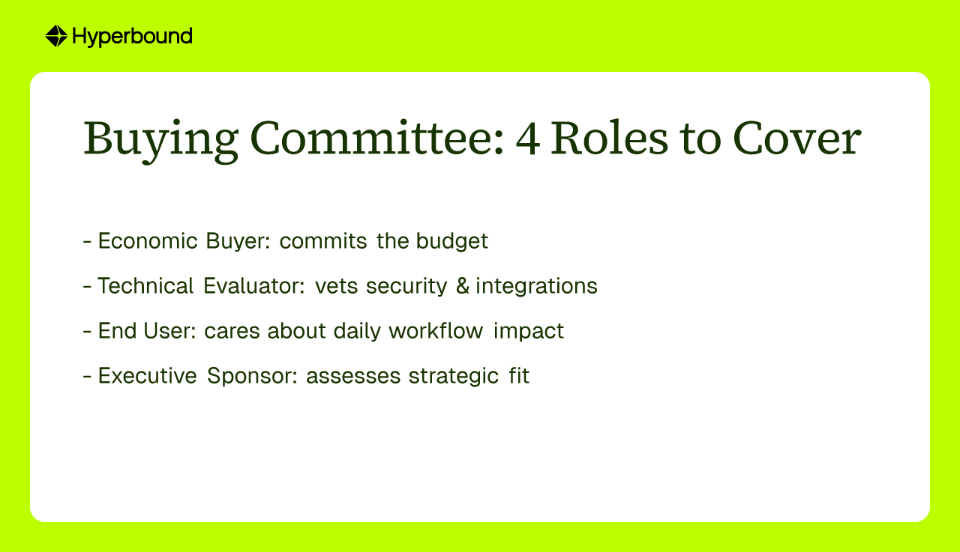
Every new contact in an account changes its internal politics. Before approaching anyone new, map the roles that need coverage:
Each role requires a different message. The economic buyer needs ROI and cost justification. The technical evaluator needs integration clarity and implementation scope. The end user needs to see workflow improvement. Sending the same message to all of them is one of the reasons multi-threading attempts stall even after the introductions are made. Spotlight.ai outlines these distinct stakeholder motivations as a foundation for building a coherent buying committee strategy.
The gap between knowing multi-threading matters and doing it consistently is often operational. Landbase's 2026 analysis makes the case for tracking contacts-per-opportunity and engagement-per-contact as scorable CRM fields rather than leaving them as informal judgements.
When multi-threading is a feeling, it gets reviewed in deal reviews and forgotten between them. When it is a field, it surfaces in pipeline reporting, flags at-risk deals before they stall, and gives managers a coachable metric rather than an anecdotal concern.
The review question changes from "Do you have a champion?" to "How many contacts are active on this opportunity, and which ones have gone dark in the last two weeks?"
A single-threaded deal is a structural condition, independent of relationship quality. The contact may be enthusiastic. The champion may be internally well-regarded. Neither of those facts changes what happens when an unmapped decision-maker surfaces late, a budget owner applies pressure in a meeting the rep was not invited to, or the champion changes roles the week before signature.
The CRM signals that reveal single-threading are visible before the deal collapses. Acting on them requires using the champion as the bridge to the people who will be part of the decision. None of this diagnosis comes from a call recording. It comes from the shape of the deal, the thing a manager sees and a rep in the middle of it often does not.
The immediate next step is to review the current pipeline and count contacts per opportunity. For every deal that shows one contact, run the fan-versus-champion test, ask the budget-owner question, and draft the ghostwritten introduction. Deals that pass that review have structural support; the others remain exposed.
A single-threaded deal is an opportunity in which only one buyer-side contact is engaged and recorded in the CRM. This creates a single point of failure because the deal depends entirely on that person's access, authority, and ability to advocate internally when the sales organization is not in the room.
Single-threaded deals collapse because they have a single point of failure: one contact carries the entire internal sale. The most common structural risks are champion departure, limited internal influence, and competitor access to other stakeholders. Without broader buying committee coverage, the deal is highly vulnerable to late-stage pushback on pricing, budget, or priorities.
A fan is warm and responsive but lacks authority and a personal stake in the purchase. A champion actively provides access to other stakeholders, advocates when the seller is not present, and has a personal business outcome tied to the deal's success. A contact who fails any of those tests is a fan, not a champion.
The CRM indicators include a single contact on the opportunity record, activity tied to one inbox, an unknown or unverified budget owner, the contact saying they will handle everything internally, and no per-contact engagement tracking. These signals show that the deal is structurally fragile even if the existing relationship feels strong.
Multi-threading through the champion, rather than around them, requires asking who else should be involved, ghostwriting the introduction email for the champion to forward, and running group meetings that make the champion look good. This positions the champion as a co-architect of the expansion instead of a gatekeeper being bypassed.
Introduce the economic buyer around the third touchpoint, after a champion has been established and validated. Reaching out to executives too early can lower win rates by about 6%, while introducing them at the right stage can improve win rates by roughly 5%.
Ask who typically approves investments at this level, whether finance sign-off is required, who owns the budget, and who else usually gets looped in when a decision like this moves forward. These questions reveal the economic buyer, technical evaluator, end users, and executive sponsor without putting the champion on the defensive.
A healthy B2B opportunity should have at least five engaged stakeholder contacts across buyer roles. Deals with five or more engaged stakeholders close at around 30%, compared with roughly 5% for single-threaded deals, making broader engagement a strong predictor of success.










Use Cases
Legal