You're about to make that critical sales call. Your palms are sweaty, your mind is racing with potential objections, and you're wondering: "How do I even start this conversation?" If you've ever felt unprepared for a high-stakes sales interaction or struggled to convert a promising lead, you're not alone.
Many salespeople find themselves trapped in the same cycle—talking too much, failing to uncover true pain points, and unsure how to transition from questions to pitching their solution. The result? Lost deals and missed opportunities.
But what if there was a proven framework that could transform your sales conversations from awkward pitches into valuable consultations that lead prospects to their own conclusions about needing your solution?
Enter the SPIN Selling model—a research-backed methodology that has revolutionized complex sales for over three decades.
SPIN Selling is a consultative sales methodology developed by Neil Rackham and introduced in his groundbreaking 1988 book of the same name. What sets this approach apart is its empirical foundation—Rackham's team analyzed over 35,000 sales calls over 12 years to identify patterns that differentiated successful sales interactions from unsuccessful ones.
The SPIN acronym represents four types of questions that guide the sales conversation:
The core philosophy of SPIN Selling flips traditional sales wisdom on its head. Instead of focusing on persuasive talking techniques, SPIN emphasizes strategic questioning and active listening. By guiding prospects to articulate their problems and the impact of those problems, salespeople create an environment where the prospect essentially sells themselves on the solution.
This approach is particularly effective for complex B2B sales and high-ticket items where building trust is paramount. In fact, studies show that mastering the SPIN model can enhance sales productivity by up to 17%.
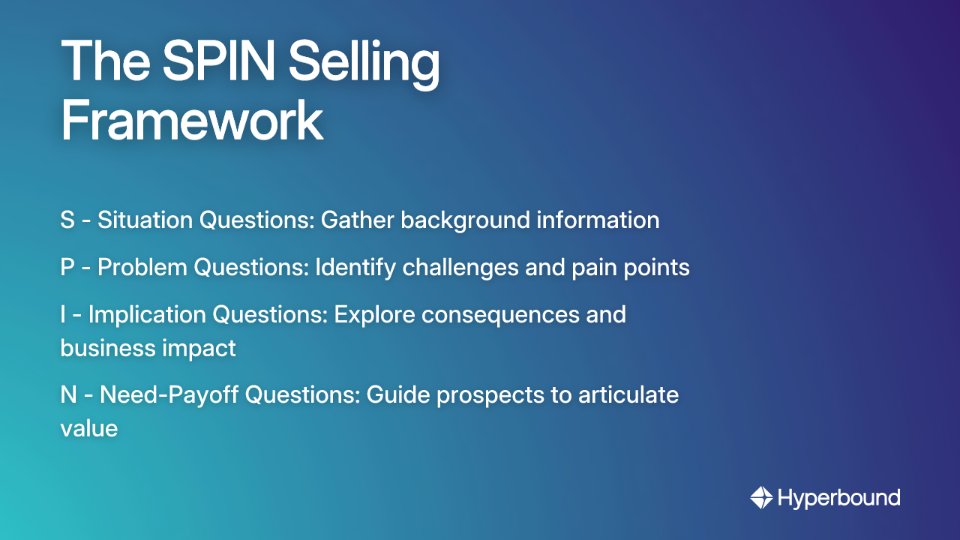
Let's break down each question type in the SPIN framework and examine how they work together to create a compelling sales narrative.
Situation questions gather background information and facts about the prospect's current environment. They help you understand the context and build initial rapport.
Example Situation Questions:
Pro-Tip: While situation questions are necessary, use them sparingly. Modern buyers expect you to have done your homework. Asking too many basic questions that could be answered through online research signals a lack of preparation. Instead, use situation questions strategically to confirm your research and fill specific knowledge gaps.
Problem questions help you identify specific challenges, difficulties, and dissatisfactions the prospect is experiencing. This is where you begin to uncover the "pain" that your solution might address.
Example Problem Questions:
Problem questions are crucial because they help the prospect identify an implicit need—the recognition that something isn't working optimally. During a sales roleplay or actual call, these questions help establish the foundation for your solution's relevance.
Implication questions explore the consequences, effects, and broader business impact of the identified problems. These questions transform a small problem into a significant business issue, creating urgency for a solution.
Example Implication Questions:
Implication questions are often the most challenging but most critical type. They help the prospect understand the full gravity of their problem in business terms. When a prospect tells you that manually entering data is time-consuming, an implication question might be: "If your team continues spending 10 hours per week on manual data entry, how will that affect your ability to meet your quarterly targets?"
During a simulated cold call, practicing these questions can help you develop the skill of building urgency without being pushy.

Need-payoff questions encourage the prospect to articulate the value and benefits of solving their problem. These questions effectively get the customer to sell themselves on the solution.
Example Need-Payoff Questions:
Need-payoff questions create the perfect transition from problem exploration to solution presentation. They bridge the common gap where salespeople struggle to move from questioning to pitching. When your prospect articulates the value in their own words, your solution becomes the logical next step in the conversation.
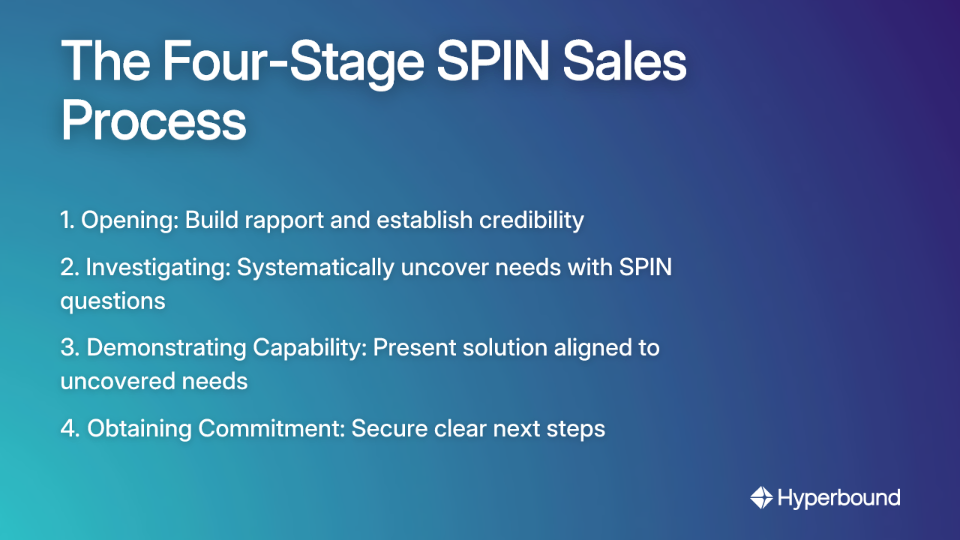
Understanding the question types is only part of the equation. To effectively implement SPIN Selling, you need to understand how these questions fit into the overall flow of the sales process. Here are the four stages of a SPIN sale:
Start by building rapport and creating a positive first impression. Use well-researched Situation questions that demonstrate you've done your homework. This stage sets the tone for the conversation and establishes your credibility.
When engaging an executive decision maker, this preliminary stage is critical—showing that you value their time by being prepared can make all the difference.
This is the heart of the SPIN approach. Move systematically through Problem and Implication questions to fully understand the customer's world and uncover explicit needs. Listen carefully and take notes on key pain points mentioned.
The investigating stage is where you'll spend most of your time during complex sales conversations. Be patient—rushing through this stage to get to your pitch undermines the entire SPIN methodology.
Once you've used Need-Payoff questions to establish the value of solving the problem, you can introduce your product or service. Focus on how its specific features and benefits directly address the stated problems and desired outcomes.
Using the prospect's own language when describing how your solution addresses their pain point creates powerful resonance and shows you've been listening attentively.
The goal of any sales conversation is to move forward. Define the possible outcomes clearly:
Always aim for a clear advance rather than a vague continuation. This maintains momentum and signals genuine interest.
Listen Actively, Talk Less: The SPIN model is built on the premise that the prospect should do most of the talking. Your job is to guide the conversation with strategic questions, not dominate it with product information.
Guide the Buying Process: Use the framework to anticipate needs and steer the conversation. Taking control doesn't mean talking more—it means asking the right questions at the right time.
Practice with Modern Tools: The best way to internalize the SPIN methodology is through practice. Modern platforms like Hyperbound allow reps to run AI-powered sales roleplays with AI buyers tailored to specific scenarios. This provides a risk-free environment to practice SPIN questions, handle objections, and receive instant, objective feedback on performance.
Be Coachable & Adaptable: SPIN is a framework, not a rigid script. The best SPIN practitioners adapt their questioning to the flow of each unique conversation while maintaining the overall structure.
Overlooking Implication Questions: Many salespeople rush from Problem questions directly to solutions without building urgency through Implication questions. This is the most common and costly error.
Rushing to Need-Payoff: Pitching your solution before the problem's consequences are fully established undermines the power of the SPIN sequence.
Failing to Adapt: Sticking religiously to a prepared list of questions when the conversation naturally flows in a different direction will make you seem mechanical rather than consultative.
The SPIN Selling model transforms the traditional sales approach by focusing on strategic questioning rather than persuasive talking. By guiding prospects through a structured discovery process, you help them articulate their own needs and the value of addressing them.
To make SPIN Selling part of your sales DNA:
For those wanting to dive deeper, Neil Rackham's original book, SPIN Selling, remains the definitive guide to this powerful methodology.

Master the SPIN model, and you'll transform from a product-pusher to a trusted advisor—someone who truly understands your customers' needs and guides them to the right solution. That's the difference between merely closing a sale and building a lasting business relationship.
SPIN selling is a consultative sales methodology that uses a specific sequence of questions to guide a prospect toward recognizing the need for a solution. Instead of the salesperson pitching, the framework empowers the buyer to articulate their own problems and the value of solving them, making it a collaborative discovery process.
The effectiveness of SPIN selling comes from its research-backed, customer-centric approach that builds trust and urgency. By focusing on strategic questioning and active listening, salespeople uncover deep-seated business problems and their consequences, which makes the proposed solution feel like a logical and necessary step for the prospect, rather than a hard sell. This method is proven to increase sales productivity, especially in complex sales cycles.
Implication questions are widely considered the most important and powerful type in the SPIN framework. While Problem questions identify a pain point, Implication questions explore the wider consequences and business impact of that pain, creating a strong sense of urgency. Mastering Implication questions is key to transforming a minor issue into a significant problem that demands a solution.
SPIN selling differs from traditional sales by shifting the focus from the salesperson talking to the customer talking. Traditional methods often rely on persuasive pitches, feature-dumping, and aggressive closing techniques. In contrast, SPIN selling is a consultative approach where the salesperson acts as a guide, using strategic questions to help the prospect discover their own needs and sell themselves on the solution.
SPIN selling is most effective for complex, high-value B2B sales where building a relationship and understanding intricate business needs are crucial. While its principles of good questioning can be adapted, it may be overly structured for simple, transactional B2C sales where the buying decision is less complex and the sales cycle is much shorter.
The most common mistake is skipping or rushing through the Implication questions. Salespeople often identify a problem and immediately jump to presenting their solution (Demonstrating Capability). This misses the crucial step of building value and urgency by exploring the full impact of the problem, which significantly weakens the entire framework.
Consistent practice is the best way to improve your SPIN selling skills. You can start by preparing a few questions for each category before your calls. For more structured and risk-free practice, modern tools like AI-powered sales roleplay platforms allow you to simulate realistic conversations, receive instant feedback on your questioning technique, and refine your approach without jeopardizing live deals.









Use Cases
Legal