You're in a high-stakes stakeholder meeting, and all eyes are on you. You need to articulate an intricate technical idea, but when you open your mouth, you end up stuttering. Your mind races, your throat tightens, and suddenly that brilliant concept you were about to share is trapped behind a wall of anxiety.
Sound familiar? You're not alone.
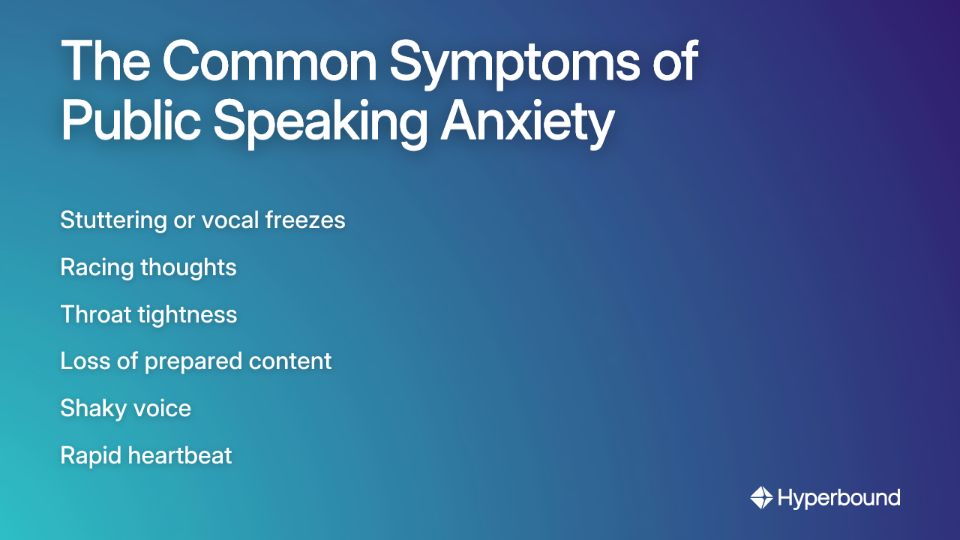
Approximately 73% of the population suffers from public speaking anxiety or stage fright. This fear often manifests as a "brain freeze" or a voice that cracks under pressure, potentially undermining your professional credibility in crucial moments.
But there's a practical, physiological solution that goes beyond motivational platitudes: vocal warm-ups.
Just like any other muscle, your vocal muscles need to be warmed up to work at their best. A simple 5-minute warm-up routine can dramatically improve your vocal quality, enhance your confidence, and ensure your message is delivered with the clarity and impact it deserves.
In this article, we'll explore five essential speech voice exercises that target different aspects of your vocal instrument: breathing, relaxation, articulation, pitch, and integration. These practical drills will prepare you physically and mentally for your next speaking engagement, whether it's a team meeting, client presentation, or keynote speech.
Before diving into the exercises, it's important to understand the mechanics behind your voice. When you speak, you make sounds in your larynx (voice box) with your vocal folds. These delicate tissues vibrate to create sound, which is then shaped by your tongue, lips, and jaw to form words.
Warming up stretches the vocal folds and increases blood flow to the larynx and other body parts including your lungs, lips, and tongue. This preparation offers several tangible benefits:
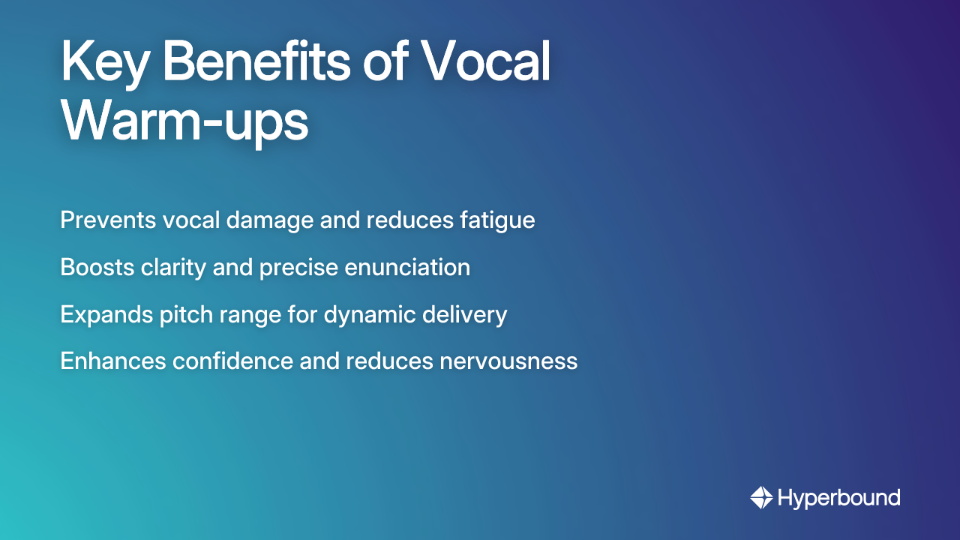
vocal strain and vocal fatigue, particularly during longer speaking engagements.enunciation, ensuring your words are crisp and clear.Now that you understand why these exercises matter, let's dive into the specific drills that will transform your speaking voice.
Your breath is the engine of your voice. Diaphragmatic breathing provides a steady, powerful stream of air, preventing a weak or shaky voice and allowing you to speak through long sentences without losing strength.
This classic exercise helps you develop awareness of proper diaphragmatic breathing:
This exercise can be done standing or sitting and is perfect right before walking into a meeting:
By mastering these breathing exercises, you're building the foundation for a strong, confident voice that won't falter mid-presentation.
Tension in your jaw, lips, and throat can constrict your voice, leading to a strained sound and poor articulation. These exercises release that tension for a more open, resonant voice.
This exercise simultaneously relaxes your throat and jaw:
jaw release muscles and relaxes the entire vocal tract.Lip trills are a favorite among professional speakers and performers for good reason:
vocal folds with gentle pressure.If you're struggling to get the lip trill working, try placing a finger at each corner of your mouth to help support your lips until you develop the muscle memory.
Mumbling or stumbling over words undermines your credibility. Articulation drills act like precision training for your tongue and lips, ensuring every word is crisp, clear, and easily understood.
Tongue twisters are more than just fun challenges—they're serious training tools for speech clarity:
This exercise targets the specific muscles used in clear speech:
enunciation.By training these specific articulators, you're developing the muscle memory needed for clear speech even under pressure.

A monotone voice puts audiences to sleep. Resonance gives your voice a rich, full quality, while pitch variation adds emotion and interest, keeping your listeners engaged.
These exercises activate the resonating chambers in your face and chest:
resonance, chant the following sounds, holding each one for a few seconds:This exercise expands your pitch range and vocal flexibility:
This exercise increases your vocal flexibility and control over your pitch range, allowing you to add emphasis and emotion to key points in your presentation.
Once the individual components are warm, it's time to integrate them into speech-like patterns. This bridges the gap between isolated drills and real-world speaking.
This simple yet effective exercise activates your expressive abilities:
This exercise builds muscle memory for clear speech:
After practicing with exaggeration, read the text again at a normal pace. You'll notice your articulation remains clearer than before, even without the exaggeration.
The 3-Second Fix (Nostril Breathing): This technique helps center you in moments of acute anxiety:
Reframe Your Fear: Nervousness and excitement are physiologically similar. Instead of telling yourself "I'm nervous," try telling yourself "I'm excited." Research from Harvard Business Review shows that this simple cognitive shift can transform your performance anxiety into positive energy.
Your voice needs to recover after a long speech or presentation, just as your body needs to cool down after exercise:
Gentle Humming: Hum the sound 'm' on a low, comfortable pitch, focusing on the vibration for a couple of minutes. This gently massages the vocal folds and helps them return to a resting state.
Hydration: Drink room temperature water to rehydrate your vocal apparatus. Avoid ice cold beverages which can constrict your vocal folds.
If your voice hurts just from using it for a short time, you should stop. Gentle warm-ups should feel good and relaxing. Pain is a signal to rest.
Avoid these common vocal habits that can damage your voice:
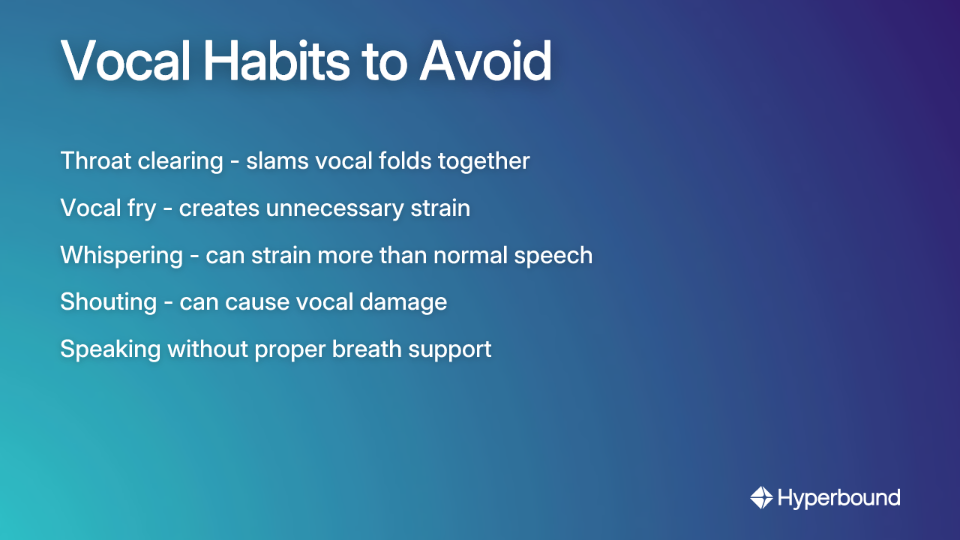
If you experience persistent pain, hoarseness, or other vocal issues, it is essential to consult a doctor or a speech-language pathologist.
These five types of speech voice exercises—Breathing, Relaxation, Articulation, Pitch, and Integration—provide a simple yet powerful toolkit for any speaker. By understanding your vocal instrument and preparing it properly, you can significantly improve how you communicate in any professional setting.
The magic isn't in doing these exercises once, but in making them a habit. Incorporate them into your daily routine—while you shower, during your commute, or for five minutes before your first video call. Studies show that voice quality significantly influences how listeners perceive a speaker's personality and credibility, making this preparation crucial.
Remember, a strong, confident, and clear voice is not a gift, but a skill. By investing a few minutes in preparation, you are ensuring your ideas are heard and your presence is felt.
Before your very next meeting, try just one of these exercises. We recommend starting with the Lip Trills as they provide immediate feedback and quickly warm up the voice.
If you're looking for a way to practice these skills and get personalized feedback, platforms like Hyperbound offer AI-powered roleplays and real call analysis. This allows you to practice in a safe environment and receive objective, data-driven insights on your articulation, pitch, and overall delivery, helping you identify unique vocal patterns and optimize your speaking style at scale.
Your voice is your most powerful tool for communication—treat it with care, prepare it with intention, and watch as your speaking impact transforms from adequate to exceptional.
Vocal warm-ups are crucial because they prepare your vocal muscles for speaking, which helps prevent strain, improves clarity, and boosts confidence. Just as an athlete warms up before a game, warming up your voice increases blood flow to the larynx and stretches the vocal folds. This preparation results in a clearer, stronger voice and reduces the risk of it cracking or sounding shaky under pressure.
A 5-minute warm-up is highly effective for most situations, while 10-15 minutes is ideal for a major presentation or keynote speech. The goal is quality over quantity. Even a few minutes of focused exercises like lip trills and diaphragmatic breathing can significantly reduce anxiety and improve vocal quality.
The single best exercise for a quick warm-up is the lip trill (the "motorboat" sound). It is incredibly efficient because it relaxes the lips and jaw, engages breath support, and gently warms the vocal folds all at once. You can do this for just 60 seconds while gliding your pitch up and down to quickly prepare your voice.
You can overcome feeling self-conscious by doing the exercises in a private space, like your car, a restroom, or an empty office before a meeting. It also helps to remember that top performers—from actors to executives—use these techniques as part of their professional preparation. Practicing with an AI tool like Hyperbound's AI Sales Roleplays can also be a great way to build confidence without the pressure of a live audience. Starting with silent exercises, like controlled breathing, can also help you get comfortable.
Yes, voice exercises are very effective at reducing a shaky voice. A shaky voice is often caused by shallow, uncontrolled breathing due to anxiety. Breathing exercises, especially diaphragmatic breathing, regulate your nervous system and provide a steady stream of air to support your voice. This physical control helps counteract the "fight or flight" response, leading to a more stable, confident sound.
For the best results, a combination of both is ideal. Daily practice, even for a few minutes, builds long-term vocal strength and flexibility. A dedicated warm-up right before you speak prepares your voice for the immediate task. Think of it like athletic training: you train regularly to build capacity and also warm up right before a game for peak performance.










Use Cases
Legal