You're in the middle of an important client call, explaining a complex DevOps solution when you suddenly notice the prospect's furrowed brow. Despite your thorough preparation with executive summaries and technical documentation, your message isn't landing. The culprit? Your racing thoughts have translated into hurried speech, turning what should be a compelling presentation into a confusing blur of words.
If this scenario resonates with you, you're not alone. Many sales professionals struggle with pacing, particularly when explaining technical concepts or communicating with non-native English speakers. The good news? The secret to more confident, credible, and successful selling isn't about what you say, but how you say it.
According to the Mehrabian model, communication is only 7% the words you use. The other 93% is nonverbal, with 38% being your tone of voice and 55% being body language. During sales calls or virtual meetings where body language is limited, your tone carries immense weight.
When you speak slowly and deliberately, you:
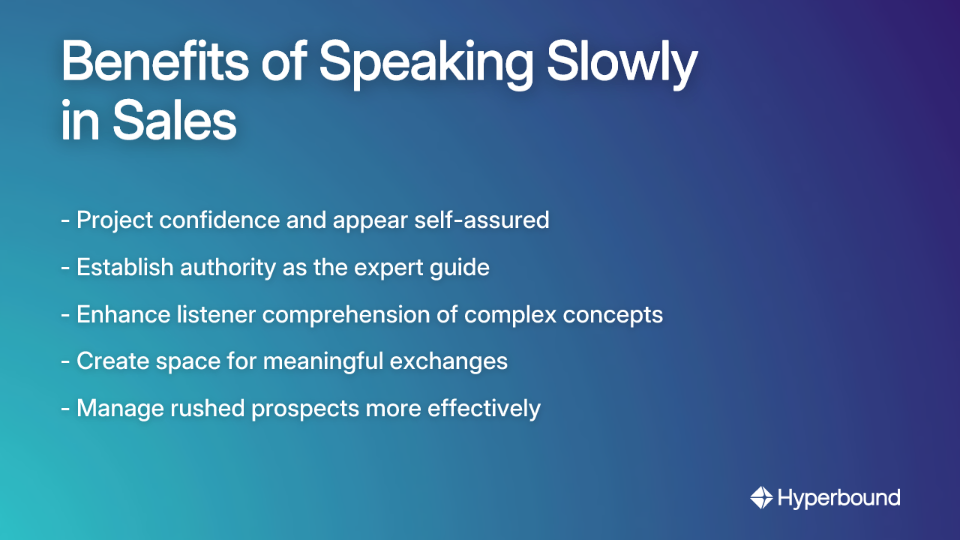
Consider this powerful analogy: Hostage negotiators deliberately use a calm, slow cadence to de-escalate tense situations. Similarly, a salesperson can use a controlled pace to manage a rushed prospect and guide the conversation effectively. Your voice becomes the tool that creates the space needed for meaningful exchange.
Speaking too quickly is a universal signal of nervousness. The "fight-or-flight" response triggers fast speech, making you seem anxious and insecure. But the consequences extend far beyond perception:

One sales engineer noted in a forum discussion, "I struggle internationally when talking to people where English isn't their first language. Since I'm an expert in what I do, I know it inside out and have given the same talk countless times, I tend to speak quickly. I have to really force myself to slow down."
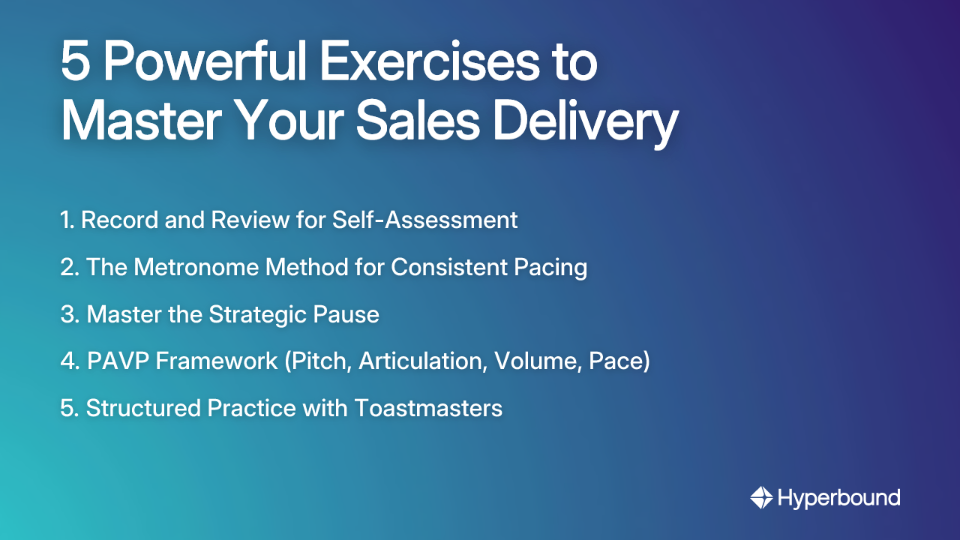
Developing a powerful, measured delivery doesn't happen overnight, but these practical exercises will help you build this critical skill:
Box Breathing Technique: Before any client call or presentation, calm your nerves and set your pace:
This simple technique centers you mentally and physically, creating the foundation for controlled speech.
The first step to fixing a problem is recognizing it. While you can manually record your sales calls or practice pitches (with permission), AI coaching platforms like Hyperbound automate this process. They analyze both practice roleplays and real calls, providing objective feedback on:
As one sales professional noted, "Recording yourself and critiquing your speech reveals a lot about delivery that you're unconscious of during the moment." Using an AI-powered tool removes the guesswork and provides consistent, data-driven insights.
To retrain your internal clock, practice speaking with a metronome. Set it to a slow, deliberate tempo (around 60-70 beats per minute) and read a script or practice your pitch in time with the beat. This builds muscle memory for a slower pacing that will become natural with practice.
Silence is not something to fear; it's a tool. Replace filler words with a deliberate pause. Count to three in your head before responding to a hard hitting question from a prospect. This gives you a moment to gather your thoughts while simultaneously:
Focus on these four pillars of vocal delivery:
For those who need a structured environment, modern tools offer targeted practice. An AI Sales Coaching platform like Hyperbound allows you to practice in hyper-realistic sales roleplays and get instant, objective feedback on your pacing and delivery. For broader public speaking skills, joining Toastmasters is also highly recommended. As one forum participant shared, "Toastmasters helped me tremendously. Find a club and join it." This organization provides regular opportunities to practice in a supportive environment with constructive feedback.
Now that you have techniques to improve your pace and tone, here's how to apply them in actual sales situations:
Establish your calm, controlled pace immediately. Your opening sets the tone for the entire conversation. When you begin with measured speech, the prospect is more likely to match your energy.
When a prospect says, "Sorry, now's not a good time," don't match their frantic energy. Slow down and respond calmly:
"I understand completely. [pause] I just wanted to share some insights that might be valuable for your current DevOps implementation challenges. [pause] Would it be better if I scheduled 15 minutes later this week?"
This demonstrates control and often piques curiosity enough to continue the conversation.
Pay close attention to your prospect's verbal cues. While you can build rapport by mirroring some aspects of their communication style, always be ready to slow the conversation down when:
Active listening plays a crucial role here. By fully focusing on what your prospect is saying rather than preparing your next response, you naturally create pauses that improve your pacing and demonstrate genuine interest.
When you get to the most crucial part of your pitch—such as the key benefit, pricing, or call to action—intentionally slow down even more. This signals to the listener: "This is important. Pay attention."
Consider how you might deliver this statement:
Normal pace: "Our solution reduces deployment failures by 72%."
Slowed pace: "Our solution... reduces deployment failures... by seventy-two percent."
The second version gives the information more weight and allows the impressive statistic to sink in.
Keep a visual cue, like a sticky note with the word "PACE" on your monitor during calls. This simple reminder can help maintain awareness of your delivery throughout longer conversations and presentations.
For those who create long-form articles or executive summaries, reading your content aloud at a measured pace can also improve your written communication by identifying overly complex sentences that would be difficult to express verbally.
Speaking too quickly is a common challenge that undermines sales effectiveness, particularly when discussing technical solutions. By mastering the art of slow, deliberate speech, you signal confidence, establish authority, and ensure your message is fully understood.
Remember these key points:
In his book "Conversations Worth Having," Jackie Stavros emphasizes that effective communication isn't about filling space with words, but creating meaningful exchanges that lead to genuine connection. By slowing down, you create that space—allowing for the kind of thoughtful dialogue that builds trust and closes deals.
As you implement these techniques, remember that improving your vocal delivery is a skill, not an innate talent. Through conscious effort and consistent practice, you can transform your voice into your most persuasive asset and become a more effective, credible, and successful sales professional.

The next time you feel your words rushing forward, take a deep breath, embrace the power of the pause, and watch as your slower, more deliberate communication style commands attention and ultimately helps you sell faster.
Speaking slowly in sales is crucial because it projects confidence, establishes you as an authority, and ensures your prospect fully understands your message. A measured pace helps you organize your thoughts and appear in control, which builds trust. According to communication models, how you say something (your tone and pace) is more impactful than the words themselves. Slowing down is especially critical when explaining complex technical products, as it gives listeners time to process the information.
You can practice speaking more slowly by recording and reviewing your calls, using a metronome to set a steady rhythm, mastering the strategic pause, and using structured practice environments like AI coaching platforms. Start with foundational breathing exercises like box breathing to calm your nerves. Recording your speech helps you identify unconscious habits, while practicing with a metronome builds muscle memory for a slower pace. Additionally, replacing filler words like "um" with a deliberate pause adds emphasis and gives you time to think.
While there's no single perfect speed, the ideal speaking rate for a sales presentation is typically between 140 and 160 words per minute (WPM), with intentional slowing for key points. This pace is clear and easy to follow without sounding unnatural. The most effective approach is dynamic; you should consciously slow down significantly when explaining complex details, discussing pricing, or delivering your unique value proposition to guide your listener's attention.
When a prospect says they're in a hurry, you should intentionally slow down your speech and calmly acknowledge their time constraint before briefly stating your value proposition. Avoid matching their frantic energy, as this will only rush the conversation and signal your own nervousness. A controlled response demonstrates confidence, piques curiosity, and can turn a potential dismissal into a scheduled meeting.
The strategic pause is the act of intentionally creating moments of silence in your speech to replace filler words, add emphasis to important points, and give the listener time to think. Instead of using "um" or "uh" when you need a moment, simply pause. This makes you sound more thoughtful and confident. Use pauses before revealing a key statistic, after asking a question, or after a prospect raises an objection to formulate a clear answer. Silence is a powerful tool that adds weight to your words.
Your tone of voice is a critical component of nonverbal communication, accounting for 38% of your message's impact and directly influencing how prospects perceive your confidence and credibility. A calm, steady, and varied tone signals authority and keeps the listener engaged. A monotone delivery can make you sound bored, while a high-pitched, fast tone often signals nervousness. By consciously managing your vocal delivery, you can guide the emotional flow of the conversation and make your message more persuasive.
For further development of your communication skills, consider exploring AI coaching platforms like Hyperbound, resources like the book "Talk Like TED" by Carmine Gallo, or joining a local Toastmasters chapter. All provide ways to practice structured thinking and deliberate speech in a supportive environment.










Use Cases
Legal