
Solidroad does something genuinely useful: it gives sales reps a safe space to practice conversations before they go live. For onboarding teams and managers who need a low-risk way to build rep confidence, that matters. But if you've spent time reading Reddit threads from actual sales reps, you'll notice a pattern in the complaints: "AI role-playing tools often fail to adapt to unexpected inquiries," responses feel "robotic and lacking natural conversation fluidity," and the scenarios are rarely realistic enough to prepare reps for actual deals.
That's problem number one. Problem number two — and the bigger one — is that even when roleplays do feel realistic, most tools stop there. They never close the loop. You can't see whether the practice translated into a better discovery call. You can't tell if reps are actually using what they learned on live deals. You're practicing in a vacuum.
That's the gap this article is here to address.
Below are 9 Solidroad alternatives, organized by what job they do best — so you can find the right fit depending on whether you need a pure practice sandbox, deeper call analysis, or a platform that connects training directly to revenue outcomes.
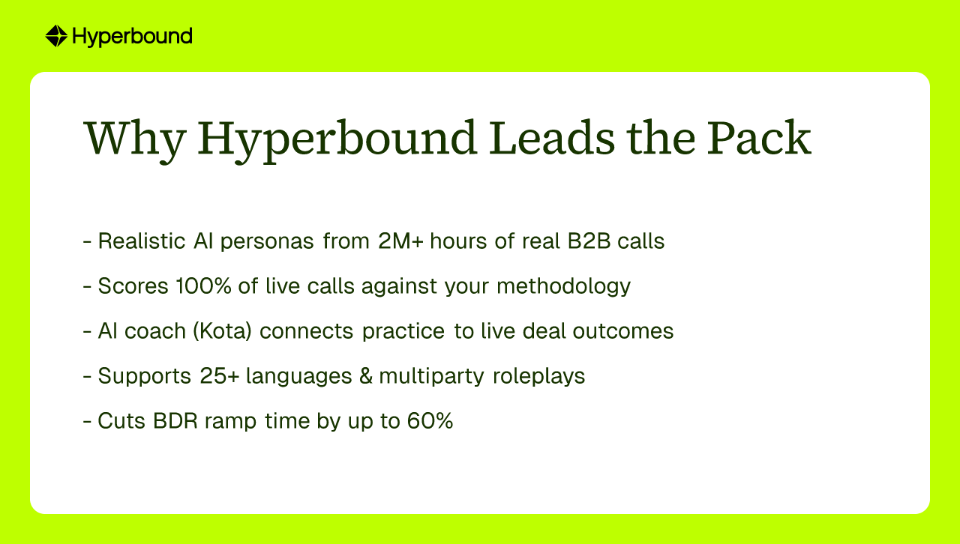
Best for: Sales teams that want to connect skill development directly to deal outcomes and revenue.
Hyperbound coined the term "Revenue Activation" to describe the problem no other tool was solving: you have call data, you have training content, but nothing connects them to change what actually happens on live deals. Hyperbound's Practice → Perform → Activate model closes that loop.
The results back this up: Vanta reduced BDR ramp time by 60% (from 210 days to 72 days) while growing their team 4x. Nivoda achieved a 150% increase in demo conversion rates and doubled revenue year-over-year. LinkedIn deployed Hyperbound to 3,000+ sellers across multiple business units.
The gap it fills vs. Solidroad: Solidroad ends at practice. Hyperbound creates a continuous improvement loop: score real calls → identify skill gaps → practice with targeted roleplays → improve on the next deal.
These tools are solid at the "practice" part of the equation. The tradeoff: they don't connect to what happens on live calls.
Best for: Teams that want visually engaging roleplay with AI avatars.
Second Nature lets reps practice with an AI avatar and supports custom scenario creation using your own materials like battle cards and playbooks. It's polished, easy to set up, and well-suited for onboarding programs.
The gap: it's a dedicated roleplay tool and doesn't integrate performance analytics or deal-level coaching. Practice stays siloed from pipeline performance.
Best for: SMBs that want to build a practice culture through gamification.
PitchMonster makes training competitive with leaderboards, team challenges, and rep rankings. If driving adoption is your first priority, the gamified format helps.
The gap: customization is limited compared to more advanced platforms, and the focus is entirely on the practice motion — not what happens when reps go live.
Best for: Smaller teams or individual reps looking for straightforward, affordable roleplay.
Kendo AI offers fully customizable scenarios tied to specific buyer personas and provides real-time feedback. Its accessibility makes it a common entry point in this category.
The gap: like others in this bucket, Kendo operates separately from your CRM and live call data, making it difficult to tie practice to measurable outcomes.
Best for: Teams focused specifically on ramping new hires and building cold call confidence.
FullyRamped specializes in onboarding. Its "AI twins" can simulate challenging call types, and it surfaces some insights from real calls to inform coaching. It's particularly strong at the top of the funnel.
The gap: limited customization compared to full-cycle platforms and a narrower scope — primarily oriented toward SDR/BDR ramp, not the full deal lifecycle.
These tools excel at diagnosing what's happening on live calls. The tradeoff: they surface problems without providing a way to practice and fix them.
Best for: Teams that want deep visibility into customer conversations and pipeline health.
Gong is the market leader in conversation intelligence. It records, transcribes, and analyzes 100% of your sales calls, and provides powerful pattern recognition across your entire team's conversations — what top reps do differently, which objections are coming up most often, how deal stages are being navigated.
If you want to diagnose where your team is falling short, Gong is excellent. But as noted in Hyperbound's breakdown of revenue activation platforms, Gong "lacks a practice environment to help reps improve." It can tell you that your reps aren't handling a competitor objection well. It won't give them a place to go work on that skill before their next deal. That's the gap — and it's a significant one when you're trying to turn insights into outcomes.
Best for: Teams already embedded in the ZoomInfo ecosystem who need structured call analysis.
Chorus records and analyzes sales conversations, tracks keyword trends, and helps managers surface coaching moments across their team's calls. It's a capable conversation intelligence tool with solid CRM integrations.
Like Gong, the limitation is directional: it's an analysis engine, not a development tool. Teams using Chorus for coaching often find themselves manually assigning follow-up training — a process that doesn't scale — because there's no automated path from insight to practice.
These platforms cover a lot of ground — content management, onboarding, training, coaching. AI roleplay is often included, but as a feature rather than a focus.
Best for: Enterprises looking for a broad, all-in-one sales readiness and enablement suite.
Mindtickle is a large platform that touches content management, onboarding, coaching, and conversation intelligence — with AI roleplay included as part of the package. For organizations that need a single platform to manage the full enablement lifecycle, it's worth evaluating.
The gap: because it covers so much ground, the roleplay component isn't as purpose-built or simulation-deep as tools that focus exclusively on it. Mindtickle can feel "overwhelming for teams that only need roleplay features," and there's no tight automated loop between live call analysis and targeted practice recommendations.
Best for: Organizations that need to manage sales content at scale and deliver guided learning paths.
Highspot is a strong content management and enablement platform with AI-powered training paths and reported benefits like faster ramp times. It includes an AI roleplay feature for pitch practice and is well-suited for teams where keeping reps up to date on content and messaging is the primary challenge.
The gap: Highspot's core value is structured learning and content governance. It doesn't offer dynamic, deal-level coaching based on live conversation data — which means enabling reps on what to say and ensuring they're saying it effectively on actual deals remain two separate problems.
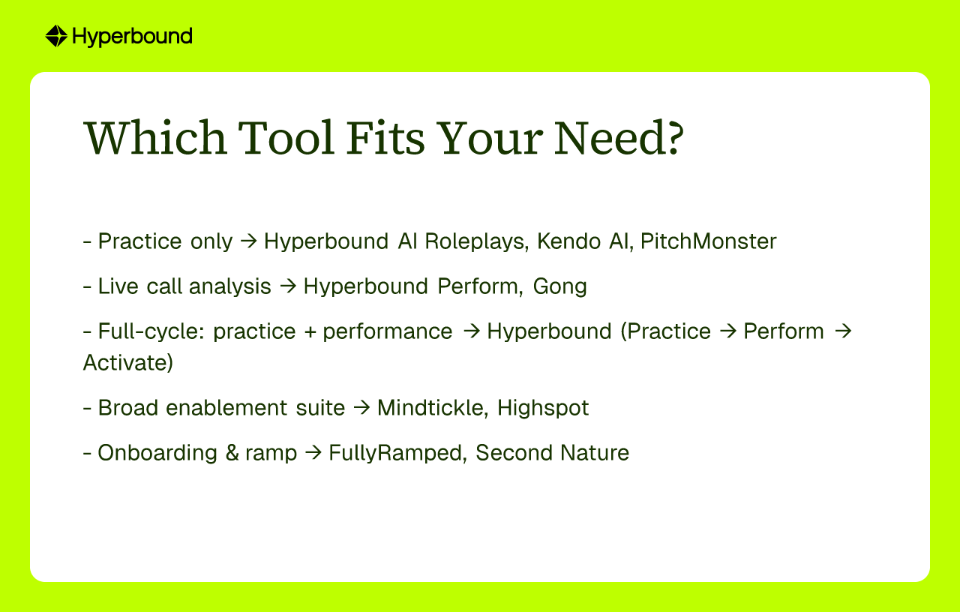
The right Solidroad alternative depends on what problem you're actually trying to solve. Here's a straightforward way to think about it:
If you need a focused place for reps to practice: → Hyperbound Practice is the leading solution for realistic AI-powered roleplays. Other tools like Kendo AI or PitchMonster are also available for teams where building a simple habit of practice is the primary goal.
If you need deep visibility into what's happening on your live calls: → Hyperbound Perform provides this by scoring 100% of calls against your methodology. As the market leader in conversation intelligence, Gong also gives you deep call analysis — just know that you'll need a separate solution like Hyperbound Practice to help reps act on what it surfaces.
If you need to connect practice to live performance and turn training into measurable revenue outcomes: → Hyperbound is the only platform built from the ground up to solve this problem. The Practice → Perform → Activate model means every insight from a real deal becomes a targeted training moment, and every roleplay rep completes feeds back into a continuous improvement cycle that shows up in pipeline — not just a training dashboard.
As Reddit's sales community has been asking for years: what's the point of practicing if there's no way to know whether it worked? Solidroad alternatives that only cover roleplay still leave this question unanswered. The tools that actually move the needle are the ones that close the loop — and right now, only one does that end to end.
If you're ready to stop practicing in a vacuum, see how Hyperbound works →
The primary limitation of most AI sales practice tools, including Solidroad, is that they operate in a vacuum. While they provide a safe space for reps to practice, they fail to connect that practice to actual performance on live sales calls, making it impossible to measure if the training is translating into better results and revenue.
Hyperbound solves this by creating a continuous feedback loop with its "Practice → Perform → Activate" model. It analyzes 100% of live sales calls to identify skill gaps (Perform), provides hyper-realistic AI roleplays to address those specific gaps (Practice), and uses an AI coach to connect insights to deal outcomes, ensuring that training directly improves performance (Activate).
Hyperbound's AI roleplays are more realistic because its AI buyer personas are built from a massive dataset of over 2 million hours of real B2B sales conversations, not generic scripts. This ensures that the practice scenarios for cold calls, discovery, and objection handling accurately reflect the nuances and complexities of actual buyer interactions.
A team should choose a conversation intelligence tool like Gong if their primary goal is to diagnose issues by analyzing what's happening on live calls. However, if the goal is to both diagnose issues and provide a structured way for reps to practice and improve on those skills, a full-cycle platform like Hyperbound is a better fit because it connects analysis directly to a practice environment.
Revenue Activation is the process of connecting sales training and coaching directly to live deal performance and revenue outcomes. Coined by Hyperbound, it addresses the common gap where call insights and training content exist separately, failing to change rep behavior on live deals. The goal is to turn coaching insights into measurable improvements and closed-won deals.
To choose the best alternative, first identify your primary need. If you only need a sandbox for practice, look at tools like Kendo AI or Second Nature. If you need to analyze live calls, consider Gong or Chorus. If you want a comprehensive platform that connects practice directly to live performance and revenue, Hyperbound is the ideal solution.








Use Cases
Legal